- Home
- Why So Many First-Time Buyers Regret Buying Oversized Watches
Why So Many First-Time Buyers Regret Buying Oversized Watches
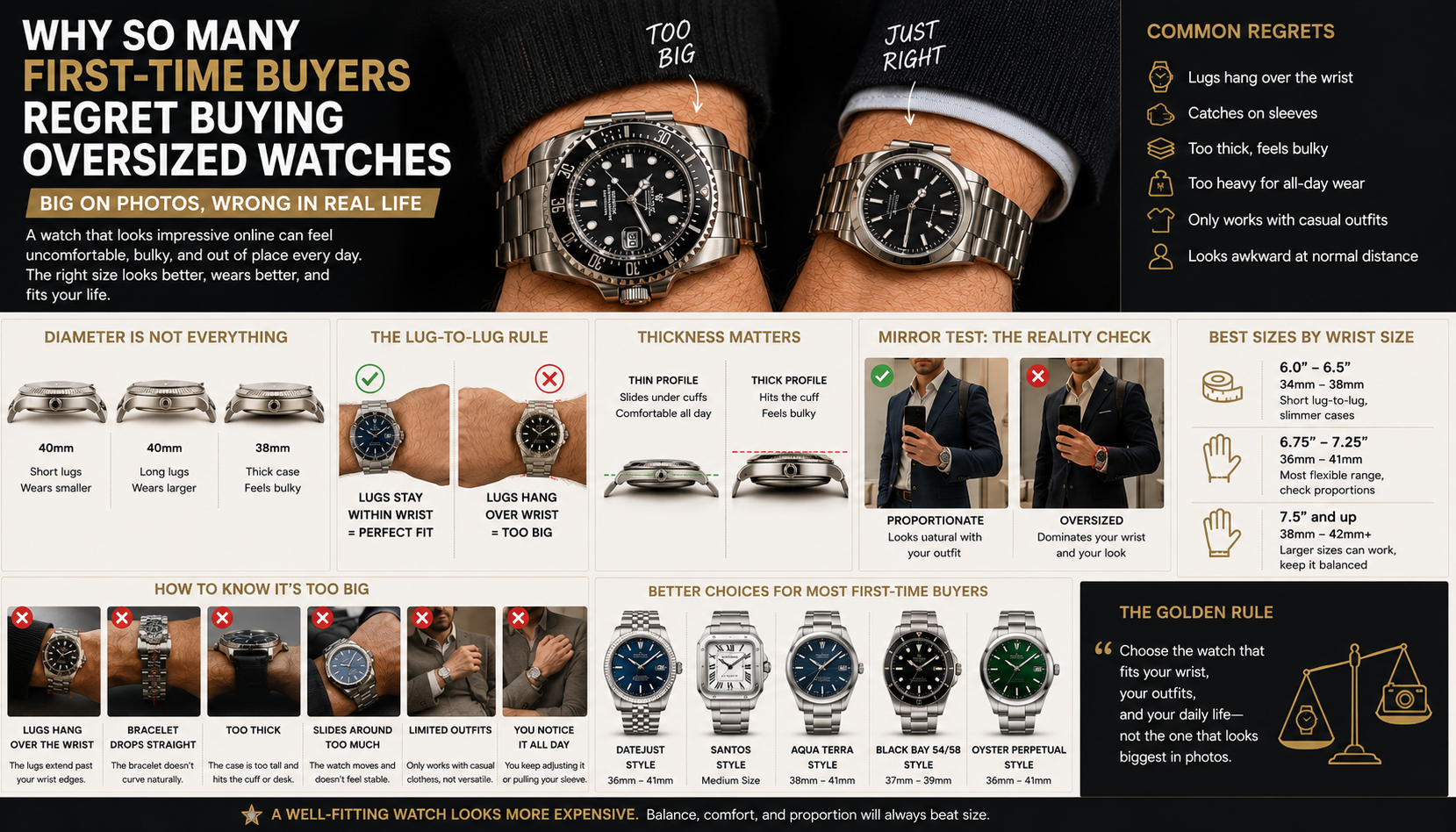
A big watch feels exciting at first.
It looks strong in photos. It fills the wrist. It feels noticeable the moment you put it on. For many first-time buyers, that strong wrist presence is exactly what makes the watch feel “luxury.”
But after a few weeks, the story often changes.
The watch starts catching on sleeves. The lugs hang over the wrist. The case feels heavy by the end of the day. It looks great in a mirror shot, but somehow feels too loud at dinner, too bulky at work, or too sporty with normal clothes.
That is when many buyers realize something important:
A watch can look impressive and still be the wrong size.
This happens often with both genuine luxury watches and replica watches. The problem is not the category. The problem is choosing based only on case diameter, online photos, or wrist presence instead of real-life wear.
A great watch should not just look powerful for ten seconds.
It should still feel right after ten hours.
Why New Buyers Often Choose Watches That Are Too Big
Most first-time buyers do not intentionally choose the wrong size.
They simply follow the wrong signals.
Online photos make large watches look dramatic. Product images are usually shot close up, with perfect lighting and no full-body context. A 41mm or 42mm watch can look balanced on a website, but much larger on a real wrist.
Social media makes this even more confusing. Wrist shots are often taken at wide angles, which can distort proportions. A watch that looks bold and clean in a close-up photo may look oversized when you see it from normal distance.
There is also the emotional side.
Many buyers want their first serious watch to feel meaningful. They want it to be noticed. A larger case seems like the safer choice because it creates instant presence.
But presence is not the same as proportion.
A watch that fits naturally usually looks more expensive over time than a watch that simply looks big.
That is why pieces like Datejust-style watches, Aqua Terra-style watches, Santos-style watches, and Black Bay-style watches often become more satisfying after months of wear. They do not rely only on size. They rely on balance.
I discussed this long-term effect in Watches That Look Better After 6 Months of Wear — Not Just on Day One, because the best watch is often the one that becomes easier to wear, not the one that feels loudest on day one.
Case Diameter Is Only One Part of the Story
Many buyers ask one simple question:
“Is 41mm too big?”
But case diameter alone does not answer that.
A 41mm watch can wear compact.
A 39mm watch can wear large.
A 36mm watch can look strong if the bracelet, bezel, and dial are designed well.
The real wearing size depends on several details:
- Case diameter
- Lug-to-lug length
- Case thickness
- Bezel width
- Dial opening
- Bracelet integration
- Case shape
- Wrist shape
This is why two watches with the same diameter can feel completely different.
For example, a 41mm Datejust-style watch does not wear like a 41mm dive watch. A dive watch usually has a thicker bezel, taller case, and stronger tool-watch presence. The Datejust-style watch feels dressier and more compact because of its case shape and bracelet flow.
That is also why the 36mm vs 41mm Datejust debate is so common. The difference is not just 5mm. It changes the whole personality of the watch. If you are comparing those two sizes, Rolex Datejust Replica 36 vs 41: Which Size Looks Better for Daily Wear? is a useful guide before choosing.
The important lesson is simple:
Do not buy by diameter only.
Buy by how the whole watch sits on your wrist.
Lug-to-Lug Length Is Where Many Regrets Start
If there is one measurement first-time buyers overlook, it is lug-to-lug length.
Lug-to-lug means the distance from the top lug tip to the bottom lug tip. In real life, this often matters more than case diameter.
Why?
Because lug-to-lug determines whether the watch stays within your wrist or hangs over the edges.
When the lugs extend beyond the wrist, the watch rarely looks natural. It may feel like the watch is sitting on top of your wrist rather than wrapping around it.
That creates several problems:
- The watch looks oversized from normal distance
- The bracelet drops straight down instead of curving naturally
- The case feels less stable
- The watch becomes more noticeable in a negative way
- The overall outfit looks less refined
A buyer with a 6.5-inch wrist may wear a 40mm watch comfortably if the lug-to-lug is short. But the same buyer may struggle with a different 40mm watch if the lugs are long and flat.
This is why Tudor Black Bay sizing is such a popular topic. The Black Bay 54 and Black Bay 58 are close in spirit, but they feel different on wrist. The Black Bay 54 has a more compact vintage-style presence, while the Black Bay 58 feels a little more substantial. I covered that comparison in Tudor Black Bay 54 vs Black Bay 58: Which One Should You Buy First?.
The right choice depends less on what sounds impressive and more on how the lugs behave on your wrist.
Thickness Can Make a Watch Feel Much Bigger
A watch does not need to be wide to feel bulky.
Sometimes thickness is the real problem.
A thick watch can feel sporty and solid at first. But after daily wear, thickness becomes more noticeable than diameter.
You feel it when:
- the watch catches under a cuff
- the case bumps against a desk
- the watch moves around because it sits high
- the weight feels top-heavy
- the profile looks too aggressive with smarter outfits
This is why some smaller dive watches still feel bigger than expected. The case diameter may be reasonable, but the thickness adds visual weight.
On the other hand, a slim 40mm watch can feel easier than a thick 39mm watch.
This matters a lot for office wear and business casual outfits. If you wear shirts, jackets, knitwear, or coats often, a watch that sits lower usually feels more premium and practical.
That is one reason Datejust, Santos, Aqua Terra, and Nautilus-style watches work well in daily settings. They tend to look more integrated with clothing instead of sitting like a separate object on the wrist.
For office-focused choices, Best Replica Watches for Office Wear: Datejust vs Santos vs Aqua Terra explains why thickness and comfort often matter more than maximum wrist presence.
The Mirror Test Can Be More Useful Than the Wrist Shot
Most people judge watch size by looking straight down at their wrist.
That is not how other people see your watch.
Looking straight down makes a watch appear larger and more dramatic. It also makes you focus on the dial instead of the whole silhouette.
A better test is the mirror test.
Put the watch on, stand in front of a mirror, and look at your whole outfit.
Ask yourself:
Does the watch match my body frame?
Does it look natural with my clothes?
Does it feel like part of the outfit?
Or does it dominate everything?
This test often changes people’s opinions.
A watch that feels slightly small from your own top-down view may look perfect in the mirror. A watch that feels impressive when you stare at it closely may look too large from normal distance.
This is especially important for first luxury-look watches. The goal is not always to wear the biggest possible watch. The goal is to create the right impression.
If you are still deciding between brand styles, Best Replica Watches for a First Luxury Look: Rolex, Cartier, Omega and Tudor Styles Compared gives a more realistic way to think about first-watch presence.
A good watch should improve your outfit, not overpower it.
Case Study: The 42mm Watch That Stayed in the Box
A first-time buyer chose a 42mm chronograph because it looked amazing online.
The panda dial was sharp. The pushers looked sporty. The bracelet gave it serious presence. In photos, it felt like the perfect first statement watch.
When it arrived, he loved it immediately.
For the first few days, he wore it constantly.
Then reality started to show.
At work, it looked too sporty with dress shirts. At dinner, the case felt large under a jacket cuff. On weekends, it looked great with casual clothes, but not with everything. After one month, he wore it only when he wanted a specific “watch-forward” outfit.
Later, he tried a 38mm Aqua Terra-style watch.
It did not feel as dramatic on day one. But it worked with almost everything. It looked good with a polo, a button-down shirt, a sweater, and a blazer. It was easier to wear, easier to match, and less tiring.
After six months, the 42mm chronograph was still impressive.
But the 38mm watch was actually worn.
That is the difference many buyers discover too late.
Bigger Does Not Always Mean More Masculine
Some buyers choose oversized watches because they believe larger watches look more masculine.
But that is not always true.
A watch looks strong when it is proportionate, confident, and intentional. Oversizing can sometimes create the opposite effect. It can make the watch look like it was chosen for attention rather than taste.
A well-fitting 36mm Datejust-style watch can look sharper than a 44mm sports watch if the proportions match the wrist and outfit.
A medium Cartier Santos can look more refined than a larger version if the smaller size fits better.
A Black Bay 54 can look more stylish than a larger diver on the right wrist.
This is why the modern trend has shifted back toward wearable sizes. Buyers are becoming more aware that elegance often comes from fit, not size.
This also applies to replica watches. A well-chosen size often makes a replica watch feel more convincing and more premium on wrist because the whole visual balance is stronger.
Dial Opening Can Make a Watch Wear Larger
Another overlooked detail is dial opening.
A watch with a large, open dial usually wears bigger than its measurement suggests.
For example, a 39mm watch with a thin bezel and wide dial can look larger than a 40mm dive watch with a thick bezel. That is because the visible dial area creates the impression of size.
This is why simple watches like Oyster Perpetual-style designs can have strong wrist presence despite clean cases. They do not need thick bezels or complicated details. The open dial makes them feel clear and modern.
If you prefer simple daily watches, Best Rolex Oyster Perpetual Alternatives: Simple Watches That Still Feel Expensive is a good reference because it shows how clean designs can still feel premium without oversized cases.
When choosing a watch, do not only check the case size.
Look at how much dial you actually see.
That visible space changes everything.
Bracelet and Strap Choice Can Change the Size Feeling
The same watch can feel different depending on the bracelet or strap.
A steel bracelet usually adds visual weight.
A leather strap can make a watch feel dressier and sometimes smaller.
A rubber strap can make it feel sportier.
A Jubilee-style bracelet can soften the overall look.
An Oyster-style bracelet can make it feel more solid and direct.
This is why bracelet choice matters so much on Rolex-style watches.
A Datejust on Jubilee often feels more refined and comfortable.
A Datejust on Oyster often feels cleaner and sportier.
Neither is better for everyone. But if your concern is oversized wrist presence, the bracelet can influence the final result.
For a deeper comparison, Jubilee vs Oyster Bracelet on Rolex Replica Watches: Comfort, Style and Daily Wear Differences breaks down how the two styles change the wearing experience.
A watch is not just a case.
The bracelet is part of the size impression.
Why Oversized Watches Often Look Better in Photos Than in Real Life
Oversized watches are very photogenic.
They fill the frame.
They show dial details clearly.
They create drama.
They look bold in wrist shots.
But real life is not a close-up photo.
In real life, people see the watch as part of your body, clothing, and movement. They see it while you walk, sit, reach, or talk. A watch that dominates in photos may feel less elegant when viewed naturally.
This is why many “quiet” watches become more impressive in person.
A Santos-style watch may not always win a close-up wrist shot battle, but it looks extremely stylish with clothing.
An Aqua Terra-style watch may seem simple online, but it can look very complete in daily settings.
A Datejust-style watch may not feel shocking, but it often looks naturally expensive.
That idea connects closely with Why Some Watches Look Expensive on Wrist — Even Before People Recognize the Brand. Expensive-looking wrist presence usually comes from proportion, not just size.
How to Know If a Watch Is Too Big for You
Here are practical signs that a watch may be too large.
1. The Lugs Hang Over Your Wrist
This is the clearest warning sign.
If the lugs extend past your wrist edges, the watch will usually look oversized.
2. The Bracelet Drops Straight Down
A bracelet should curve naturally around the wrist. If it falls straight down from the lugs, the watch case may be too long for your wrist shape.
3. The Watch Slides Around Too Much
A top-heavy watch often moves more. This usually happens when the case is thick or the bracelet does not balance the weight well.
4. It Only Looks Good With Casual Clothes
If the watch works with a hoodie but not a shirt, jacket, or sweater, it may be too sporty or too bulky for your lifestyle.
5. You Notice the Size All Day
The best watches eventually disappear on the wrist. If you keep noticing the size, weight, or thickness, it may not be the right daily watch.
6. You Keep Adjusting It
Comfort problems often reveal sizing problems.
If you constantly move the watch around, tighten the bracelet, or pull your sleeve over it, the fit may be wrong.
A Simple Size Guide for First-Time Buyers
There is no perfect universal rule, but these guidelines help.
For Small Wrists
If your wrist is around 6 to 6.5 inches, look carefully at:
- 34mm to 38mm dress or daily watches
- 37mm to 39mm compact sports watches
- short lug-to-lug designs
- thinner cases
- bracelet taper
This is why 36mm Datejust-style watches, 38mm Aqua Terra-style watches, and Black Bay 54-style watches are often strong choices.
For Medium Wrists
If your wrist is around 6.75 to 7.25 inches, you have more flexibility.
You may wear:
- 36mm to 41mm daily watches
- 39mm to 41mm sports watches
- some 42mm watches if thickness and lug length are reasonable
But you still need to check the full design.
For Larger Wrists
If your wrist is above 7.5 inches, larger watches may work naturally.
Still, bigger is not automatically better. A well-proportioned 40mm watch can still look more refined than an oversized 44mm piece.
The goal is balance.
Not maximum size.
Why 36mm and 38mm Watches Are Coming Back
Many buyers used to think 36mm watches were too small.
Now more people are realizing they often look better in daily life.
A 36mm or 38mm watch can feel:
- more elegant
- more vintage
- easier under sleeves
- more balanced
- less tiring
- more versatile
This does not mean everyone should wear small watches.
It means buyers should not dismiss smaller sizes too quickly.
Many first-time buyers who start with oversized watches eventually move down in size because they discover that smaller watches often look more mature.
This trend is especially clear with Datejust, Oyster Perpetual, Black Bay 54, and Aqua Terra-style watches.
The watch does not need to fill your whole wrist to feel premium.
Sometimes the space around the watch makes it look better.
Replica Watch Buyers Should Be Extra Careful With Size
Replica buyers often focus on factory version, dial accuracy, movement type, and QC photos.
Those details matter.
But size still matters just as much.
A top-tier replica in the wrong size can still feel disappointing. A standard version in the right size may be worn more often because it fits your life better.
Before ordering, ask:
- Have I checked lug-to-lug, not just diameter?
- Will this thickness work with my clothes?
- Is the bracelet style right for my wrist?
- Am I choosing this size because it fits, or because it looks impressive online?
- Would I still choose this watch if nobody noticed it?
For a broader pre-purchase process, use First Replica Watch Buying Checklist: 12 Things to Check Before You Order.
And when reviewing QC photos, do not only look for alignment. Also consider whether the watch style still fits your wrist and lifestyle. How to Read Replica Watch QC Photos Before Buying: Dial, Date, Bezel, Bracelet and Case Checks can help you inspect the visual details more carefully.
A watch should pass both QC and real-life fit.
Best Watch Styles for Buyers Worried About Oversizing
If you are worried about buying too large, these styles are usually safer.
Datejust-Style Watches
Datejust-style watches are balanced, versatile, and available in wearable sizes. They work especially well if you want something that feels polished but not too sporty.
Cartier Santos-Style Watches
The square case gives strong character without needing a huge size. Many buyers find the medium Santos-style watch more elegant than expected.
You can compare size and metal choices in Cartier Santos Replica Watch Guide: Medium vs Large, Steel vs Two-Tone, and Which One Looks More Elegant.
Omega Aqua Terra-Style Watches
Aqua Terra-style watches are excellent if you want sporty refinement without dive-watch bulk.
The 38mm vs 41mm decision is important, and Omega Aqua Terra Replica Guide: 38mm vs 41mm, Blue vs Black Dial, and Everyday Styling Tips explains that choice clearly.
Black Bay 54 or 58 Style Watches
These are strong options if you like dive-watch character but want more wearable proportions than larger modern divers.
Oyster Perpetual-Style Watches
Clean, simple, and easy to wear. These watches prove that you do not need extreme size to create a premium impression.
Practical Buying Rule: Choose the Watch You Can Forget You Are Wearing
This may sound strange, but a great daily watch is often one you can forget.
Not because it is boring.
Because it fits so well that it stops bothering you.
You should not constantly notice:
- the weight
- the case height
- the lugs
- the clasp
- the sleeve catching
- the bracelet pulling
A good watch should feel natural during normal life.
That is why long-term satisfaction often comes from restraint.
A slightly smaller watch that you wear five days a week is usually a better purchase than a large watch that only feels right occasionally.
Final Thoughts
Many first-time buyers regret oversized watches because they buy for first impression instead of daily reality.
They choose the watch that looks powerful online, fills the wrist in photos, and feels exciting on day one.
But after real wear, comfort and proportion become more important.
The better question is not:
“What is the biggest watch I can wear?”
The better question is:
“What size makes this watch look natural on me?”
A properly sized watch looks more confident, more expensive, and more personal. It works with more outfits, feels better for longer days, and stays enjoyable after the new-watch excitement fades.
Whether you are choosing a genuine luxury watch, a top-tier replica, or your first serious daily piece, remember this:
The right size does not make a watch less impressive.
It makes the watch look like it belongs on your wrist.