Water Resistance Explained for Everyday Watches: 30m vs 50m vs 100m vs 200m — What You Can Actually
 One of the most misleading numbers in watch buying is water resistance.
A buyer sees 30m, 50m, 100m, or 200m printed on a dial or spec sheet and naturally assumes it tells them how deep they can take the watch. That sounds logical, but in real life, that is not how most people should interpret it.
Here is the practical answer most buyers actually need:
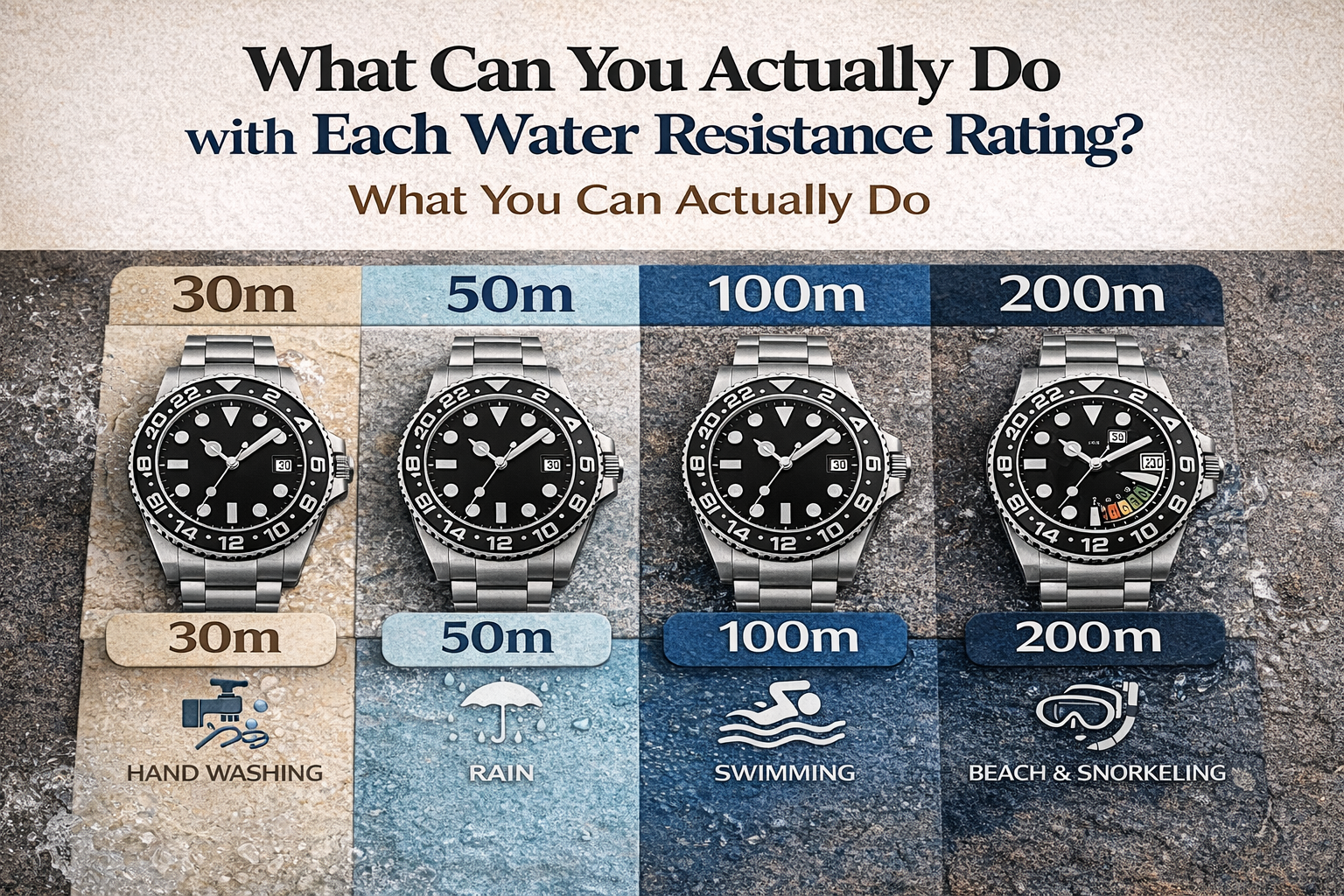
30m means splash-resistant at best. 50m is usually fine for everyday contact with water. 100m is the safest all-round choice for swimming and active daily wear. 200m is more than enough for most non-professional users and is ideal if you want true sports-watch confidence.
So yes, water resistance matters—but what matters even more is what you actually plan to do with the watch.
For many buyers, this is not a diving question. It is a normal-life question:
- Can I wear it in the rain?
- Can I wash my hands with it on?
- Can I swim in it on vacation?
- Is 30m enough for daily wear?
- Do I really need 200m?
That is what this guide is for.
If you are still earlier in the buying process, it may help to first understand What Is an Automatic Watch? Pros, Cons & Who Should Buy One and Automatic Watch vs Quartz: Differences, Pros & Which to Choose. But if your real question is “what can I actually do with 30m, 50m, 100m, or 200m,” this article is the practical version.
The short answer: what each water resistance rating actually means
Let’s start with the real-world version, not the marketing version.
30m water resistance
Think: splashes, accidental rain, maybe hand-washing if you are careful.
Do not think: showering, swimming, beach use, or any water-heavy activity.
50m water resistance
Think: daily life around water. Washing hands, rain, light splashes, and safer general use.
Still not the rating most people should choose for regular swimming.
100m water resistance
Think: the sweet spot for most buyers.
Rain, hand-washing, travel, pool use, swimming, and active daily wear are usually fine—assuming the watch is in good condition and the crown is secure.
200m water resistance
Think: real sports-watch confidence.
Swimming, snorkeling, heavy water exposure, beach trips, and more demanding use are where 200m starts to feel genuinely valuable.
That is the simple buying answer. But there is more nuance behind it.
Why “30 meters” does not mean you can casually take it 30 meters underwater
This is the part that confuses almost everyone at first.
A water resistance rating is based on controlled pressure testing, not on the full messiness of real life. Real life includes:
- movement in water
- pressure changes from arm motion
- age and wear of seals
- heat from showers
- soap and chemicals
- crown position issues
- knocks, drops, and gasket aging
That is why experienced watch owners do not read “30m” as “safe to swim with.” They read it as minimal water protection.
The rating is helpful, but it is not a free pass.
The most useful rule: buy for your real lifestyle, not the minimum technical limit
Many people buy watches based on what they think they might do once or twice a year. A better approach is to buy based on what your watch will see most of the time.
Ask yourself:
- Do you mostly work indoors and want a dressier daily watch?
- Do you travel often and want something worry-free?
- Do you swim on trips?
- Do you want a true everyday sports watch?
- Do you simply want peace of mind?
That answer should drive the rating you choose.
This matters because a watch can have excellent styling, comfort, and value without needing extreme water resistance. For example, many pieces in Best Automatic Dress Watches Under $1000: Elegant Picks for Formal Style are not meant to be water-heavy sports tools. On the other hand, buyers looking for more robust daily use usually end up closer to the types of watches seen in Best Automatic Dive Watches Under $1000: Durable, Reliable & Built for Adventure.
30m vs 50m vs 100m vs 200m: what you can actually do
Here is the practical chart most people wish brands included.
| Water Resistance | Rain | Hand-Washing | Shower | Pool Swimming | Snorkeling | Beach / Water Sports | Best For |
|---|---|---|---|---|---|---|---|
| 30m | Usually yes | Cautiously | No | No | No | No | Dressy, low-water daily wear |
| 50m | Yes | Yes | No | Better avoided | No | Limited | Everyday urban wear |
| 100m | Yes | Yes | Better avoided | Yes | Usually yes | Yes | Best all-round everyday choice |
| 200m | Yes | Yes | Better avoided | Yes | Yes | Yes | Sporty, worry-free ownership |
Two quick notes:
- Showering is still better avoided, even with higher ratings, because heat, soap, and long-term gasket stress are different from a quick rinse or swim.
- Ratings assume the watch is in good condition, with seals intact and the crown properly secured.
Real-life scenario #1: the office buyer who just wants a no-stress daily watch
Let’s say someone wants one automatic watch for work, commuting, occasional travel, and normal day-to-day use. They are not diving. They are not swimming every week. They just do not want to panic every time it rains or they wash their hands.
For that buyer, 100m is often the best answer.
Why not 30m? Because 30m is where people start second-guessing normal life.
Why not 200m? Because they may not need the added sport-tool emphasis, thickness, or style shift.
This is why 100m has become such a strong “everyday sweet spot.” It gives enough real-life margin without forcing you into a full dive-watch personality.
If that kind of one-watch decision is what you are making, Best Automatic Watches for Beginners: Top Picks & Buying Tips and Best Automatic Watches by Budget: $300 vs $500 vs $1000 — How to Choose the Right One are good next reads.
Real-life scenario #2: the buyer choosing between a dress watch and a dive watch
This happens all the time.
A buyer loves the clean profile of a dress watch, but also wants a watch for vacations, pool days, or a more carefree routine.
This is where many people realize they are not really choosing between “beautiful” and “ugly.” They are choosing between style priority and use priority.
A slimmer dress watch with 30m or 50m can be the better-looking option for office wear. But if the owner keeps worrying near sinks, pools, weather, and travel, the watch may be technically attractive but emotionally inconvenient.
That is why so many buyers eventually keep one more refined watch and one tougher everyday sports watch. If you prefer a more rugged but still understated look, Best Automatic Field Watches Under $1000: Rugged, Minimal & Built to Last is also relevant here.
Real-life scenario #3: the vacation watch problem
A watch can feel perfect at home and annoying on vacation.
At home, maybe 30m is fine because your routine is controlled. But on a trip, you are around hotel pools, beaches, sunscreen, humidity, and spontaneous swimming. That is where a low rating stops feeling elegant and starts feeling restrictive.
For travel, 100m or 200m usually feels much better.
It is not just about underwater use. It is about not needing to baby the watch all day.
30m water resistance: when it is enough, and when it is not
30m is best treated as basic protection, not active water capability.
A 30m watch is usually fine for:
- daily indoor wear
- brief light rain
- occasional incidental splashes
- low-risk office and dress use
A 30m watch is usually not the best choice for:
- frequent hand-washing without thinking
- shower use
- beach trips
- swimming
- humid, careless vacation wear
- sports or outdoor-heavy routines
This does not make 30m “bad.” It just means it belongs on the right type of watch and the right owner.
A slim dress watch is allowed to be a dress watch. The problem begins when buyers expect dress-watch elegance to behave like sports-watch utility.
50m water resistance: better than many buyers think, but still not a sports rating
50m is a practical step up from 30m.
For many people, 50m is enough for:
- daily commuting
- rain
- washing hands
- normal city life
- more relaxed ownership
But 50m still sits in an awkward zone for some buyers. It is better than minimal, but not always enough to inspire full confidence around swimming and travel.
That is why 50m works best for people who are not water-heavy users, but still want more daily margin than 30m provides.
100m water resistance: the most practical choice for most people
If there is one rating that solves the most problems for the most buyers, it is 100m.
A good 100m watch usually gives you confidence for:
- daily wear
- rain
- hand-washing
- poolside use
- swimming
- general travel
- more active ownership
This is why many experienced buyers quietly prefer 100m for a daily watch. It covers real life extremely well without requiring a full dive-watch mindset.
And in ownership terms, that matters. The best watch is often the one you stop worrying about.
200m water resistance: do you need it?
Sometimes yes. Often no. But many people genuinely enjoy having it.
A 200m rating is especially attractive if you:
- swim often
- spend time at the beach
- want a true sports-watch feel
- like the reassurance of overbuilt capability
- want a watch you never have to “think about” near water
That said, plenty of buyers choose 200m less because they need it and more because they like the psychology of toughness. There is nothing wrong with that. Watches are emotional purchases too.
Still, if a watch is thicker, heavier, or less versatile with formal clothing, that is part of the tradeoff.
Actual operation: how to use your watch safely around water
Here is the practical part many articles skip.
Before exposure to water
- Check that the crown is fully pushed in or screwed down.
- Do not operate the crown or pushers in water, unless the watch is specifically designed for it.
- Make sure the crystal and case are not damaged. A knock can compromise water resistance.
- Think about the environment. Pool chlorine, seawater, hot tubs, and soap are not the same as clean tap water.
After swimming or beach use
- Rinse the watch with fresh water if it has been in salt water or chlorinated water.
- Dry it with a soft cloth.
- Check the crown again before storing it.
- If you notice fogging under the crystal, treat it as a warning sign and have the watch checked.
What not to do
- Do not pull the crown out with wet hands if you can avoid it.
- Do not assume an old gasket still performs like a new one.
- Do not treat hot showers as harmless just because the rating number looks high.
- Do not ignore service intervals if the watch sees frequent water use.
That last point matters more than many people realize. Water resistance is not just a factory number. It is also a maintenance issue. If your watch is part of regular daily rotation, How to Maintain an Automatic Watch: Daily Wear, Storage & Servicing and How Often Should You Service an Automatic Watch? Intervals, Costs, Warning Signs & What to Expect are worth keeping bookmarked.
The three buyer mistakes that cause the most confusion
1. Reading the number too literally
30m does not mean carefree swimming. 50m does not automatically mean beach-proof ownership. The number is useful, but context matters.
2. Buying for fantasy use instead of real use
A lot of people buy a 200m dive watch and never go near open water. Others buy a 30m dress watch and then get frustrated on every vacation. The better approach is simple: match the watch to your routine.
3. Forgetting that water resistance changes with age
Seals wear out. Crowns get knocked. Casebacks get opened during service. Water resistance is not a forever guarantee.
How to choose the right rating for your lifestyle
Here is the simplest decision guide.
Choose 30m if:
- you want a dress-first watch
- you mostly wear it in dry, controlled environments
- style matters more than active utility
- you are comfortable being careful
Choose 50m if:
- you want a cleaner everyday watch
- you are mostly in office or city settings
- you want better daily margin than 30m
- swimming is not part of the plan
Choose 100m if:
- you want the safest all-round answer
- you travel, swim, or live a fairly active daily life
- you want one watch that can handle most normal situations
- you do not want to overthink water exposure
Choose 200m if:
- you want maximum confidence for everyday sports use
- you swim often or spend time near water regularly
- you prefer dive-watch capability and psychology
- you like having more tool-watch reassurance than you strictly need
The most honest recommendation for most buyers
If someone asks for one simple buying rule, this is mine:
For a true everyday watch, 100m is the most practical target.
That does not mean every good watch needs 100m. It means 100m is where convenience, confidence, and normal-life usefulness come together most cleanly.
30m and 50m are still valid on the right watch.
200m is excellent if you want a more robust sports watch.
But 100m is the rating that solves the most everyday ownership questions with the fewest compromises.
FAQ
Can I swim with a 30m water-resistant watch?
It is better not to. A 30m rating is best treated as splash resistance, not swim-ready protection.
Is 50m water resistance enough for daily wear?
Yes, for many people it is. Rain, hand-washing, and everyday use are usually fine, but it is still not the best choice for regular swimming.
Is 100m water resistance enough for swimming?
Yes, in most normal real-world cases, 100m is a very solid rating for swimming and active daily wear, assuming the watch is in good condition and the crown is secure.
Do I need 200m water resistance if I am not diving?
Not necessarily. Many people choose 200m for extra confidence and sports-watch durability, but most everyday users do not strictly need it.
Can I shower with a 100m or 200m watch?
It is still better avoided. Heat, steam, soap, and long-term gasket stress make showers less ideal than many people assume.
Does water resistance last forever?
No. Gaskets age, seals wear down, and case openings during service can affect performance. Water resistance should be checked over time, especially if the watch sees frequent water exposure.
Final verdict
If you want the simplest real-world answer:
- 30m = fine for careful dry-life wear and minor splashes
- 50m = good for everyday city use and normal contact with water
- 100m = the best all-round choice for most buyers
- 200m = ideal if you want sports-watch confidence and more worry-free ownership
The right rating is not the highest number you can afford. It is the one that fits the way you actually live.
And for most people, that answer is not “as much as possible.”
It is enough to stop worrying, without buying the wrong kind of watch for the rest of your life.