UTC vs GMT: What’s the Difference—and How to Track UTC with a GMT Bezel or World Timer
 Start with the big picture first:
GMT vs World Time Explained: Differences, How They Work, and Which You Need
Quick Answer
- UTC (Coordinated Universal Time) is the global time standard used as a reference worldwide.
- GMT is commonly used as a time-zone label (and in casual use often means the same thing as UTC).
- Pilots and aviation schedules use UTC/Zulu time to avoid time-zone and DST confusion.
- The easiest way to track UTC on a watch is with a GMT hand set to UTC (00–23).
If you’re ever confused by 24-hour time, this guide helps:
How to Read a 24-Hour Bezel: Day/Night, GMT Hands, and Common Confusions
UTC vs GMT: What’s the Practical Difference for Watch Owners?
Here’s the simplest practical framing:
| Term | What it means in watch usage | Why it matters |
|---|---|---|
| UTC | Global reference time (no local DST changes) | Best for travel, aviation, scheduling |
| GMT | Often used like a “label” for a zone (commonly UTC+0) | People say “GMT” when they mean “reference time” |
For most watch use, you can treat UTC as your “base time,” then everything else is an offset.
What Is “Zulu Time” (Z Time)?
Zulu time is simply UTC in aviation/military shorthand.
Examples:
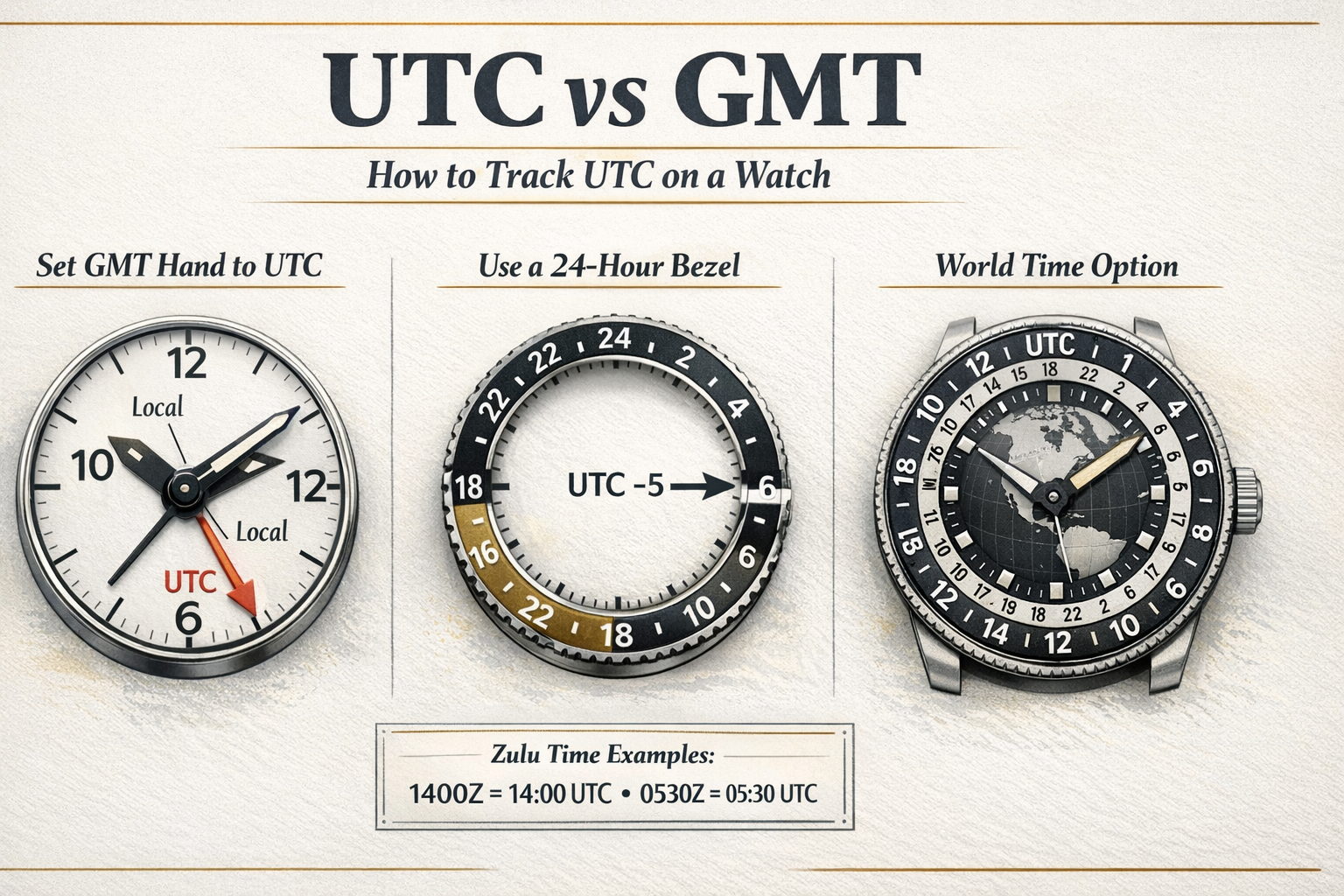
- 1400Z = 14:00 UTC (2 PM UTC)
- 0530Z = 05:30 UTC
“Z” = Zulu = UTC reference time.
Why Pilots Use UTC (Instead of Local Time)
UTC avoids:
- DST changes (which can throw schedules off by one hour)
- confusion when crossing time zones
- date mistakes on long routes
DST guide (important):
DST (Daylight Saving Time) and GMT/World Time Watches: How to Adjust and Avoid Common Mistakes
And if you ever get confused about “today vs tomorrow” across oceans:
International Date Line Explained for Watch Owners: How Dates Change With GMT and World Time
How to Track UTC on a Watch
Method 1 (Best): Track UTC with a GMT Hand
Step-by-step
- Set your main hands to local time
- Set the GMT hand to UTC (00–23)
- Read UTC directly from the 24-hour scale
Full step-by-step setting tutorial:
How to Set a GMT Watch
If you’re not sure which kind of GMT you have:
True GMT vs Office GMT Explained
Method 2: Track UTC + Another Zone with a Rotating GMT Bezel
A rotating 24-hour bezel lets you keep the GMT hand on UTC and use the bezel to track a different zone.
Guide:
How to Use a GMT Bezel to Track a Third Time Zone (Step-by-Step)
Simple idea:
- GMT hand stays at UTC
- Bezel rotates to represent another time zone offset
- Read GMT hand against bezel for that zone
Method 3: Track UTC on a World Time Watch
World time watches can display many zones at once, so UTC is usually one of the easiest to read once set.
Setup guide:
How to Set a World Time Watch: Step-by-Step Guide for City Rings and 24-Hour Discs
Fast reading cheat sheet:
How to Read a World Time City Ring Quickly: A Simple Cheat Sheet for Any Worldtimer
Common Mistakes (And Quick Fixes)
Mistake 1: Reading 24-hour time wrong
18 = 6 PM, not 6 AM.
Fix: use this quick guide:
How to Read a 24-Hour Bezel: Day/Night, GMT Hands, and Common Confusions
Mistake 2: “Everything is off by one hour”
Usually DST confusion (UTC itself does not “do DST”).
Fix:
DST (Daylight Saving Time) and GMT/World Time Watches: How to Adjust and Avoid Common Mistakes
Mistake 3: Date confusion after long travel
This often feels like a UTC problem but is actually date-line logic:
International Date Line Explained for Watch Owners: How Dates Change With GMT and World Time
Mistake 4: You set the watch in the date danger zone
Fix: follow safe setting:
How to Set an Automatic Watch Safely (Time, Date, and the “Danger Zone” Explained)
Quick Table: Convert UTC to Local Time
If your watch tracks UTC, your local time is simply UTC plus/minus an offset. (Offsets change with DST in some regions.)
| UTC | Local time = UTC + offset | Example |
|---|---|---|
| 08:00 | +8 hours | 16:00 local |
| 14:00 | -5 hours | 09:00 local |
| 22:00 | +1 hour | 23:00 local |
Tip: if your region uses DST, the offset may shift by 1 hour seasonally.
FAQ: UTC on Watches
Is UTC the same worldwide?
Yes. UTC is the same reference time for everyone; only local time changes.
Is GMT the same as UTC?
In casual watch talk, people often treat them as the same reference. Practically, tracking UTC on a GMT watch works the same.
What does “1400Z” mean?
It’s 14:00 UTC (2 PM UTC). Z = Zulu = UTC.
What’s the easiest watch setup for UTC?
A GMT watch with the GMT hand set to UTC, and main hands to local time.
Can a world time watch show UTC?
Yes—once set correctly, you can read UTC from the city/24-hour rings.