True GMT vs Office GMT Explained: Differences, How to Tell, and How to Set Them
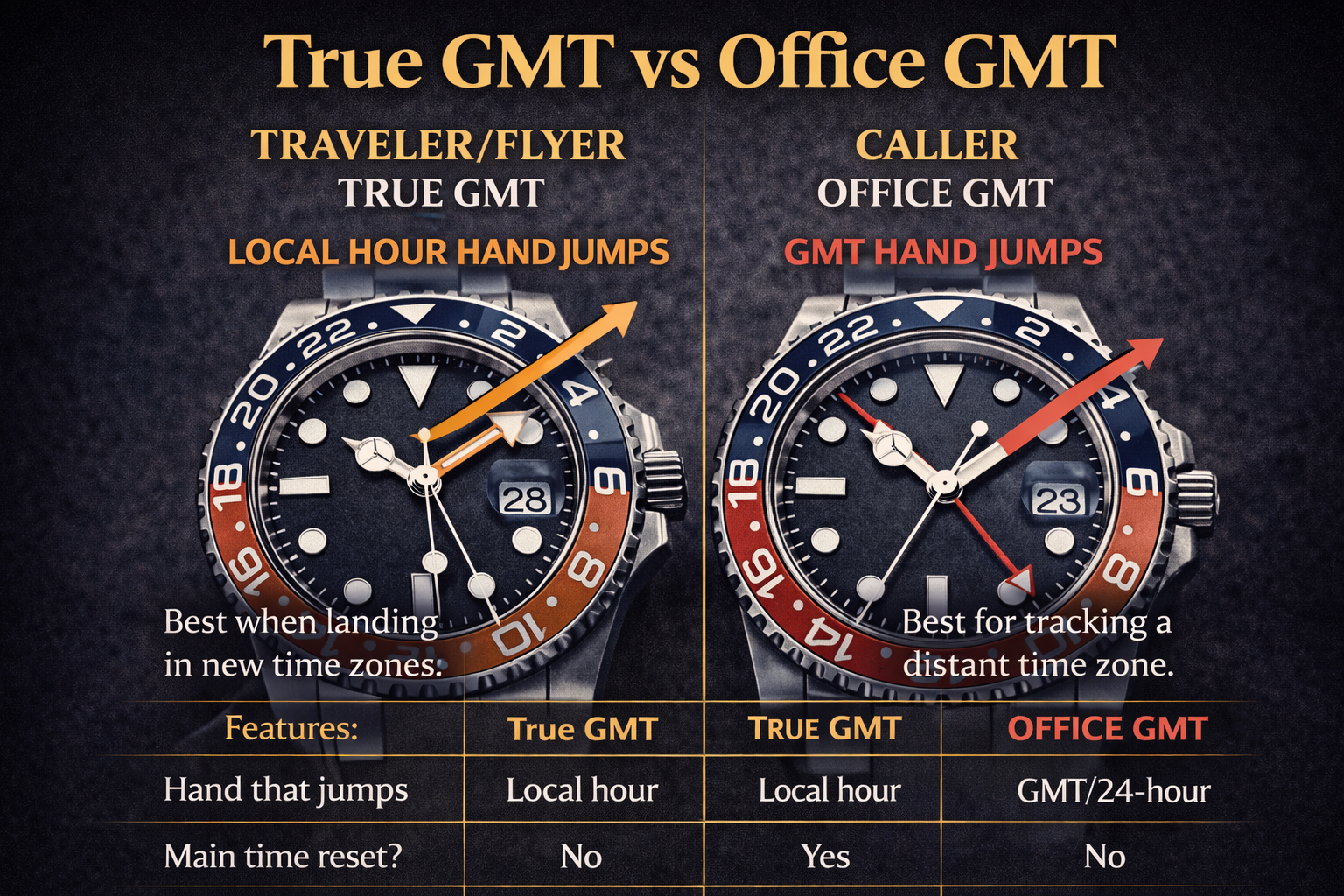 If you’ve read about GMT watches, you’ve probably seen two confusing terms: “True/Traveler GMT” and “Office/Caller GMT.” Both display a second time zone—but they’re set differently, and one is much more convenient for frequent travel.
If you want the big-picture comparison first, read:
GMT vs World Time Explained: Differences, How They Work, and Which You Need
Quick Answer
-
True (Traveler/Flyer) GMT: the local hour hand jumps in one-hour steps. Best for frequent flyers.
-
Office (Caller) GMT: the GMT/24-hour hand jumps independently. Best for people who stay in one place but track another city.
What Makes a Watch “GMT” in the First Place?
A GMT watch adds an extra 24-hour hand that circles the dial once per day. That hand points to a 24-hour scale on the dial or bezel so you can read day/night for a second time zone.
If you want the movement basics behind this, start here:
How Does an Automatic Watch Work? Simple Beginner Guide
True GMT vs Office GMT: The Core Difference
It’s all about which hand adjusts independently.
| Feature | True (Traveler/Flyer) GMT | Office (Caller) GMT |
|---|---|---|
| What jumps in 1-hour steps | Local hour hand | GMT/24-hour hand |
| Best for | Frequent travel | Tracking a remote time zone |
| Convenience when landing in a new time zone | ✅ Very high | ❌ Lower |
| Risk of messing up date when traveling | Lower (if used right) | Higher (more full-time resets) |
How to Tell Which Type You Have (Fast Checks)
Check 1: Pull the crown to the “hour-jump” setting
-
If the main hour hand jumps forward/backward one hour at a time → likely True GMT
-
If the GMT hand jumps in one-hour steps while the main time stays fixed → likely Office GMT
Check 2: What happens to the date when you jump hours?
Many True GMT watches change the date as you jump the local hour hand across midnight.
Important safety note: Setting hands and date incorrectly can cause issues. Follow safe setting habits:
How to Set an Automatic Watch Safely (Time, Date, and the “Danger Zone” Explained)
How to Set a True (Traveler) GMT — Step by Step
Goal: Main hands show local time, GMT hand shows home time.
-
Set the GMT hand to your home time on the 24-hour scale
-
Set the minutes/seconds accurately
-
When you arrive somewhere new, jump the local hour hand forward/back to match local time
-
Keep GMT hand on home time
If your watch stops during travel (normal power reserve), you may need to reset it:
Do Automatic Watches Stop If Not Worn? Power Reserve, Why It Happens & Easy Fixes
How to Set an Office (Caller) GMT — Step by Step
Goal: Main hands show local time, GMT hand shows the remote “office/home” time.
-
Set the main hands to your local time
-
Set the GMT hand to your second time zone on the 24-hour scale
-
If you travel, you’ll usually need to reset main time (less convenient than True GMT)
Common GMT Mistakes (Avoid These)
1) Getting AM/PM wrong on the 24-hour hand
A 24-hour hand uses “military time.”
-
18 = 6 PM
-
06 = 6 AM
2) Changing date at unsafe times
Many watches have a “danger zone” when the date mechanism is engaged.
Use this guide:
How to Set an Automatic Watch Safely (Time, Date, and the “Danger Zone” Explained)
3) Expecting a GMT to be “perfectly accurate”
Mechanical watches have tolerances.
Start here:
Are Automatic Watches Accurate? Real-World Tolerances, Why They Drift & How to Improve Accuracy
4) Sudden fast running after travel (magnetism)
Travel environments = magnets everywhere (phones, chargers, bags).
Check:
Watch Magnetism: Signs Your Watch Is Magnetized, How to Test It
Does GMT Make a Watch Harder to Maintain?
GMT adds complexity, but it’s still very manageable with normal care:
-
keep seals healthy
-
avoid impacts/magnets
-
service on schedule
Care routine:
How to Maintain an Automatic Watch: Daily Wear, Storage & Servicing
Service expectations:
How Often Should You Service an Automatic Watch? Intervals, Costs, Warning Signs & What to Expect
GMT vs World Time: When to Choose Which (Quick Reminder)
If you only need two zones and want travel practicality → GMT
If you want many zones at a glance → world time
Full guide:
GMT vs World Time Explained: Differences, How They Work, and Which You Need
FAQ: True GMT vs Office GMT
Is “True GMT” always better?
Not always. It’s better for travel. Office GMT is great for desk work and remote teams.
Why do people call it “Flyer” or “Traveler” GMT?
Because the local hour hand jumping makes it easy when you fly into new time zones.
Can an office GMT still be useful for travel?
Yes, but you’ll do more full resets and it’s less convenient.
Does GMT affect accuracy?
Not directly, but more features mean maintenance matters. Accuracy guide:
Are Automatic Watches Accurate? Real-World Tolerances, Why They Drift & How to Improve Accuracy