Tool Watch vs Dress Watch: Which One Fits Your Lifestyle Better?
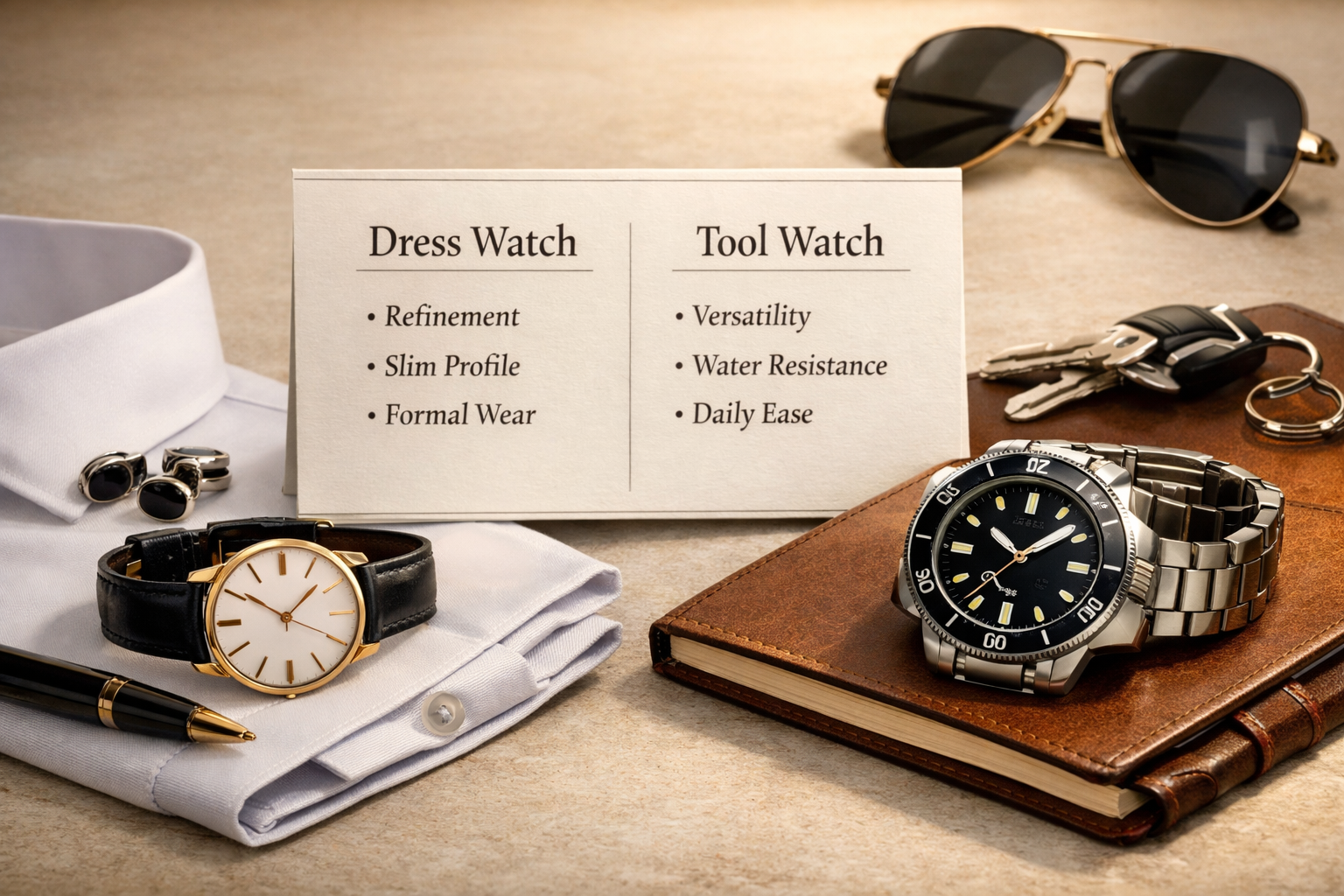
Some watch decisions are really about aesthetics.
This one is more about how you live.
A dress watch and a tool watch can both be excellent purchases. They can both be beautiful, practical in their own way, and deeply satisfying to own. But they are built around very different ideas of what a watch is supposed to do for you.
A dress watch usually asks for a bit more care and gives you more elegance in return.
A tool watch usually asks less from your lifestyle and gives you more flexibility in return.
That is why this comparison matters so much.
Because many buyers do not regret choosing the wrong brand. They regret choosing the wrong kind of companion for their actual daily life.
So here is the practical answer first:
Choose a tool watch if you want durability, casual versatility, and a watch that handles normal life with less fuss. Choose a dress watch if you care more about refinement, slimness, and how the watch works with smart clothing and formal settings.
That is the short version.
For most first-time buyers, tool watch is usually the safer choice. But for some lifestyles, dress watch is still absolutely the better one.
If you are still working through the basics, it helps to start with What Is an Automatic Watch? Pros, Cons & Who Should Buy One and Best Automatic Watches for Beginners: Top Picks & Buying Tips. But if your real question is which style better fits your life, this guide is the practical version.
The short answer: what is the real difference?
The simplest way to think about it is this:
- A dress watch is built to look refined
- A tool watch is built to feel useful
A dress watch usually prioritizes:
- elegance
- restraint
- slimness
- lower visual bulk
- formal compatibility
A tool watch usually prioritizes:
- clarity
- toughness
- easier everyday wear
- stronger water tolerance
- practical versatility
That does not mean dress watches are delicate decorations or that tool watches are ugly instruments. Modern watches blur the categories all the time. But the center of gravity is still different.
A dress watch is usually there to complement you quietly.
A tool watch is usually there to go with you almost anywhere.
What is a tool watch?
A tool watch is a watch designed with function first.
That does not always mean it looks extreme or highly technical. It simply means the watch is built around practical use rather than pure elegance.
A tool watch often emphasizes:
- easy readability
- robust case design
- stronger water resistance
- lume
- grip-friendly crown or bezel design
- a more casual, purposeful look
That broad category includes many field watches, dive watches, and pilot-style watches. They are not all the same, but they usually share one idea:
this watch is meant to be used without constant second-guessing.
That is exactly why tool watches remain so popular. They fit modern life very naturally.
If you want to explore specific tool-watch branches, Best Automatic Dive Watches Under $1000: Durable, Reliable & Built for Adventure and Best Automatic Field Watches Under $1000: Rugged, Minimal & Built to Last are good category extensions.
What is a dress watch?
A dress watch is a watch designed to look elegant, controlled, and appropriate with smarter clothing.
A dress watch often emphasizes:
- thinner case profile
- cleaner dial
- more restrained design
- less visual clutter
- better shirt-cuff behavior
- more formal styling
It is usually not trying to look rugged or overbuilt. It is trying to look composed.
A good dress watch often works best when it feels:
- quiet
- slim
- tasteful
- refined rather than sporty
That is why dress watches tend to be loved by buyers who care deeply about proportion, clothing, and understated style.
If you want to go directly into that category, Best Automatic Dress Watches Under $1000: Elegant Picks for Formal Style is the natural related page.
Tool watch vs dress watch: the real-life comparison
| Category | Tool Watch | Dress Watch |
|---|---|---|
| Core purpose | Practical everyday use | Refinement and elegance |
| Best setting | Casual, active, mixed daily life | Office-smart, formal, dressier wear |
| Water friendliness | Usually stronger | Usually lower |
| Thickness and presence | Often more substantial | Usually slimmer |
| Readability | Usually stronger | Often cleaner, but less tool-like |
| Strap flexibility | High | More style-sensitive |
| Formality | Lower | Higher |
| First-watch safety | Safer for most buyers | Better for specific lifestyles |
That table gets the key point across quickly.
If your life is varied and unpredictable, tool watch usually wins.
If your life is more refined and style-led, dress watch may be the smarter answer.
Style: which one works with more of real life?
For most people, tool watch works with more of real life.
That is because most modern routines include some mix of:
- commuting
- casual clothing
- weather changes
- errands
- travel
- movement
- weekends that do not look formal at all
A tool watch usually handles that easily.
A dress watch can absolutely look better in the right outfit, but it often asks your wardrobe to meet it halfway. A tool watch usually asks less.
That does not make tool watches better-looking. It makes them easier to integrate.
Elegance: where dress watch still wins clearly
A dress watch still does something a tool watch usually cannot fully replace.
It creates a more polished, more intentional, more refined visual impression.
That matters if you regularly wear:
- tailoring
- dress shirts
- fine knitwear
- smarter office clothing
- clothing where slimness and restraint matter
A tool watch can sometimes dress up surprisingly well. But in a real side-by-side comparison, a true dress watch still looks more at home in elegant settings.
That is why buyers who care deeply about style often feel the difference immediately.
Comfort: tool watches can feel freer, dress watches can feel finer
This is one of the most useful ownership differences.
Tool watch comfort
A tool watch often feels comfortable because you worry less about it. It is built for a wider range of conditions. That psychological ease matters.
Dress watch comfort
A dress watch often feels comfortable in a different way. It may be slimmer, lighter, and easier under sleeves. Physically, it can feel more graceful.
So the choice is often between:
- freedom
- and refinement
A tool watch often feels easier.
A dress watch often feels nicer.
Those are not the same thing.
Water resistance and daily stress: tool watch wins
This is one of the biggest practical dividing lines.
A tool watch is usually better suited for:
- rain
- hand-washing
- travel uncertainty
- more active routines
- mixed daily use
A dress watch can still be worn daily, but many dress-leaning pieces bring more caution into ownership. You think more. You check more. You sometimes swap it out more.
That does not mean you should fear them. It means they are often designed around different expectations.
This is why practical specs matter. If you want a watch that makes ordinary life easier rather than more restrictive, tool watch usually has the edge.
Real-world buyer case #1: the one-watch buyer
This is the most common buyer.
They want one watch for:
- work
- weekends
- dinner
- errands
- travel
- normal life
For this buyer, tool watch usually wins.
Why?
Because the first watch has to solve more problems than the buyer initially realizes. It needs to survive uncertainty. Tool watches are usually better at that.
A compact diver, field watch, or other practical everyday automatic will often get far more wrist time than a dress watch in this situation.
That is also why so many budget and beginner guides naturally lean toward daily-capable options like Best Automatic Watches by Budget: $300 vs $500 vs $1000 — How to Choose the Right One.
Real-world buyer case #2: the office-refined buyer
This buyer wears smart clothing regularly, cares about subtle style, and wants the watch to disappear into a polished outfit rather than stand out as equipment.
For this buyer, dress watch may absolutely be the better lifestyle fit.
Why?
Because a thick, sporty, or overly casual tool watch may solve practical life on paper, but still feel slightly wrong every day in actual wear. And that mismatch becomes annoying.
For this person, elegance is not a “special occasion” need. It is their baseline.
Real-world buyer case #3: the casual buyer who still wants something tasteful
This person dresses cleanly, but not formally. They want something versatile, masculine, well-designed, and easy to live with. They do not want the watch to feel too precious.
For this buyer, a restrained tool watch often ends up being the best compromise.
A well-sized field watch or clean everyday sports watch can feel polished enough while still offering better everyday freedom than a true dress piece.
That is exactly why the middle of the market performs so well: many people want function first, but not at the cost of taste.
Which one works better as your first watch?
For most buyers, tool watch works better as a first watch.
That is the honest answer.
It is usually:
- more flexible
- easier to wear often
- less stressful in normal life
- more forgiving if your style changes
- more adaptable while you are still learning your taste
A dress watch is a great first watch only when the buyer already knows that elegance is the priority and practicality is secondary.
Otherwise, a tool watch usually gives more value in actual use.
Which one is better long-term?
This depends on what you value.
Tool watch is better long-term if you care about:
- daily wear frequency
- versatility
- easier ownership
- utility across settings
- fewer lifestyle restrictions
Dress watch is better long-term if you care about:
- elegant style
- timeless restraint
- clothing harmony
- slimmer proportions
- owning something more refined than practical
So the answer is not about which category is objectively superior.
It is about whether you want your watch to be:
- your most useful object
- or your most refined accessory
Tool watch types are not all the same
This is important.
“Tool watch” is a broad category. A field watch, dive watch, and pilot watch all count, but they do not solve life in the same way.
A field watch often feels:
- understated
- compact
- easy daily wear
A dive watch often feels:
- more robust
- more water-ready
- more visually substantial
A pilot watch often feels:
- more dial-driven
- more readable at a glance
- more stylistically specific
So if you know you want a tool watch, the next question becomes what kind of tool-watch personality fits you.
Size and thickness: dress watches usually wear easier, tool watches usually wear stronger
This is one of the main physical differences buyers notice.
Dress watches are often:
- smaller or more restrained in visual presence
- thinner
- easier under a cuff
- less dominant on the wrist
Tool watches are often:
- thicker
- more substantial
- more visibly “there”
- stronger in sporty or casual outfits
That is why smaller-wrist buyers sometimes instinctively prefer dress watches at first. They simply wear more neatly. But that does not always mean dress is the right choice overall. It just means proportion matters.
If you are balancing fit with daily practicality, that question becomes very similar to the ones explored in Best Automatic Watches for Small Wrists: What to Look for Before You Buy.
Which one travels better?
Usually, tool watch.
Travel makes practicality matter more:
- changing weather
- mixed outfits
- more movement
- more unpredictability
- less patience for babying a watch
A tool watch usually thrives there.
A dress watch can still be great for business travel or refined city travel, but as a broad category, tool watches simply ask less from the owner on the road.
Which one gets worn more?
For most people, tool watch gets worn more.
This is not because it is more beautiful. It is because it fits more situations with less hesitation.
A dress watch may be the more emotionally satisfying choice when you wear it. But a tool watch is often the one you actually reach for on an ordinary Tuesday.
That difference matters.
Because the best watch is not always the one that makes the strongest impression. Sometimes it is the one that quietly earns more wrist time.
What buyers often get wrong
1. Assuming tool watch means ugly or bulky
Not true. Many tool watches are extremely well-balanced and attractive.
2. Assuming dress watch means better taste
Not necessarily. It simply means your priorities lean toward refinement.
3. Buying dress first because it feels more “serious”
This often backfires if your real life is mostly casual or mixed.
4. Buying tool first when you already know you live in smart clothing
That can backfire too. Practical does not always mean personally right.
The mistake is not choosing the wrong watch type.
It is choosing the wrong type for the life you actually have.
A simple lifestyle test
If you are not sure, ask yourself these questions.
Do I need this watch to handle rain, travel, weekends, and mixed everyday use?
That points toward tool watch.
Do I wear tailored, clean, dressier clothing often enough that elegance matters every week?
That points toward dress watch.
Am I buying for maximum use or maximum refinement?
Maximum use points toward tool.
Maximum refinement points toward dress.
Do I want to think less about my watch, or enjoy the way it completes an outfit?
Think less = tool watch
Complete the outfit = dress watch
That one test will solve the question for many buyers.
Which one should most buyers choose?
Here is the most honest recommendation.
Choose a tool watch if:
- you want one watch for most of life
- your wardrobe is casual to smart-casual
- you value practicality and low-fuss ownership
- you travel, commute, or move through varied daily conditions
- you want the safer first purchase
Choose a dress watch if:
- elegance matters more than utility
- your clothing leans refined regularly
- you want slimmer, quieter proportions
- you do not need your watch to handle everything
- style harmony matters more than rugged flexibility
If you are unsure
Choose tool watch first.
That is the lower-risk answer for most people.
FAQ
What is the difference between a tool watch and a dress watch?
A tool watch is designed mainly for practical daily use, durability, and function. A dress watch is designed mainly for elegance, slimness, and refined wear.
Which is better for everyday wear, tool watch or dress watch?
For most people, tool watch is better for everyday wear because it is more versatile and easier to live with.
Is a dress watch worth buying first?
Yes, if your lifestyle genuinely supports it. If you dress smartly often and value elegance, a dress watch can absolutely be the right first purchase.
Can a tool watch be worn with formal clothes?
Sometimes, yes. A restrained tool watch can dress up better than many people expect, but it still will not usually feel as naturally formal as a true dress watch.
Can a dress watch be worn casually?
Yes, but it depends on the design and the outfit. Some dress watches look great casually, but the category is still less flexible overall than a tool watch.
Which gets more wrist time?
For most buyers, tool watches usually get more wrist time because they fit more daily situations.
Final verdict
If you want the simplest possible takeaway:
- Tool watch is for life
- Dress watch is for elegance
- Tool watch is the safer first choice for most people
- Dress watch is the better first choice for the right lifestyle
That is the real difference.
Not which one is more respected.
Not which one sounds more sophisticated.
Not which one looks better under studio lighting.
The real question is:
Do you want a watch that adapts to your life, or a watch that elevates your look?
If you want the first, choose a tool watch.
If you want the second, choose a dress watch.
And if you are buying your first watch and do not want to make the wrong move,
the safer answer is usually the tool watch.