Pilot Watch Explained: What Makes a Pilot Watch Different and Is It a Good Everyday Choice?
Pilot Watch Explained: What Makes a Pilot Watch Different and Is It a Good Everyday Choice?
A pilot watch does not need to fly a plane to feel like a pilot watch.
That is one of the reasons the category remains so popular.
Most buyers are not choosing a pilot watch because they need cockpit timing or navigation functions. They are choosing it because pilot watches offer something that still matters in everyday life: clarity, confidence, and purpose.
That is the easiest way to understand them.
A pilot watch is usually designed around fast legibility, simple time reading, practical handling, and a strong sense of tool-watch identity. Even if modern buyers never step into a cockpit, those qualities still translate surprisingly well to normal daily wear.
So here is the practical answer first:
A pilot watch is a watch designed with aviation-inspired priorities like legibility, large hands and markers, easy operation, and strong visual function. And yes, for many buyers, it can be an excellent everyday watch—especially if they prefer clean design, easy readability, and a more practical style.
That is the short version.
The better answer depends on what kind of everyday watch you want. Pilot watches are not as versatile as some all-rounders, but they can be much more wearable than many first-time buyers expect.
If you are still early in the buying process, it helps to start with What Is an Automatic Watch? Pros, Cons & Who Should Buy One and Best Everyday Automatic Watch Features: 8 Specs That Matter More Than Marketing. But if your real question is what makes a pilot watch different and whether it fits real life, this guide is the practical version.
The short answer: what is a pilot watch?
A pilot watch is a watch designed with aviation-inspired usability in mind.
That usually means some combination of:
- very clear numerals or markers
- large, easy-to-read hands
- strong contrast on the dial
- simple layout
- oversized crown on some designs
- a case size that favors visibility
- a more functional, less decorative overall style
Not every pilot watch has all of those features. But most pilot watches are built around the same idea:
you should be able to read the time quickly and use the watch easily under less-than-perfect conditions.
That design logic is what makes the category so appealing even today.
What makes a pilot watch different from other watches?
A lot of watch styles can be called “sporty” or “tool-like.” Pilot watches stand out because they usually feel more purpose-built around visibility than almost any other category.
A pilot watch tends to prioritize:
1. Readability first
The dial is usually bold, clean, and easy to understand at a glance.
2. Function over decoration
Pilot watches often look simpler than they first appear. Their design is usually there to serve legibility, not complexity.
3. Strong visual identity
Even people who are not watch enthusiasts can often tell when a watch has “pilot watch energy.” The numerals, hands, and overall proportions tend to feel more specific and more purposeful.
4. A sense of instrument-style design
Pilot watches often feel less like jewelry and more like equipment, even when they are refined.
That combination makes them different from dress watches, divers, and even field watches.
What are the common pilot watch features?
Not every pilot watch is the same, but these are the most common traits.
Large numerals and clear markers
Pilot watches are often built to be read quickly. Large Arabic numerals are especially common, along with clear minute tracks and strong contrast.
Big, high-contrast hands
The hands are usually easy to pick out from the dial background. That matters more in daily life than many buyers realize.
Oversized crown
Some pilot watches feature a larger crown, originally associated with easier operation. Today it is part practical detail, part design signature.
Clean dial layout
Good pilot watches usually avoid unnecessary clutter. Even when they include extra features, the dial often tries to stay readable first.
Lume and low-light usability
Because pilot-inspired design usually values function, pilot watches often emphasize visibility in darker conditions too.
Larger case presence
Many pilot watches lean slightly larger, not always because they need to, but because readability and design tradition often push them that way.
That last point matters for buyers, because it affects whether the watch feels like a pure everyday piece or more of a style-specific choice.
Why pilot watches still appeal to modern buyers
Because their core values still make sense.
Even if most buyers are not pilots, they still appreciate:
- a watch they can read instantly
- a clear and uncluttered design
- a practical, no-nonsense feel
- a style that looks confident without being flashy
In a market full of watches that try to impress with complexity, pilot watches often stand out by being easier to understand.
That is a big reason why the category remains relevant.
A pilot watch often feels like the visual opposite of an overcomplicated watch. It says:
I am here to be used.
That is a very attractive message in daily wear.
Is a pilot watch a good everyday watch?
For many people, yes.
In fact, pilot watches can be better everyday watches than buyers expect because their strengths line up with what daily ownership actually needs:
- strong legibility
- simple operation
- clear visual identity
- comfortable practicality
- easy casual styling
That said, they are not perfect for everyone.
A pilot watch is usually a strong everyday choice if you:
- value readability a lot
- like simple, purposeful design
- dress casually or smart-casually
- want a watch that feels practical, not delicate
- enjoy a little more personality than a plain three-hand everyday watch
A pilot watch is less ideal if you:
- want something very dressy
- prefer smaller, quieter watches
- dislike bold numerals
- want maximum versatility with formal clothing
So yes, pilot watches can be very good daily watches—but the answer depends on your wardrobe and your taste.
Pilot watch vs field watch: what is the difference?
This is one of the most useful comparisons for buyers because the two categories can overlap visually.
The simplest distinction is this:
- Pilot watch = designed around fast, easy reading and aviation-inspired instrument style
- Field watch = designed around rugged simplicity, compact practicality, and military-style everyday use
A field watch often feels:
- a little more compact
- a little more understated
- more outdoor-minimal
- easier as a pure casual daily watch
A pilot watch often feels:
- a little bigger
- a little bolder
- more dial-driven
- more visually specific
So if you like clean, functional watches but want the most understated everyday option, a field watch may be the safer choice. If you like stronger numerals, bigger presence, and more visual clarity, pilot watch usually feels more distinctive.
That is why buyers who love rugged simplicity often overlap with the audience for Best Automatic Field Watches Under $1000: Rugged, Minimal & Built to Last, while pilot-watch buyers often want a bit more dial character.
Pilot watch vs dive watch: which is better daily?
This is another useful real-life comparison.
A dive watch usually gives you:
- stronger water-ready capability
- more visual heft
- rotating bezel
- more robust sports-watch identity
A pilot watch usually gives you:
- better immediate readability
- a cleaner time-first layout
- less visual hardware on the case
- a more instrument-like personality
So the better everyday choice depends on your daily life.
If your routine involves more water exposure, more casual clothing, or you want a tougher all-purpose sports watch, a diver often makes more sense. That is why diver buyers often end up in guides like Best Automatic Dive Watches Under $1000: Durable, Reliable & Built for Adventure.
But if you care more about reading time instantly and wearing something visually simple but distinctive, a pilot watch can be the better daily companion.
Real-world buyer case #1: the office casual wearer
This buyer wears jeans, chinos, knitwear, overshirts, and casual office clothing. They want something practical but not boring. They do not need a formal dress watch, and they do not want a heavy dive watch either.
For this person, a pilot watch can be excellent.
Why?
Because it offers:
- clear time reading
- strong design character
- casual-smart wearability
- less bulk than some dive styles
- enough personality without feeling overly decorative
In this kind of wardrobe, a pilot watch often feels very natural.
Real-world buyer case #2: the first-time mechanical watch buyer
This buyer wants their first automatic watch to feel “special,” but still easy to understand and easy to wear.
For them, a pilot watch can be a very good first category if they like:
- bold numerals
- a simple functional dial
- everyday readability
- a more tool-like personality
But there is one caution: some pilot watches wear larger than expected. So the buyer needs to think carefully about fit, not just design.
That is especially true if they are comparing with more general-purpose beginner options in Best Automatic Watches for Beginners: Top Picks & Buying Tips.
Real-world buyer case #3: the one-watch traveler
This buyer wants one watch for everyday wear, light travel, casual use, and quick time reading in changing environments.
A pilot watch can work very well here, especially if it has:
- clear dial contrast
- reasonable water resistance
- comfortable strap or bracelet
- moderate case size
The strongest pilot watches for daily life are not just “aviation-themed.” They are pilot-inspired watches that still behave well as normal everyday watches.
That is the difference between a category watch and a truly wearable one.
Why pilot watches are so easy to read
This is the biggest practical strength of the category.
Pilot watches are often very readable because they usually combine:
- strong contrast
- large numerals
- simple dial hierarchy
- bold hands
- less visual clutter
That sounds basic, but it is one of the most useful real-world advantages a watch can have.
Many watches look interesting.
Not all of them are easy to read in a split second.
That is why pilot watches often feel so immediately satisfying. They reduce friction.
And if you are buying a daily watch, reducing friction matters more than adding extra design tricks.
Are pilot watches too big for everyday wear?
Sometimes, but not always.
This is one of the category’s main tradeoffs.
Some pilot watches are deliberately larger because:
- the design tradition favors visibility
- bigger dials emphasize the numerals
- the category often leans toward instrument-like presence
That can be great if you like bold wrist presence. But it can be a problem if you:
- have a smaller wrist
- wear slimmer sleeves often
- want a more discreet watch
- need the watch to work in more formal settings
So the smartest pilot-watch buyer does not just ask, “Do I like the dial?”
They also ask, “Will this actually fit my life?”
Case size and thickness matter a lot here. A readable dial is a strength. A watch that overwhelms your wrist is not.
Are pilot watches formal enough?
Usually not in the pure dress-watch sense.
Pilot watches can look clean and handsome, but they are generally more:
- casual
- smart-casual
- weekend-friendly
- rugged-refined
They usually work better with:
- jackets without ties
- knitwear
- casual office wear
- denim
- travel outfits
They are usually less natural with:
- strict formalwear
- slim dress-shirt cuffs
- very elegant tailoring
That is why buyers who need true formal versatility usually end up leaning more toward dress-oriented options like those in Best Automatic Dress Watches Under $1000: Elegant Picks for Formal Style.
What strap works best on a pilot watch?
This depends on what role you want the watch to play.
Leather strap
Leather is often the most natural fit for a pilot watch. It reinforces the classic aviation-inspired look and makes the watch feel warmer and more character-driven.
Bracelet
A bracelet can make a pilot watch feel more everyday-versatile and more practical in different conditions. It also helps if you want one watch that can do more across seasons.
Rubber
Rubber is less traditional for many pilot-watch styles, but it can work well on modern, sportier versions, especially if comfort and heat matter more than vintage character.
If you are still thinking broadly about how strap choice changes ownership, Leather vs Bracelet vs Rubber Strap: How Strap Choice Changes Fit, Style, and Value is a useful companion read.
Do pilot watches need special features to be good daily watches?
Not really.
In fact, the best daily pilot watches are often the ones that keep things simple.
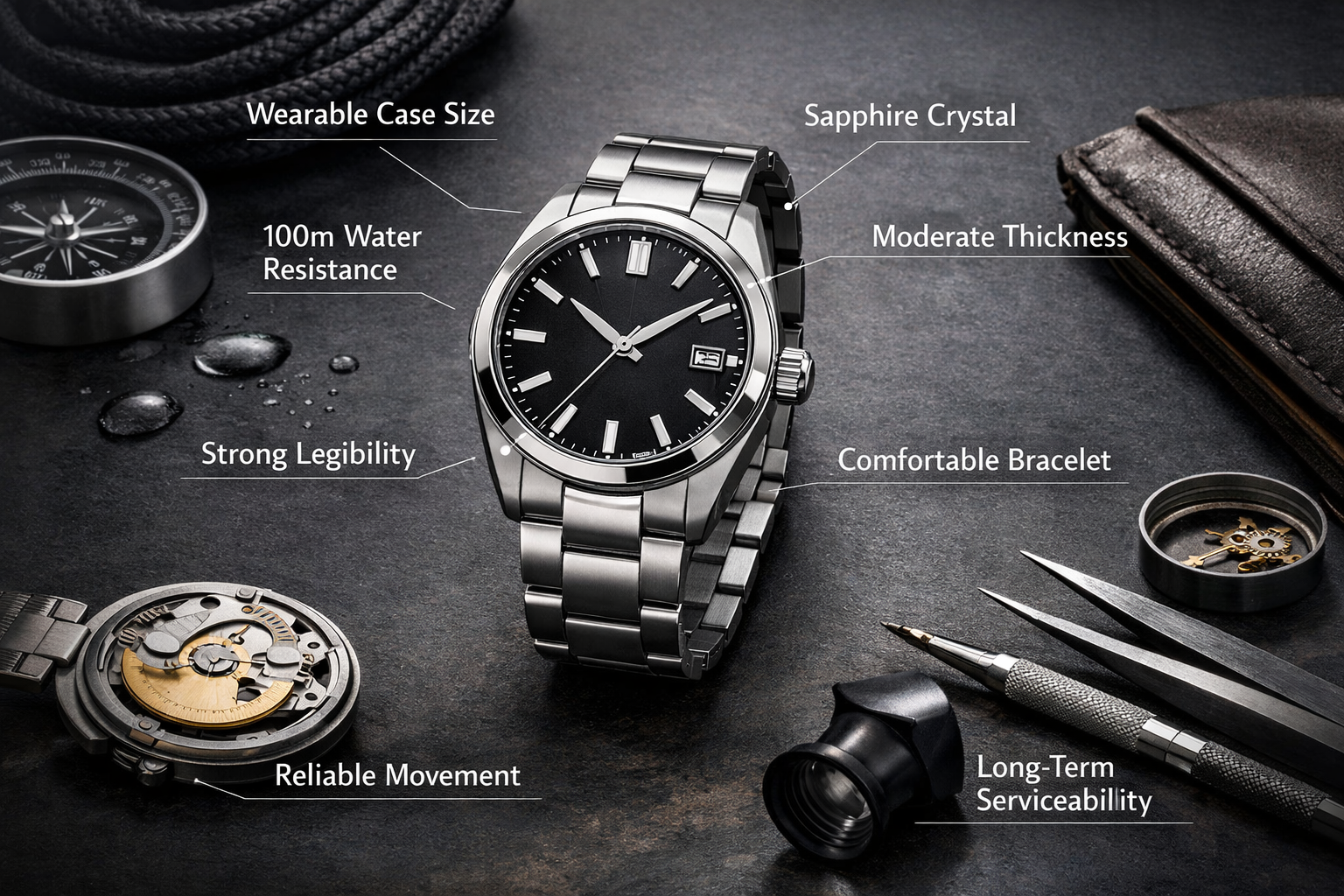
The most useful pilot-watch traits for everyday life are:
- easy legibility
- wearable size
- comfortable thickness
- decent water resistance
- a reliable, practical movement
- a strap or bracelet that matches your routine
That is it.
A pilot watch does not need to be loaded with aviation-themed features to work. In many cases, the simpler the watch, the better it functions as a daily piece.
What buyers often get wrong about pilot watches
1. Assuming every pilot watch is huge
Some are. Many are not. The category has variety, and fit matters more than stereotype.
2. Assuming pilot watches are only for aviation fans
Not true. Many buyers choose them simply because they are clear, functional, and attractive.
3. Confusing pilot style with pure military style
There is overlap, but pilot watches usually lean more into dial clarity and instrument feel, while field watches lean more into compact rugged simplicity.
4. Buying the look without thinking about wardrobe
Pilot watches can be great daily pieces, but they are still more casual than dressy. Buyers should think honestly about where the watch will actually live.
Who should buy a pilot watch?
A pilot watch is a strong choice if you are the kind of buyer who wants:
- easy readability
- strong visual identity
- tool-watch practicality
- a casual to smart-casual everyday watch
- something less common than a standard diver
It is especially good for people who like clean design but do not want their watch to feel generic.
A pilot watch is less ideal if you want:
- maximum dress versatility
- very compact sizing
- a more minimal or abstract dial
- heavy water-use capability as the main priority
A quick buying checklist for pilot watches
If you are considering one, ask yourself these five questions:
1. Can I read this instantly?
If not, it is not a very good pilot watch.
2. Does the size match my wrist?
Pilot style is not an excuse for poor fit.
3. Does the watch suit my real wardrobe?
If most of your clothing is casual or smart-casual, pilot often works very well.
4. Is the water resistance enough for my daily life?
Pilot watches are not usually bought for diving, but basic real-life durability still matters.
5. Do I like the numerals enough to live with them every day?
This matters more than buyers think. Pilot numerals are part of the charm—but also part of the commitment.
FAQ
What is a pilot watch?
A pilot watch is a watch designed with aviation-inspired priorities such as strong legibility, large numerals or markers, simple layout, and easy usability.
What makes a pilot watch different?
Pilot watches usually stand out through very readable dials, high-contrast hands, simple function-first design, and a strong instrument-like personality.
Is a pilot watch good for everyday wear?
Yes, for many buyers it is. A pilot watch can make an excellent everyday watch if you value readability, casual versatility, and practical design.
Are pilot watches too big?
Some are, but not all. Many pilot watches wear larger than dress watches, so fit should be checked carefully before buying.
Pilot watch or field watch for everyday use?
Field watches are often a bit more understated and compact. Pilot watches are often bolder and easier to read. The better choice depends on whether you want quiet versatility or stronger dial-driven personality.
Can you wear a pilot watch with a suit?
You can, but it is usually not the most natural pairing. Pilot watches generally work better with smart-casual or casual clothing than with strict formalwear.
Final verdict
If you want the simplest real-world answer:
A pilot watch is different because it puts readability and function first. And yes, it can absolutely be a good everyday watch—if you like its bold, practical style.
Pilot watches are usually at their best when they are:
- easy to read
- sensibly sized
- simple enough for daily use
- strong in casual and smart-casual settings
They are not the most formal watches.
They are not always the most compact.
But they often succeed where many daily watches fail:
they make telling the time feel easy and satisfying.
And for a lot of buyers, that is exactly what an everyday watch should do.