Open-Heart vs Skeleton Watches: Differences, Pros, Cons & Which Style Ages Better
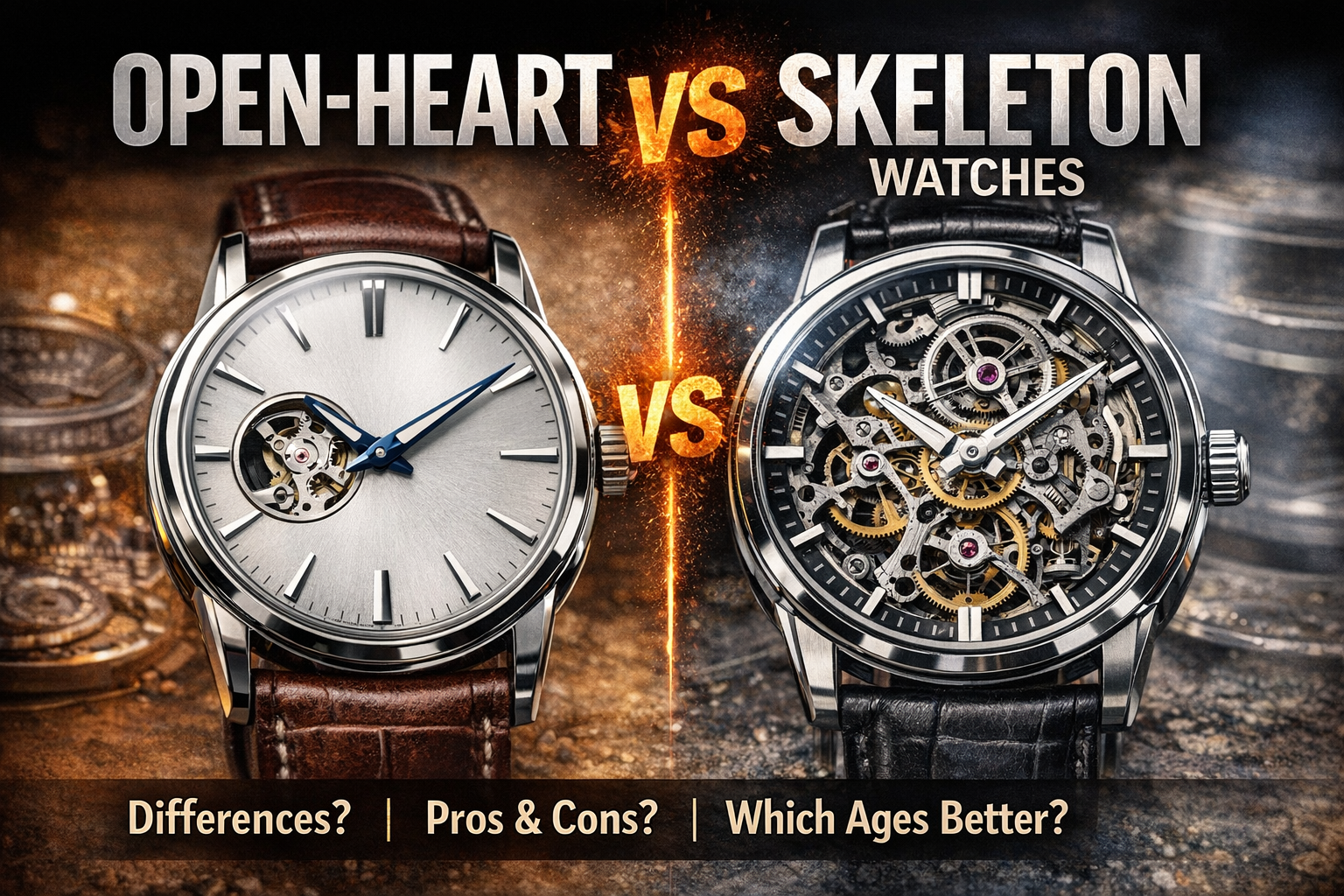
Some watches want to show you the movement.
Others want to show you almost all of it.
That is the easiest way to understand the difference between open-heart and skeleton watches.
If you are deciding between the two, you are not really choosing between “more mechanical” and “less mechanical.” You are choosing between two different ways of enjoying visible mechanics.
And that choice matters more than many buyers expect, because these two styles do not just look different. They wear differently, read differently, and age differently in your collection.
So here is the practical answer first:
Choose an open-heart watch if you want a cleaner, more versatile daily watch with a touch of visible mechanics. Choose a skeleton watch if you want the movement to be the main event and you are comfortable trading some simplicity for drama.
That is the short version.
In real life, open-heart tends to be easier to wear long-term. Skeleton tends to make a stronger first impression. One is usually safer. The other is usually more expressive.
If you are still early in the buying process, it helps to first understand What Is an Automatic Watch? Pros, Cons & Who Should Buy One and How Does an Automatic Watch Work? Simple Beginner Guide. But if your question is specifically about visible-movement design, this guide is the practical one.
The short answer: what is the difference?
Here is the simplest possible distinction:
- Open-heart watch: shows a small part of the movement through an opening in the dial, usually near the balance wheel
- Skeleton watch: exposes much more of the movement, often across most or all of the dial
That means an open-heart watch still behaves visually like a normal watch first.
A skeleton watch behaves more like a movement showcase first.
And that difference affects almost everything:
- readability
- styling
- versatility
- long-term wearability
- how quickly the watch feels “special” versus “too much”
What is an open-heart watch?
An open-heart watch is a watch with a cutout in the dial that reveals part of the movement, usually the balance wheel or another visually active area.
It gives you a glimpse of mechanical life without taking over the whole watch.
That is exactly why many buyers like it. You still get:
- a mostly complete dial
- clearer hour markers
- easier readability
- a more traditional overall appearance
But you also get one little window of animation that reminds you this is not quartz. Something is alive underneath.
For many buyers, that is the sweet spot.
What is a skeleton watch?
A skeleton watch goes much further.
Instead of just giving you a small opening, it removes or minimizes much of the dial so you can see the movement architecture itself. Gears, bridges, cutouts, layers, and mechanical depth become the look of the watch.
A skeleton watch is less about “a glimpse of movement” and more about “the movement is the design.”
That can be visually stunning. It can also be visually busy.
And that is where the real buying decision begins.
Why people confuse the two
The confusion is understandable because both styles expose the movement. To a newer buyer, they can seem like the same idea at different price points.
But the ownership experience is quite different.
Open-heart says:
“I like mechanical watches, but I still want a normal dial.”
Skeleton says:
“I want the mechanics to be the whole personality of the watch.”
That is the real divide.
Which style is easier to wear every day?
For most people, open-heart is easier to wear every day.
That is because it usually offers:
- better readability
- a cleaner dial layout
- easier pairing with different clothing
- less visual fatigue over time
- a more balanced mix of dressy and interesting
A skeleton watch can absolutely be worn daily, especially if the owner loves that style. But it demands more from the wearer. It asks you to enjoy detail, visual complexity, and a stronger design statement every time you put it on.
Some people love that. Others eventually want something calmer.
Which style makes the bigger first impression?
Usually, skeleton wins the first impression battle.
It looks more dramatic in photos, more obviously mechanical, and more likely to get comments from non-watch people.
If someone wants a watch that immediately says, “This is not a normal watch,” skeleton does that faster.
Open-heart is subtler. It tends to impress more quietly. It does not scream for attention, but it rewards closer looking.
That makes skeleton more exciting on day one, while open-heart often feels easier to live with by month six.
Which style ages better?
For most buyers, open-heart tends to age better.
That does not mean skeleton ages badly. It means open-heart is more likely to keep fitting into your wardrobe, your routine, and your taste as your watch preferences mature.
Why?
Because open-heart is usually:
- less trend-sensitive
- easier to dress up or down
- less visually tiring
- more restrained
- more compatible with changing tastes
Skeleton watches can still age well, especially if they are thoughtfully designed and the buyer genuinely loves the look. But they rely much more on taste staying aligned with bold visual complexity.
In practical terms, open-heart is usually the safer long-term style. Skeleton is usually the more emotional short-term purchase.
Open-heart vs skeleton: the real-life comparison
| Category | Open-Heart | Skeleton |
|---|---|---|
| Visibility of movement | Partial | Extensive |
| Readability | Usually better | Often weaker |
| Visual complexity | Moderate | High |
| Daily versatility | Strong | More limited |
| First impression | Refined and interesting | Dramatic and technical |
| Formality | Easier to dress up | Usually more casual or statement-oriented |
| Long-term wearability | Strong | Depends more on personal taste |
| Best for | First visible-movement watch, daily use | Enthusiasts, statement style, movement lovers |
That chart gets to the point quickly.
If you are buying with your head, open-heart often makes more sense.
If you are buying with your heart, skeleton often pulls harder.
Readability: the biggest practical difference
This is the part buyers often underestimate.
A watch can look beautiful online and still be annoying to read in daily life.
Open-heart readability
Open-heart watches usually keep enough of the dial intact that reading the time remains easy. You still have:
- clearer markers
- stronger contrast
- a cleaner visual center
- a more familiar watch-reading experience
Skeleton readability
Skeleton watches often sacrifice some of that clarity. The exposed movement creates visual noise behind the hands and indices, which can make quick time checks slower.
This does not make skeleton “bad.” It just means it is more style-forward and less practical in this specific area.
If you are buying one watch for actual daily use, readability should matter more than many first-time buyers think.
Style: refined mechanics vs full mechanical drama
The styling difference is really about restraint.
Open-heart style
Open-heart feels like:
- classic with a twist
- refined but not plain
- mechanical without shouting
- dressier and easier to integrate
Skeleton style
Skeleton feels like:
- technical
- expressive
- design-heavy
- more obviously enthusiast-driven
- more likely to be the center of attention
That is why open-heart often fits naturally into the same conversation as Best Automatic Dress Watches Under $1000: Elegant Picks for Formal Style, while skeleton often feels less formal and more like a special-style purchase.
Real-world buyer case #1: the first-time automatic watch buyer
This buyer wants something mechanical and interesting, but still wearable enough for work, weekends, and occasional smarter outfits. They love the idea of seeing the movement because it makes the watch feel alive.
For this buyer, open-heart is usually the better first choice.
Why?
Because it gives them the emotional reward of visible mechanics without forcing them into a full statement-watch decision. It is more forgiving, more versatile, and less likely to feel like a phase.
If you are just starting out, this kind of choice often works better than jumping straight into the most dramatic option. That is the same reason Best Automatic Watches for Beginners: Top Picks & Buying Tips often leans toward versatility over spectacle.
Real-world buyer case #2: the collector who already owns simpler watches
Now imagine someone already owns a clean three-hand watch, maybe a diver, maybe a field watch, maybe a dress piece. They are not trying to build a one-watch collection. They want something visually different and more expressive.
For that buyer, skeleton can be a great addition.
Because now the watch does not need to do everything. It just needs to do one thing very well:
be mechanically fascinating.
That is where skeleton starts making more sense. It is often a stronger second or third watch than a first one.
Real-world buyer case #3: the buyer choosing mostly with outfit versatility in mind
This buyer wants the watch to work with office clothes, casual dinners, travel, and maybe the occasional formal moment. They are not trying to impress watch forums. They just want a nice-looking mechanical watch that keeps feeling right in normal life.
For this buyer, open-heart almost always wins.
Skeleton may still be tempting in product photos, but open-heart is usually easier to integrate into a real wardrobe.
Which one works better in an office?
Usually, open-heart.
That is because it feels more controlled and less visually loud. It gives just enough interest without becoming a constant talking point on the wrist.
A skeleton watch can work in an office too, especially in creative or casual environments. But in more traditional settings, it can feel a little too expressive, especially if the watch is also large, thick, or highly polished.
This is similar to the broader rule that cleaner watches tend to age better in more situations. Subtle design gives you more room to wear the watch, rather than making the watch define the whole outfit.
Which one feels more luxurious?
This depends on how you define luxury.
Open-heart luxury feels like:
- restraint
- polish
- controlled detail
- quiet craft
- “I know what I’m wearing”
Skeleton luxury feels like:
- visual complexity
- engineering on display
- dramatic depth
- “look at what’s happening inside”
So open-heart usually feels more quietly premium. Skeleton usually feels more theatrical.
Neither is wrong. They just appeal to different instincts.
Which one is better for formal wear?
In most cases, open-heart.
Formal and dress-leaning watches usually benefit from:
- cleaner dials
- less visual clutter
- easier cuff behavior
- more restrained character
Skeleton watches are generally less formal, not because they are lower quality, but because they ask for more visual attention. That makes them more of a statement piece than a quiet companion.
Which one feels more “mechanical”?
Skeleton, without question.
If your main joy comes from seeing more of the gears, bridges, and movement architecture, skeleton gives more of that experience. It turns the watch into a miniature machine on the wrist.
That is exactly why some enthusiasts love them.
But here is the catch: what feels fascinating on a close-up photo can feel busy in normal life. So the question is not only “Do I love the idea?” It is also “Do I want to live with this every day?”
Practical buying test: how to decide between open-heart and skeleton
If you are comparing two watches online or in person, use this simple test.
Step 1: look at the watch from arm’s length
Not nose-to-dial distance. Normal human distance.
Ask yourself:
- Can I read the time quickly?
- Does the watch feel calm or busy?
- Is the movement view enhancing the watch, or overwhelming it?
Step 2: imagine your normal wardrobe
Would this watch feel right with:
- work shirts?
- knitwear?
- casual jackets?
- a dinner outfit?
- weekend clothes?
Open-heart usually passes more of these.
Step 3: think about month six, not minute six
This is the most important test.
Will you still enjoy the visual complexity after six months?
Or are you mainly reacting to the novelty right now?
Novelty is not bad. But it should be recognized for what it is.
Step 4: ask what role the watch is meant to play
- One main daily watch? Open-heart usually fits better
- Style statement or collection addition? Skeleton becomes more attractive
That simple four-step test prevents a lot of regret purchases.
The hidden issue: visual fatigue
This is a real thing, especially with bold watches.
A design can be impressive but still tiring over time.
Open-heart generally creates less visual fatigue because the mechanical display is contained. It adds interest without constantly demanding attention.
Skeleton can create more visual fatigue if:
- the dial is too busy
- contrast is weak
- the hands blend into the movement
- the watch is thick and flashy at the same time
This does not happen to every owner, but it is common enough that it should be part of the buying decision.
Does one style hold value in a collection better?
Emotionally, open-heart often does.
Not necessarily in resale terms, but in collection usefulness.
Why? Because it occupies a more flexible slot. You can still wear it when you want:
- a slightly dressier watch
- a mechanical conversation starter
- something more interesting than a plain three-hander
- a watch that does not dominate your outfit
Skeleton watches often become more situational. They can still be loved, but they tend to get worn when the owner is specifically in the mood for them.
That is another reason open-heart often ages better in a real collection.
What buyers often get wrong
1. Assuming skeleton is automatically more premium
Not necessarily. It is more visually complex, but complexity alone does not guarantee better design or a better long-term purchase.
2. Assuming open-heart is boring
It is not. A well-designed open-heart watch can feel balanced, elegant, and mechanically satisfying without being overwhelming.
3. Buying a skeleton as a first watch because it looks exciting online
This is common. Sometimes it works out. Often, the buyer later realizes they wanted something more versatile.
4. Ignoring readability
A watch still has to tell the time. If reading it quickly becomes annoying, the design may feel less charming over time.
Which style should most buyers choose?
Here is the most honest recommendation.
Choose open-heart if:
- this is your first visible-movement watch
- you want a daily wearable automatic
- you care about readability
- you want something that works with more outfits
- you want a style that is more likely to age well
Choose skeleton if:
- you already own simpler watches
- you genuinely love seeing the movement architecture
- you want a statement piece
- you do not mind more visual complexity
- the mechanical drama is the whole point
Choose with budget and use in mind
If you are buying with one-watch practicality in mind, open-heart is usually safer. If you are adding personality to a growing collection, skeleton becomes more appealing.
That same logic often applies when people compare by budget and purpose in Best Automatic Watches by Budget: $300 vs $500 vs $1000 — How to Choose the Right One.
A 30-second buying checklist
If you want the fastest possible answer, use this:
Pick open-heart if your main thought is:
“I want a normal watch, but more interesting.”
Pick skeleton if your main thought is:
“I want the movement to be the whole experience.”
That is usually enough to point you in the right direction.
FAQ
What is the difference between an open-heart and a skeleton watch?
An open-heart watch shows a small part of the movement through a dial opening. A skeleton watch exposes much more of the movement across most or all of the dial.
Which is better, open-heart or skeleton?
Neither is automatically better. Open-heart is usually better for daily versatility and readability. Skeleton is usually better for dramatic mechanical display and visual impact.
Are skeleton watches harder to read?
Often, yes. Because more of the movement is visible, the dial can become visually busier and harder to read at a glance.
Do open-heart watches age better?
For many buyers, yes. Open-heart tends to be more versatile, less visually tiring, and easier to wear across different settings over time.
Is a skeleton watch a good first automatic watch?
It can be, but for most first-time buyers, open-heart is the safer choice because it is easier to live with daily.
Are open-heart watches dressy?
Usually more dressy than skeleton watches, yes. They keep a more traditional dial structure and generally pair better with smarter clothing.
Final verdict
If you want the simplest real-world answer:
- Open-heart is the better everyday choice
- Skeleton is the bolder enthusiast choice
- Open-heart usually ages better
- Skeleton usually makes the stronger first impression
So the real decision is not just about how much movement you can see.
It is about what role you want the watch to play in your life.
Do you want:
- a versatile watch with a little mechanical charm?
or - a statement piece where the mechanics are the whole point?
For most buyers, open-heart is the smarter long-term choice.
For the right buyer, skeleton is the more exciting one.
And that is exactly why both exist.