Minimalist Watch vs Tool Watch: Which One Ages Better in Daily Wear?
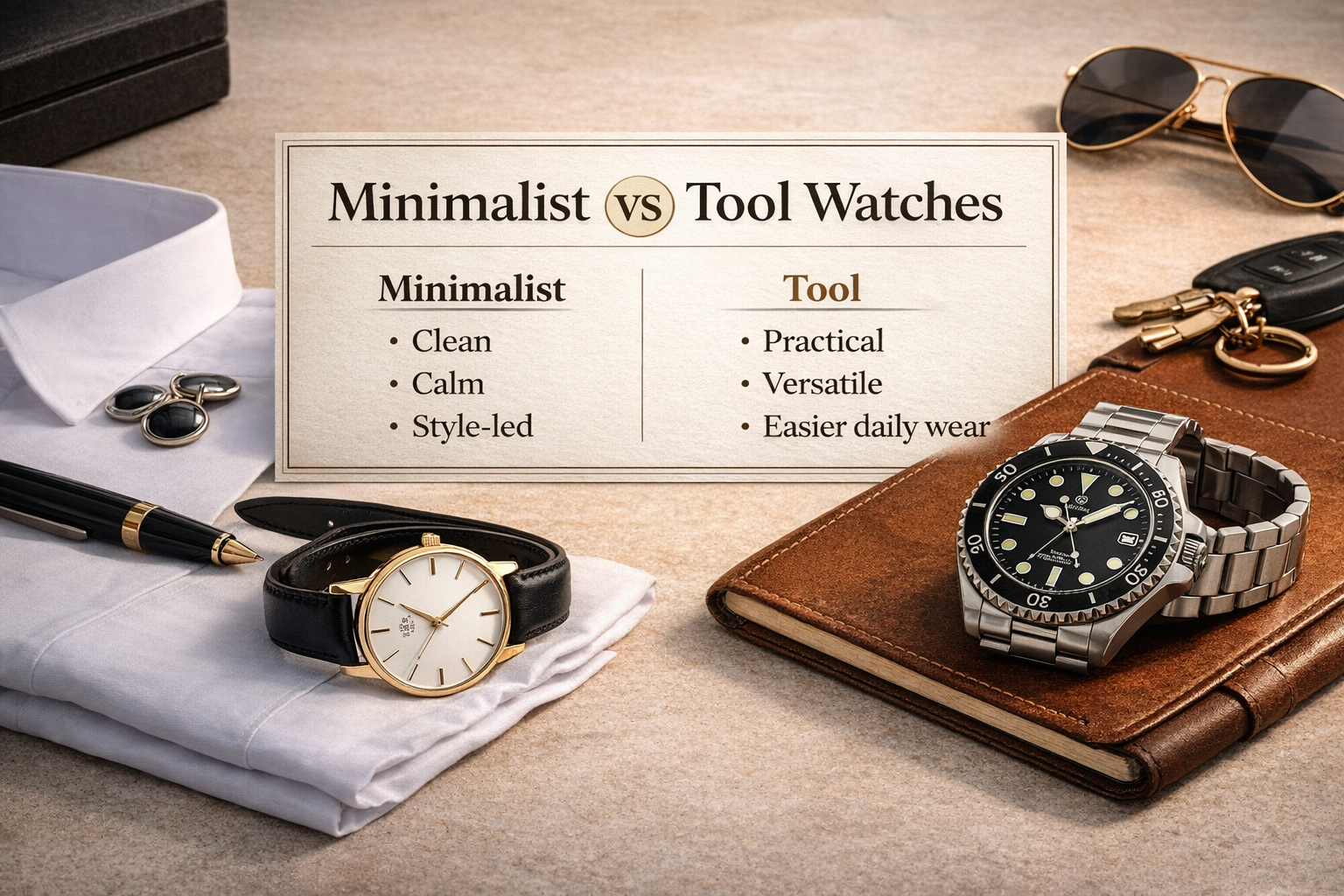
Minimalist Watch vs Tool Watch: Which One Ages Better in Daily Wear?
Some watches impress you in the first five minutes.
Others earn their place after five hundred wears.
That is why the question of minimalist watch vs tool watch is more interesting than it first sounds. At a glance, it may seem like a style debate. In real life, it is really a question about long-term satisfaction.
A minimalist watch often wins on first impression if you like clean design, visual calm, and a more modern pared-back look. A tool watch often wins later, when daily life starts testing the watch in ways product photos never do.
So here is the practical answer first:
For most people, a tool watch ages better in daily wear because it is easier to live with, easier to trust, and easier to keep wearing across changing routines. A minimalist watch can still age beautifully—but usually only when the owner genuinely wants simplicity more than versatility.
That is the short version.
The better answer depends on how you dress, how much variety your daily life demands, and whether you want your watch to disappear into your style or actively support your routine.
If you are still working through the basics, it helps to start with What Is an Automatic Watch? Pros, Cons & Who Should Buy One and Best Everyday Automatic Watch Features: 8 Specs That Matter More Than Marketing. But if your real question is which style holds up better over years of actual wear, this guide is the practical version.
The short answer: what is the real difference?
The simplest way to think about it is this:
- A minimalist watch is built to look calm
- A tool watch is built to stay useful
A minimalist watch usually prioritizes:
- visual simplicity
- fewer dial elements
- lower visual noise
- cleaner styling
- design restraint
A tool watch usually prioritizes:
- readability
- practicality
- water resistance
- stronger daily durability
- lower hesitation in normal use
That does not mean minimalist watches are fragile or tool watches are ugly. It means they are optimized around different kinds of pleasure.
A minimalist watch often feels good because it looks clean.
A tool watch often feels good because it removes friction from ownership.
And over time, that difference becomes very important.
What is a minimalist watch?
A minimalist watch is a watch designed around visual restraint.
That usually means:
- simple dial layout
- fewer numerals or markers
- little to no extra visual clutter
- refined proportions
- a focus on clean lines rather than rugged capability
A good minimalist watch can feel modern, elegant, and intelligently restrained. It often appeals to buyers who dislike busy dials, heavy-handed styling, or overdesigned watches.
The category works best when it feels:
- intentional
- uncluttered
- balanced
- easy on the eyes
That is exactly why minimalist watches can be so appealing at first.
What is a tool watch?
A tool watch is a watch designed with function first.
That does not always mean it is bulky or extreme. It simply means the design is anchored in practical use. A tool watch often focuses on:
- quick time reading
- robust case design
- stronger water tolerance
- lume
- easy handling
- lower day-to-day worry
That broad idea includes many field, dive, and pilot-adjacent watches. They are not identical, but they usually share one important quality:
they want to be worn without hesitation.
That is what makes tool watches age so well for many owners. They keep fitting into normal life.
Why this comparison matters so much
Because both styles can look great on day one.
But daily wear exposes different strengths.
A minimalist watch may start to feel:
- beautifully calm
- or slightly too plain
- refined
- or a little too delicate for real life
- stylish
- or slightly limited
A tool watch may start to feel:
- practical
- or a little more obvious
- slightly rugged
- or exactly right for daily use
- less elegant
- but much easier to trust
That is why “which one ages better?” is really asking:
Which kind of satisfaction lasts longer once novelty fades?
Minimalist watch vs tool watch: the real-life comparison
| Category | Minimalist Watch | Tool Watch |
|---|---|---|
| First impression | Clean, elegant, modern | Practical, purposeful, robust |
| Readability | Often good, sometimes too sparse | Usually very strong |
| Daily versatility | Good in style, weaker in tougher use | Strong across mixed daily life |
| Water and worry | Often more limited | Usually more forgiving |
| Emotional feel | Calm and refined | Confident and reliable |
| Long-term wearability | Strong for the right owner | Strong for most owners |
| Best for | Style-led buyers, clean wardrobes | Daily wearers, one-watch buyers, active routines |
| Ages better daily | Sometimes | Usually |
That table gets to the point quickly.
Minimalist often wins aesthetically at first.
Tool often wins functionally over time.
Why minimalist watches feel so good at first
Because visual calm is powerful.
A minimalist watch often feels like a relief compared to overly busy watches. No unnecessary text. No heavy bezel. No crowded subdials. No extra visual shouting.
That makes the watch feel:
- smarter
- quieter
- more deliberate
- easier to pair with clean modern clothing
- less trend-driven in the moment
A good minimalist watch can look more expensive than it is simply because restraint often reads as confidence.
That is the emotional appeal of the category.
Why tool watches often win later
Because life is not a still photograph.
Over time, daily wear introduces:
- rain
- travel
- changing outfits
- quick time checks
- more movement
- less patience
- more occasions where you just want the watch to work
That is where tool watches often start pulling ahead.
They usually age well because they make fewer demands on the owner. You do not need to protect them emotionally as much. You do not need to keep wondering whether they fit the situation. They usually just keep doing their job.
And when a watch becomes that easy to trust, it tends to stay in rotation.
Which one ages better visually?
This is where the answer gets more nuanced.
A minimalist watch can age better visually if:
- your wardrobe is clean and modern
- you genuinely love restrained design
- you dislike sporty or rugged elements
- you want the watch to feel quiet forever
A tool watch can age better visually if:
- you want more dial character
- you appreciate purpose-driven design
- you dress more casually or practically
- you like watches that feel grounded rather than abstract
So visually, there is no universal winner.
But in real life, many buyers discover something important:
a watch that is visually perfect but slightly impractical can still get worn less than a watch that is visually less pure but far easier to live with.
That is why the daily-wear question changes the result.
Readability: tool watch usually wins
Minimalist watches can be readable, but not always.
Some are beautifully clean but slightly too subtle in normal use. Thin hands, low-contrast markers, minimal minute definition, or overly quiet dials can all look elegant while making quick time checks less satisfying.
Tool watches usually avoid that problem.
They tend to favor:
- stronger hand contrast
- clearer markers
- more obvious dial hierarchy
- easier reading in mixed conditions
That is one reason tool watches tend to age better in daily wear. You keep benefiting from the watch rather than just admiring it.
Water resistance and confidence: tool watch wins clearly
This is one of the biggest differences over time.
A minimalist watch can be fine for calm daily wear. But many minimalist designs are not built around “do not worry about me” ownership. They are built around appearance first.
A tool watch is far more likely to offer the kind of everyday resilience that matters after the honeymoon phase:
- better rain confidence
- easier hand-washing tolerance
- stronger travel suitability
- less general hesitation
That is why buyers who want one main watch so often end up happier with more practical designs. If this part of ownership matters to you, Water Resistance Explained for Everyday Watches: 30m vs 50m vs 100m vs 200m — What You Can Actually Do is directly relevant.
Which one is more likely to become boring?
This depends on the wearer.
Minimalist watch can become boring if:
- you bought it mainly because it looked “safe”
- you actually enjoy stronger visual personality
- the dial is so restrained that it stops feeling distinctive
- the watch lacks enough practical strengths to make up for the quietness
Tool watch can become boring if:
- it is too generic
- it lacks refinement
- it feels more utilitarian than emotionally satisfying
- you bought function when what you really wanted was elegance
So boredom is not built into either category. It usually comes from buying against your real taste.
Still, for many buyers, minimalist watches are more vulnerable to becoming “a bit too plain” once the first-clean-design excitement fades.
Which one is easier to keep wearing for years?
For most buyers, tool watch.
That is the most honest answer.
A tool watch usually stays relevant because:
- it handles more situations
- it asks less from the wearer
- it remains useful even as taste changes
- it usually works with more daily clothing than buyers expect
A minimalist watch can still last beautifully in a collection, but it tends to work best when the owner is consistently drawn to calm, style-led restraint.
A tool watch is more forgiving if your life changes. That makes it age better for more people.
Real-world buyer case #1: the one-watch beginner
This buyer wants one automatic watch for commuting, weekends, casual office use, dinner, and travel. They like clean design, but they also want to avoid regret.
For this buyer, tool watch usually ages better.
Why?
Because the first watch has to survive real life. A restrained field watch, clean everyday sports watch, or compact diver will usually provide more confidence, more ease, and more wearing frequency than a minimalist piece that looks elegant but asks for more caution.
This is exactly why beginner-friendly recommendations so often lean practical, as in Best Automatic Watches for Beginners: Top Picks & Buying Tips.
Real-world buyer case #2: the style-first office buyer
This person dresses neatly, values visual calm, and wants a watch that feels more like a clean design object than an instrument. Their daily life is mostly dry, controlled, and aesthetically consistent.
For this buyer, minimalist watch can age beautifully.
Why?
Because the watch is not fighting the lifestyle. It fits it. If the owner truly values quiet design over rugged flexibility, the minimalist watch may continue to feel exactly right years later.
This is where style consistency beats generic practicality.
Real-world buyer case #3: the active casual wearer
This buyer travels, commutes, moves around, and wants the watch to handle normal life without much thought. They still want good design, but not at the cost of low-grade ownership stress.
For this buyer, tool watch almost always ages better.
It becomes the watch they keep reaching for because it removes friction rather than introducing it.
That matters more than first-impression elegance.
Which one works better with changing wardrobes?
Tool watch usually does better.
A minimalist watch often shines most when the wardrobe stays coherent:
- clean lines
- modern basics
- restrained styling
- low visual clutter
A tool watch often works better when the wardrobe is mixed:
- T-shirts
- overshirts
- jackets
- weekend wear
- travel clothes
- casual-smart outfits
That flexibility is one reason tool watches age so well. They keep finding reasons to be worn.
Strap choice changes this comparison more than buyers expect
A minimalist watch on leather often feels exactly right.
A tool watch on bracelet often feels like the most useful real-life setup.
That matters because strap choice affects not just comfort, but how the category behaves in your life.
Minimalist watch usually feels best on:
- leather
- slim, clean bracelets
- simple refined strap setups
Tool watch usually feels best on:
- bracelet
- leather, if the watch is field-leaning or vintage-inspired
- rubber, if comfort and active use matter
That is why a tool watch often offers more room to evolve. You can change the strap and shift the mood without changing the watch’s core usefulness. If strap strategy matters to you, Leather vs Bracelet vs Rubber Strap: How Strap Choice Changes Fit, Style, and Value belongs in this decision too.
Size and thickness: minimalist often wears neater, tool often wears stronger
Minimalist watches often win in:
- visual slimness
- lower-profile elegance
- cleaner proportions
- easier cuff behavior
Tool watches often win in:
- stronger presence
- more secure everyday feel
- more robust case logic
- practical wrist confidence
That is why smaller-wrist buyers can sometimes be very drawn to minimalist watches at first. They often wear neatly. But neatness alone does not decide long-term satisfaction.
A compact tool watch can still age better if it fits well and keeps solving daily needs. That is the same logic behind Best Automatic Watches for Small Wrists: What to Look for Before You Buy.
Minimalist vs tool watch in an office
This depends on the kind of office.
Minimalist watch is better if:
- your office style is clean, modern, and refined
- visual restraint matters
- your routine is controlled
- elegance is part of your daily identity
Tool watch is better if:
- your office is casual or mixed
- you commute heavily
- you want one watch for before, during, and after work
- practicality matters more than polish
Again, there is no universal winner. But in mixed modern life, tool often proves easier to live with.
Which one is more likely to stay in a collection?
For many owners, both survive—but for different reasons.
A minimalist watch stays if it becomes:
- the calm option
- the clean option
- the refined option
- the visual reset in a collection
A tool watch stays if it becomes:
- the reliable option
- the go-anywhere option
- the least complicated choice
- the one you wear when you do not want to think
The difference is subtle but important.
Minimalist often survives by taste.
Tool often survives by usefulness.
And usefulness is usually the stronger long-term force.
What buyers often get wrong
1. Assuming minimalist automatically means timeless
Sometimes it does. Sometimes it just means visually quiet. Quiet is not always the same as lasting.
2. Assuming tool watch means bulky or overly sporty
Not true. Many tool watches, especially field-style daily pieces, are balanced and understated.
3. Buying minimalist because it looks “mature”
That can backfire if the buyer actually wants more capability and more dial character.
4. Buying tool watch because it sounds practical
That can also backfire if the buyer really values calm design and dislikes rugged styling.
The mistake is not choosing the wrong category on paper.
It is choosing the wrong source of long-term satisfaction.
Which one should most buyers choose?
Here is the most honest recommendation.
Choose a minimalist watch if:
- you genuinely love clean, restrained design
- your wardrobe is refined or visually calm
- you do not need the watch to do everything
- elegance matters more than rugged flexibility
- you are confident that simplicity will keep satisfying you
Choose a tool watch if:
- you want one watch for most of life
- you value practicality and easy ownership
- you travel, commute, or move through mixed daily conditions
- you want the safer long-term choice
- you care more about use than visual purity
If you are unsure
Choose tool watch.
It is usually the category that ages better for most real-world owners.
A quick 30-second decision test
Ask yourself this:
Do I want my watch to disappear into my style, or support my routine?
If the answer is disappear into my style, choose minimalist.
If the answer is support my routine, choose tool watch.
That one question gets surprisingly close to the truth.
FAQ
Which ages better in daily wear, a minimalist watch or a tool watch?
For most people, a tool watch ages better because it is easier to live with and more versatile across normal daily situations.
Are minimalist watches good for everyday wear?
Yes, they can be excellent for everyday wear when the owner values clean design, has a more controlled routine, and does not need strong practical capability.
Do tool watches become boring over time?
Not usually, if they are well chosen. Their usefulness often helps them stay relevant longer than buyers expect.
Can a minimalist watch be a one-watch collection?
It can, but only when the buyer truly wants simplicity first and does not need broader lifestyle versatility.
Is a tool watch always bulky?
No. Many tool watches, especially compact field or everyday models, wear very well and feel balanced rather than oversized.
Which is better for a first automatic watch?
For most buyers, a tool watch is the safer first automatic because it handles more of real life with fewer compromises.
Final verdict
If you want the simplest possible takeaway:
- Minimalist watch often looks better at first
- Tool watch usually lives better over time
- Minimalist ages better for the right taste
- Tool ages better for the average daily wearer
That is the real answer.
Not which one is more sophisticated.
Not which one is more fashionable.
Not which one looks cleaner under studio lighting.
The real question is:
What kind of satisfaction do you want from a watch after the novelty fades?
If you want calm design and visual restraint, choose the minimalist watch.
If you want reliability, flexibility, and easier daily ownership, choose the tool watch.
And for most people wearing one watch through ordinary life,
the tool watch is usually the one that ages better.