How to Tell if a Watch Listing Is a Franken Watch, Not Just a Fake
Most buyers know to worry about fake watches.
Far fewer know to worry about Franken watches.
That is a problem, because in real-world pre-owned buying, a Franken watch can be harder to spot, easier to justify, and sometimes just as expensive a mistake.
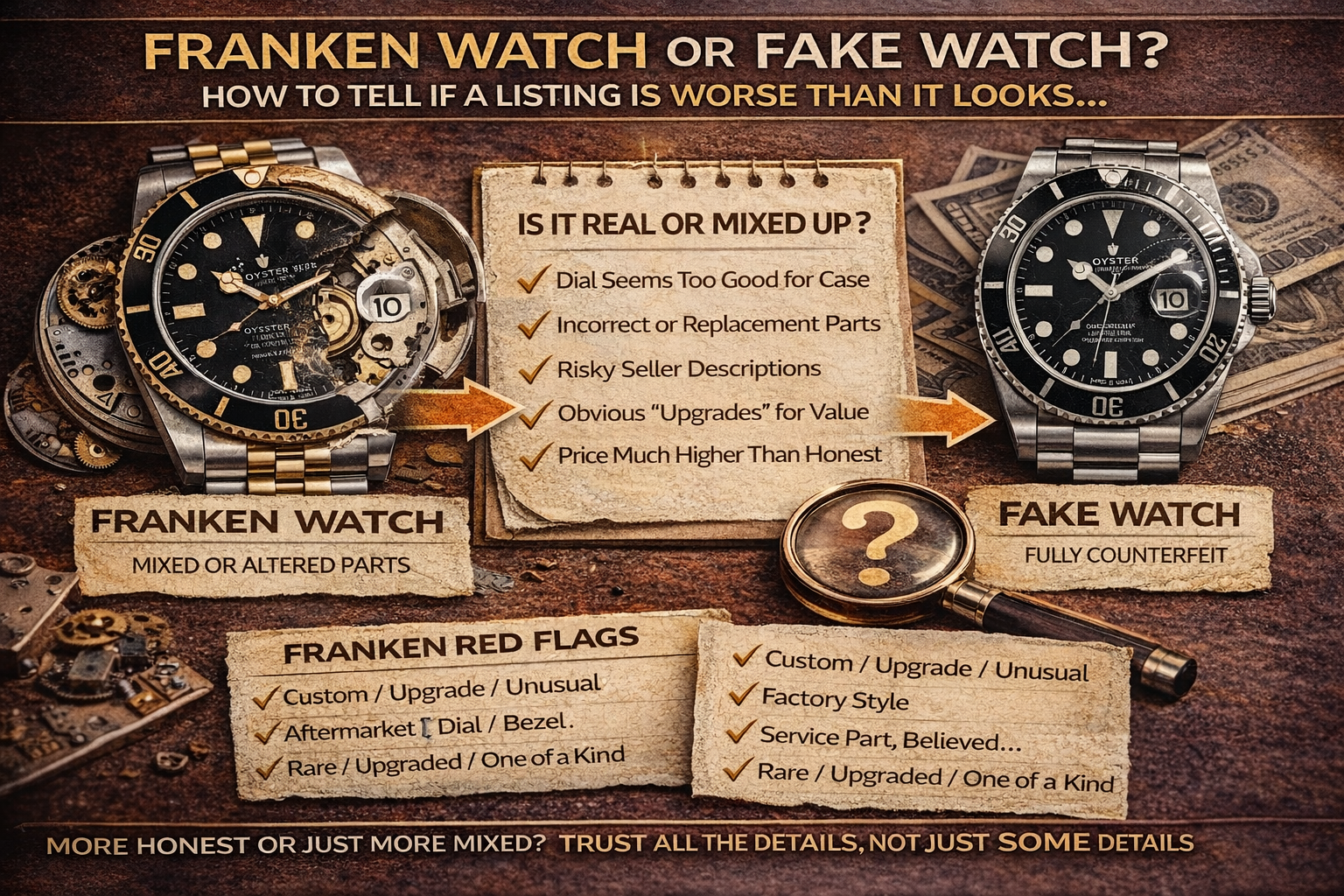
A fake watch is usually trying to be something it is not. A Franken watch is trickier. It may contain some genuine parts, sometimes many genuine parts, but the watch as a whole is no longer an honest original example of what the seller claims it to be.
That difference matters.
Because a lot of bad watch purchases do not happen when someone buys an obvious counterfeit. They happen when someone buys a watch that is part real, part replaced, part modified, part misunderstood — and pays original-watch money for it.
If you buy pre-owned often enough, you will eventually run into one of these listings. Sometimes it is innocent. Sometimes it is careless. Sometimes it is deliberate. But either way, the result is the same: a watch that looks more correct than it really is.
This guide is here to help you catch that before money leaves your account.
What is a Franken watch?
A Franken watch is a watch assembled from mismatched, replaced, aftermarket, refinished, or incorrect parts, often in a way that makes it look more original, more desirable, or more expensive than it really is.
It is not always fully fake.
That is what makes the category confusing.
A Franken watch might have:
- a genuine case and a non-original dial
- a genuine movement with replacement hands
- a correct bracelet but incorrect bezel
- service parts from the wrong generation
- aftermarket diamond settings
- a refinished dial being sold as original
- parts from two different references merged into one “good-looking” watch
This is where a lot of beginners get trapped. They ask one simple question:
Is it real?
But that is not always enough.
A better question is:
Is it honest?
That is the real dividing line.
If you have already read Homage vs Replica vs Counterfeit Watch: What’s the Difference and What Should You Actually Buy?, this is the next step in that same conversation. A Franken watch sits in the grey zone that many buyers do not understand until it is too late.
Why Franken watches are often more dangerous than obvious fakes
Because they give buyers just enough truth to relax.
A seller says:
- “movement is genuine”
- “case is original”
- “all Rolex except dial”
- “factory service replacement parts”
- “custom but authentic base watch”
And suddenly the buyer starts mentally negotiating.
That is where trouble begins.
An obvious fake is easier to reject.
A Franken watch invites compromise.
It says, “Most of it is right.”
It says, “You’ll never notice on the wrist.”
It says, “That’s normal for vintage.”
It says, “Service parts are common.”
Sometimes those statements are partly true. But partly true is not the same as safe to buy.
A watch with mixed components can still be wearable. It can still be enjoyable. It can even be legitimate to own. But the price, the description, and the expectations all have to match reality.
That is where many listings fail.
The three big categories of Franken watch problems
Not all Franken watches are equally bad. That is important.
1. Honest mixed-part watches
These are watches where parts were replaced over time, usually through wear, service, or repair, and the seller is transparent about it.
Example:
A vintage watch with a later service dial, replacement hands, and a period-correct bracelet from a different year.
That may not be ideal for a purist, but it is not automatically dishonest.
2. Cosmetic-upgrade watches
These are watches altered to look more desirable.
Example:
A standard steel sports watch fitted with an aftermarket diamond bezel or a bright aftermarket dial to imitate a more expensive version.
These are very common and often sold with slippery wording.
3. Intentionally deceptive Franken watches
These are the most dangerous.
Example:
A seller combines genuine and non-genuine parts, or mismatched genuine parts, then lists the watch as fully original, rare, or investment-worthy.
That is not a harmless customization issue. That is misrepresentation.
The biggest mistake buyers make
They assume “not fake” means “good buy.”
It does not.
A Franken watch can be:
- genuine but overpriced
- wearable but wrongly described
- attractive but incorrect
- partly original but not collectible
- technically authentic in parts but bad in value
That is why articles like How to Buy a Used Luxury Watch Online: 12 Checks Before You Pay and Box, Papers, Warranty, and Service History: What Really Matters When Buying Pre-Owned? matter so much. Pre-owned buying is rarely just about whether the watch runs. It is about whether the whole story makes sense.
10 signs a watch listing may be a Franken watch
1. The configuration looks “special” in a way that is hard to explain
This is one of the biggest tells.
You look at the watch and think:
- nice case
- nice dial
- good bracelet
- interesting bezel
But somehow the pieces do not fully belong together.
That tension matters.
A lot of Franken watches survive because each part looks believable on its own. The problem only appears when you judge the watch as a full object. The dial might be from one era, the bezel from another, and the bracelet from a third.
If the watch feels unusually attractive in a suspiciously custom way, slow down.
2. The seller uses vague phrases like “custom,” “upgraded,” or “rare configuration”
These phrases are not automatic deal-breakers. But they are often camouflage.
Watch out for lines like:
- “custom factory style”
- “rare dial variation”
- “aftermarket upgrade”
- “professionally refinished”
- “believed original”
- “all authentic except…”
- “vintage parts may vary”
That wording often means the seller knows the watch is not straightforward but does not want to describe the problem clearly.
3. The dial is doing too much work
The dial is where many Franken problems start.
Why?
Because the dial is emotional. It is the part buyers react to first. Change the dial, and the whole watch can suddenly look more expensive, more vintage, rarer, or closer to a high-demand version.
Common issues include:
- redials sold as original
- aftermarket logo printing
- incorrect lume color
- markers not matching the case era
- fonts that feel slightly wrong
- dial colors that seem too convenient for the market
This is especially common in Rolex, Omega, Cartier, and older dress watches.
It is also exactly why our recent fake-identification pieces matter. If you have not read them, these connect directly:
- How to Spot a Fake Rolex Datejust Online: 11 Red Flags Buyers Miss
- How to Spot a Fake Cartier Santos: Photo Checks Before You Buy
- How to Spot a Fake Omega Seamaster Diver 300M Online
A Franken watch is not always fake in the same way, but the dial still gives away a lot.
4. The hands and dial do not seem to belong to the same watch
This is more common than people realize.
Sometimes the dial is from one generation, but the hands are later service replacements. Sometimes the lume tone on the hands does not match the dial. Sometimes the style is simply wrong — too sporty, too modern, too polished, too short, too long, or too heavy.
Hands are often replaced because they are easy to change and visually powerful.
That is exactly why they matter so much.
5. The bezel or insert feels “newer” or “nicer” than everything else
This is a classic mixed-parts tell.
You see a watch with normal wear on the case, normal aging on the bracelet, maybe some softness on the edges — and then a bezel or insert that looks dramatically fresher, brighter, or more expensive.
That mismatch is worth questioning.
Maybe it was replaced in service. That happens.
Maybe it is correct.
Maybe it is not.
The issue is not that a part was replaced. The issue is whether the seller is telling the truth about it, and whether the asking price reflects it.
6. The bracelet is right enough to pass, but wrong enough to matter
Many buyers do not scrutinize bracelets properly.
They should.
A mismatched bracelet can be:
- from the wrong era
- from the wrong reference family
- heavily stretched and refinished
- partially genuine with replacement links
- aftermarket but sold as original
Sometimes the bracelet is not the biggest value issue. Sometimes it is. But it almost always tells you something about how carefully the listing was built.
If you want a deeper framework for how bracelet choice changes how a watch feels and presents, Leather vs Bracelet vs Rubber Strap: How Strap Choice Changes Fit, Style, and Value is helpful context.
7. The watch looks too good for the age, but not in a clean way
This is subtle, but very real.
A genuinely well-preserved older watch usually looks coherent.
A Franken watch often looks selectively improved.
The case may look soft from polishing.
The dial may look suspiciously fresh.
The bezel may feel newer than the rest.
The crown may be wrong.
The hands may glow too white.
It is the pattern that matters.
A watch that has “been through time” should show time in a believable way.
8. The caseback, reference, and visible details do not tell the same story
This is where buyers need discipline.
If the seller claims one thing, but the visible watch suggests another, do not explain that away too quickly.
Examples:
- the model reference suggests a different dial style
- the caseback period does not line up with the visible watch parts
- the claimed year feels inconsistent with the visible configuration
- the bracelet code or clasp style suggests a different timeline
You do not need to become a brand archivist. You just need to ask: does this listing become clearer the more I inspect it, or less clear?
A good listing becomes more coherent.
A Franken listing usually gets messier.
9. The seller avoids boring originality questions
This is one of the best tests in all pre-owned buying.
Ask:
- Is the dial original?
- Are the hands original?
- Is the bezel original?
- Is the bracelet original to the watch?
- Has it been polished?
- Are any parts service replacements?
- Are any parts aftermarket?
Honest sellers may not know everything. But they usually do not become defensive when asked normal questions.
A deceptive seller often does.
10. The price only makes sense if the watch were more original than it is
This is the final red flag.
A mixed-part watch is not always worthless.
But it should not be priced like a clean original example.
A lot of Franken listings rely on one trick: they sell an altered watch using the value language of an original watch.
That is the mistake you are trying to avoid.
A simple 12-minute process to check whether a listing is Franken, not just fake
Here is the practical part.
If I were screening a pre-owned listing tonight, this is what I would do.
Step 1: Ignore the description for 30 seconds
Just look.
Does the watch feel coherent?
Or does it feel assembled?
That instinct is useful.
Step 2: Ask what the watch is supposed to be
Not just the model name. Ask for:
- exact reference
- production year if known
- originality of dial, hands, bezel, bracelet
- service history
- any replaced parts
- any aftermarket parts
This creates the seller’s official story.
Step 3: Ask for six specific photos
Request:
- straight-on dial shot
- side profile
- caseback
- clasp / bracelet close-up
- crown-side photo
- movement photo if available
A mixed-parts watch often gets weaker under these angles.
Step 4: Compare wear consistency
Do the age, finishing, and condition of all visible parts feel like they lived the same life?
If not, ask why.
Step 5: Ask one direct question
Use this exact phrasing:
“Is this watch fully original to its reference, or are any visible parts replaced, serviced, refinished, or aftermarket?”
That question forces clarity.
Step 6: Recheck the asking price
Now ask yourself:
If the answer is “mixed,” does the price still make sense?
That is where many bad listings fall apart.
Three real-world buying scenarios
Case 1: The attractive Rolex with the “rare dial”
A buyer finds a Datejust that looks unusually appealing. The dial color is perfect. The bracelet is decent. The price is strong, but not absurd.
Then the questions begin.
The seller says the dial is “believed original,” then later says it may have been refinished years ago. The bezel looks newer than the case. The bracelet is period-correct, but probably not original to the watch. Suddenly the listing stops being a clean Datejust and becomes a bundle of uncertainties.
That is a classic Franken-risk listing.
Case 2: The honest vintage watch with service parts
A seller lists an older watch and openly says:
- service dial
- replacement crown
- later bracelet
- movement serviced
- priced accordingly
That may not be collectible in the purest sense, but it is honest.
That is not the same problem as a deceptive Franken listing.
This distinction matters because not every mixed-parts watch is evil. Some are simply watches that have lived.
Case 3: The “custom Santos” that is really just a dressed-up problem
A buyer sees a Cartier Santos with a bright aftermarket dial, polished case, and replacement screws. The seller calls it “custom luxury styling.”
That is a dangerous phrase.
Maybe the base watch is genuine. But if major visible parts are altered and the price still assumes full-brand prestige, the buyer is not getting a bargain. They are getting a compromised watch with a cleaner story than it deserves.
When a Franken watch is acceptable — and when it is not
This is the part a lot of people oversimplify.
A Franken watch is not always an automatic no.
It may be acceptable if:
- the seller is fully transparent
- the parts are disclosed clearly
- the price reflects the compromise
- you are buying for wearing, not collecting
- you personally like the result
It is not acceptable if:
- the listing hides the truth
- originality is implied but not real
- the seller prices it like a clean example
- aftermarket parts are disguised as factory
- you are being pushed into a decision fast
That is the real standard.
What to do instead of forcing a doubtful listing
If a watch listing feels wrong, you usually have three better options:
1. Wait for a cleaner example
This is boring advice, which is why it is good advice.
2. Buy from a seller who is less exciting but more precise
A dramatic listing is not the same thing as a trustworthy listing.
3. Buy a simpler watch or simpler configuration
Many Franken traps happen in “special” watches: rare dials, unusual combinations, aftermarket sparkle, or supposedly unique setups.
Sometimes the safer choice is the cleaner choice.
This is one reason why articles like Best Rolex Datejust Configurations: Fluted vs Smooth, Jubilee vs Oyster (What Actually Looks Right?) matter. Cleaner, more standard configurations are often easier to evaluate and easier to trust.
Final verdict: how to tell if a watch listing is a Franken watch
The smartest way to spot a Franken watch is not to ask whether the watch is fake.
It is to ask whether the whole watch makes sense.
Do the dial, hands, bezel, bracelet, case, age, story, and price all point in the same direction?
Or does the listing feel like several believable parts arranged into one unconvincing whole?
That is usually the answer.
A Franken watch often survives because every individual part looks close enough. But close enough is not the same thing as correct, and correct is not the same thing as honestly described.
The safest buyers are not the ones who memorize every brand code and production chart.
They are the ones who slow down, ask boring questions, compare the whole story, and refuse to pay original-watch money for a mixed-watch answer.
FAQ
What is a Franken watch?
A Franken watch is a watch made from mismatched, replaced, refinished, or aftermarket parts, often assembled to look more original, more desirable, or more expensive than it really is.
Is a Franken watch the same as a fake watch?
Not exactly. A fake watch is usually fully counterfeit. A Franken watch may contain genuine parts, but the watch as a whole is not an honest original example.
Can a genuine watch still be Franken?
Yes. A watch can use genuine brand parts and still be Franken if the parts are from different references, eras, or configurations and the watch is represented as fully original.
Are service parts always bad?
No. Service parts are common, especially on older watches. The issue is transparency and pricing, not the mere existence of replacement parts.
Should I avoid every Franken watch?
Not necessarily. If the watch is disclosed honestly, priced fairly, and you are buying it to wear rather than collect, it may still make sense.
What is the biggest red flag in a Franken listing?
Usually inconsistency: a dial, bezel, bracelet, or story that does not fully match the rest of the watch.
Suggested Featured Excerpt
A Franken watch is not always fully fake, but it can still be a bad buy. The biggest warning signs are mismatched parts, vague seller language, inconsistent wear, suspiciously strong dial upgrades, and pricing that assumes more originality than the watch actually has.