How to Buy a Used Luxury Watch Online: 12 Checks Before You Pay
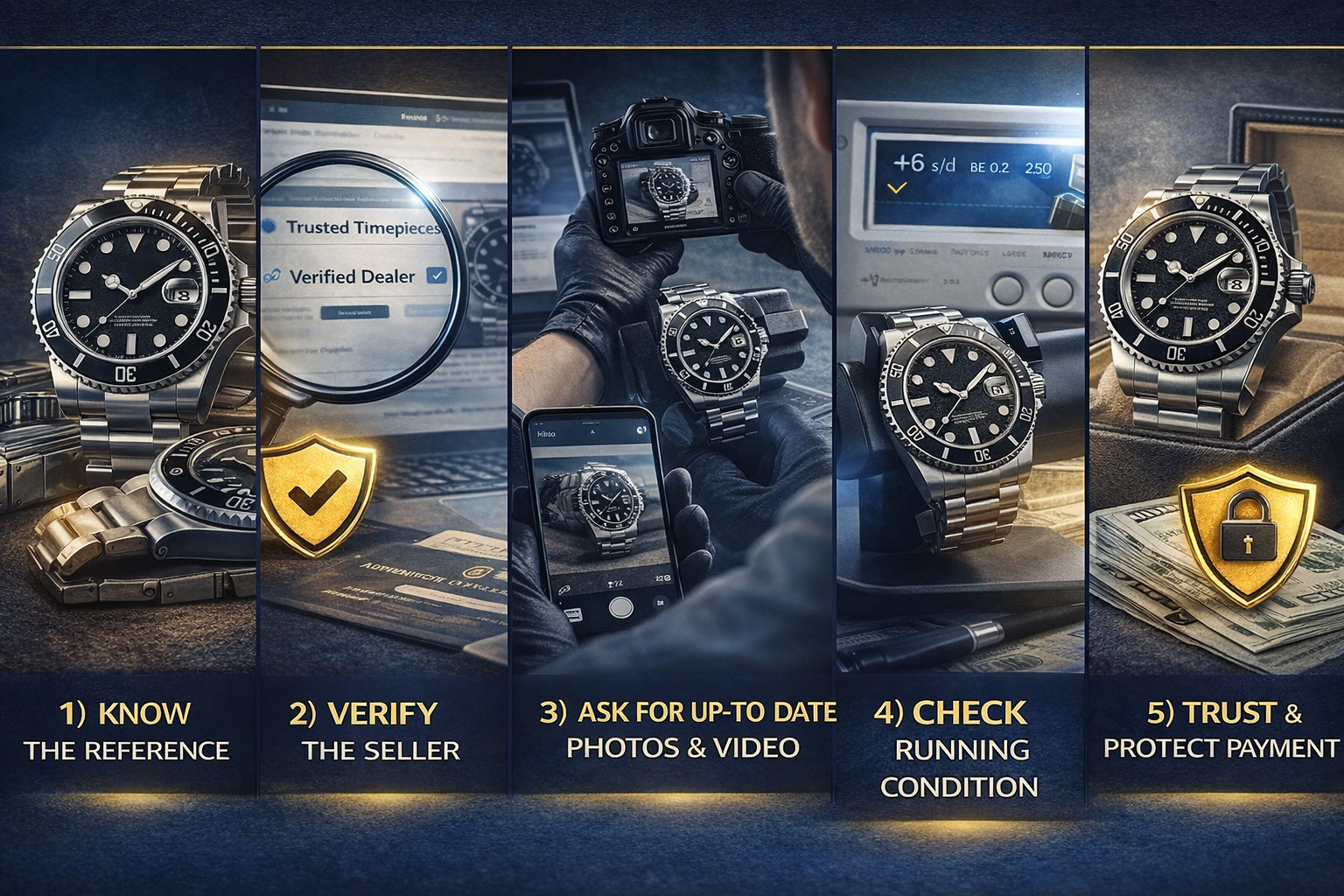
How to Buy a Used Luxury Watch Online: 12 Checks Before You Pay
Buying a used luxury watch online can be one of the smartest ways to enter the hobby. It can also be one of the fastest ways to waste money.
A lot of first-time buyers think the main risk is choosing the wrong brand. In reality, that is usually not the problem. The bigger problem is buying the right brand from the wrong seller, or buying a watch that looks great in photos but comes with hidden wear, unclear history, or no realistic protection if something goes wrong.
That is why the used market rewards calm buyers more than excited buyers.
If you are shopping for a pre-owned Rolex, Omega, Cartier, Tudor, Grand Seiko, or another luxury watch online, this guide will help you slow down, ask better questions, and avoid the mistakes that make used watch buying feel riskier than it needs to be.
Quick answer
The safest way to buy a used luxury watch online is to verify the exact reference, check the seller’s reputation, ask for fresh photos and video, confirm service history, understand bracelet fit, read the return policy carefully, and use protected payment. Most expensive mistakes happen because buyers fall in love with the listing before they verify the details.
Why buying used makes sense for many first-time luxury buyers
For a lot of people, used is not the risky choice. It is the rational choice.
You often get better value, better proportions, and access to more interesting models than you would at the same price buying new. That matters even more if you are still figuring out whether mechanical watch ownership really suits you. If you are not fully sure yet, it helps to read What Is an Automatic Watch? Pros, Cons & Who Should Buy One and compare it with Automatic Watch vs Quartz: Differences, Pros & Which to Choose, because many buyers realize too late that they loved the idea of an automatic watch more than the reality of setting, wearing, and maintaining one.
The good part is that used buying can be a great way to learn your taste without paying full retail. The bad part is that it only works if you buy with discipline.
1) Start with the exact reference, not just the model name
Do not shop vaguely for “a Datejust,” “a Seamaster,” or “a Santos.” Shop for a specific reference, size, generation, or at least a clearly defined version.
Two watches with the same model family name can wear differently, look different in person, and command very different prices. Case size, clasp type, movement generation, bracelet style, and dial layout can all change the ownership experience.
This is one reason buyers get misled online. In listing photos, 36mm, 39mm, and 41mm can look surprisingly similar. On the wrist, they do not. If you are still not fully confident on fit, review Automatic Watch Size Guide: 36mm vs 38mm vs 40mm vs 42mm — What Actually Fits Your Wrist? before you decide that a watch is a “great deal.” A great deal that wears badly is still the wrong watch.
2) Compare total ownership cost, not just the asking price
A used watch priced at $3,900 is not automatically a better buy than one listed at $4,400.
The cheaper one may still need servicing, regulation, pressure testing, a clasp repair, replacement links, or a new strap. Suddenly that “deal” costs more than the cleaner listing you skipped.
This is where new buyers tend to underestimate mechanical ownership. A watch can look great and still carry invisible future costs. That is why it helps to think beyond the purchase price and remember that a mechanical watch is a long-term object. If you want the bigger picture, How Long Do Automatic Watches Last? Lifespan, Durability, and What Really Determines Longevity is a useful baseline before buying used.
3) Study the seller as hard as you study the watch
The best-looking watch from a weak seller is still a weak buy.
A good seller usually has a clear history, recent reviews, realistic descriptions, and no problem answering specific questions. A bad seller usually leans on confidence instead of clarity. They say the watch is “beautiful,” “rare,” or “100% authentic,” but avoid direct answers on service, condition, bracelet stretch, or return rights.
The easiest way to reduce risk is to stop asking only “Is this a good watch?” and start asking “Is this a trustworthy seller?”
A serious seller should be comfortable providing:
- current photos
- timing info if available
- service details
- link count or strap details
- clear return terms
- realistic condition language
If a seller gets vague or irritated the moment you ask practical questions, that is not a personality issue. That is information.
4) Ask for fresh photos and a short video
Never buy a used luxury watch online based only on listing photos.
Ask for updated pictures in natural light showing the dial, case sides, caseback, clasp, crown, bracelet, and any visible wear. Then ask for a short video showing the watch being handled, wound, and set.
This does two things. First, it proves the seller actually has the watch. Second, it shows how transparent they are once real money is involved.
A real example: one buyer I know was deciding between a used Omega Seamaster from an established dealer and a much cheaper Rolex Datejust from an online marketplace account. The Rolex looked tempting in the original listing, but once he asked for fresh clasp photos, movement timing, and a quick video of the crown action, the seller suddenly became hard to pin down. The photos came back cropped, dark, and oddly selective. He walked away and bought the Omega. That was probably the cheapest expensive mistake he never made.
5) Learn to read condition, not sales adjectives
“Excellent condition” means almost nothing on its own.
What matters is whether the watch has been over-polished, whether the lugs are still even, whether bezel edges remain sharp where they should be, whether the crystal has chips, whether the bracelet is stretched, and whether any visible damage has been hidden by lighting or filters.
This matters even more with iconic models where case shape is part of the appeal. A heavily polished sports Rolex, a softened Omega bevel, or a worn Cartier case can still function perfectly, but it may no longer look like the watch buyers think they are paying for.
In other words, do not read the adjective. Read the shape.
6) Do not ignore bracelet fit, strap quality, and clasp condition
A luxury watch is not only a dial and a case. It is something you wear all day.
That means bracelet stretch, clasp wear, missing links, poor fit, and cheap aftermarket parts can change the ownership experience immediately. A watch can be authentic and still feel disappointing if it does not fit properly or if the bracelet feels tired.
Ask how many links are included, what wrist size it currently fits, whether the clasp is original, and whether the strap is factory or aftermarket. This matters especially when you are choosing your first serious daily watch, because comfort changes how often you actually wear it. If you are still deciding whether a bracelet or strap makes more sense for your lifestyle, Bracelet Watch vs Leather Strap Watch: Which One Is Better as Your First Automatic? is worth reading before you assume the more “luxurious” option is automatically the better one.
7) Ask direct questions about service history and current performance
“Runs well” is not a useful answer.
A serious used watch listing should be able to tell you when the watch was last serviced, who serviced it, whether there is documentation, how it is currently running, and whether the power reserve feels normal.
A vague answer sounds reassuring, but gives you nothing to work with. A useful answer sounds like this: serviced in 2023 by an independent watchmaker, running around +6 seconds/day, power reserve normal, pressure-tested after gasket replacement.
That kind of answer shows the seller actually knows the watch.
If you want a better sense of what service expectations look like in normal ownership, How Often Should You Service an Automatic Watch? Intervals, Costs, Warning Signs & What to Expect is a good reference point. And if a seller mentions erratic timekeeping, it may be something as simple as magnetism rather than a full movement problem, which is why Watch Magnetism: Signs Your Watch Is Magnetized, How to Test It is a helpful article to keep in mind during the buying process.
8) Treat water resistance as unconfirmed unless recently tested
This is where buyers get overconfident.
If a listing says “diver,” “sports watch,” or “100m water resistance,” that does not mean you should automatically trust it for swimming or travel. On a used watch, especially an older one, water resistance should be treated as unconfirmed unless it has been checked recently.
Ask when it was last pressure-tested, whether seals or gaskets were replaced, and whether the crown function feels normal. If the seller cannot answer clearly, assume the watch is fine for dry daily wear and nothing more until you have it tested yourself.
That mindset may sound conservative, but it is the smarter one. Water Resistance Explained for Everyday Watches: 30m vs 50m vs 100m vs 200m — What You Can Actually Do is a good refresher if you want to separate marketing language from practical reality.
9) Read the return policy line by line
A surprising number of buyers feel safe as soon as they see words like “warranty” or “guaranteed authentic,” but never ask what those words actually mean.
How many days do you have to inspect the watch? Can you return it for any reason, or only if it is seriously misdescribed? Who pays return shipping? Is there a restocking fee? Does the warranty cover timing issues, or only total mechanical failure?
These are not small details. They are the difference between “I can inspect this safely” and “I am stuck with it.”
In practice, a slightly more expensive watch with a real 7-day or 14-day return window is often a safer purchase than a cheaper watch with no meaningful return protection.
10) Learn the warning signs around replica, counterfeit, and misleading listings
This is an area you specifically said you want to build out more, and honestly, it is a smart direction.
The online watch market includes authentic pre-owned pieces, legitimate homages, rebuilt watches, Frankenwatches, and outright counterfeits. The problem is that many first-time buyers think fake listings are always obvious. They are not.
Be careful when you see phrases like:
- “AAA”
- “1:1”
- “super clone”
- “factory version”
- “same as genuine”
- “Swiss style”
- “custom build”
Those terms usually mean you are no longer looking at a normal used luxury listing. You are looking at counterfeit culture dressed up as value.
Even when the language is subtler, the classic red flags stay the same: the price is unreal for the model, the photos avoid useful detail, the seller wants fast payment, and the paperwork story sounds vague but convenient.
A good rule is this: if a desirable Rolex, Cartier, or Patek looks dramatically cheaper than the market without a clear reason, do not call it a bargain. Call it a problem until proven otherwise.
11) Match the watch to your real lifestyle, not your fantasy lifestyle
This is one of the most human mistakes in watch buying.
A buyer imagines a more polished, adventurous, or formal version of themselves and buys for that imaginary life. Then six months later the watch spends more time in a drawer than on the wrist.
Someone who wears casual clothes most days may force themselves into a dress watch because it feels sophisticated. Someone who works in an office may buy a large dive watch because it feels safer and more famous. Someone who wants one watch for everything may choose by internet hype instead of real habits.
This is why category still matters even when you are buying pre-owned. If you are deciding between something dressier and something more versatile, Dress Watch vs Everyday Watch: What’s the Real Difference and Which Should You Buy First? helps clarify that choice, while Tool Watch vs Dress Watch: Which One Fits Your Lifestyle Better? is useful if you are torn between rugged practicality and cleaner all-round style.
A practical example: a buyer with a $5,000 budget may assume a pre-owned Submariner is the obvious answer because it is famous, recognizable, and easy to resell. But if that buyer works in a formal office, wears cuffs most days, and wants one watch for travel, work, and weekends, a Datejust, Aqua Terra, or Santos may actually make more sense.
12) Use protected payment and keep a clean paper trail
Once you decide to buy, do not get careless in the final step.
Use a payment method with buyer protection whenever possible. Save screenshots of the listing, private messages, updated photos, invoice details, shipping information, and the exact wording of the return policy.
If the watch arrives in worse condition than described, or if anything changes after payment, documentation matters.
The safest buyers do not act dramatic. They act organized.
A message you can copy and send to any seller
Here is a simple message that filters weak listings fast:
Hi, I’m seriously interested in the watch. Before moving forward, could you please send fresh photos of the dial, case sides, caseback, clasp, bracelet, and any included accessories, plus a short video showing the watch running and the crown/date function? I’d also appreciate details on service history, current timing, wrist fit, and your return policy. Thanks.
A good seller will understand exactly why you are asking. A bad seller will often reveal themselves in the reply.
A real-world buying scenario
Imagine a buyer named Alex shopping with a budget of around $4,500.
He narrows the search to three listings:
- a pre-owned Omega Seamaster from a respected dealer
- a Tudor Black Bay from a forum seller with decent history
- a suspiciously cheap Rolex Datejust from a marketplace account using dark, heavily edited photos
The Rolex pulls the most emotion because the name is stronger. But as soon as Alex asks about service history, bracelet links, updated photos, and the return policy, the listing starts to unravel. The seller keeps repeating that it is authentic, but never answers clearly on condition or ownership history, and pushes for quick payment.
Alex buys the Omega.
It is not the cheapest listing, and it is not the most dramatic story. But it comes with a real inspection period, better documentation, and much less anxiety. That is what a strong first used luxury watch purchase usually looks like. It does not feel thrilling for five minutes. It feels right for five years.
Final takeaway
If you remember one rule, remember this:
Buy the seller first, the watch second, and the story last.
The story is what gets buyers into trouble.
It is a Rolex for less.
It is “probably fine.”
It is “just a small issue.”
It is “too good to miss.”
Maybe. But usually not.
Used luxury watch buying gets easier the moment you stop chasing the most exciting listing and start choosing the most defensible one. Confirm the reference. Verify the seller. Ask for fresh media. Check service history. Read the return policy. Stay realistic about water resistance. Watch for counterfeit language. Use protected payment.
Do that, and the used market stops feeling dangerous and starts feeling useful.
FAQ
Is box and papers a deal breaker when buying used?
No. Box and papers are nice to have and can help resale, but they are not more important than seller trust, condition, service history, and return rights.
Should I avoid any watch with unknown service history?
Not always, but you should price that uncertainty in. If service history is unknown, leave room in your budget for maintenance.
Is buying used online always risky?
No. It becomes risky when the seller is vague, the return terms are weak, or the buyer gets emotionally attached before verifying the basics.
How do I reduce the chance of buying a fake watch online?
Be suspicious of unrealistic pricing, counterfeit-style wording, poor detail photos, rushed payment requests, and sellers who avoid direct answers.
Is used a good first step into luxury watches?
For many buyers, yes. It often gives better value, broader choice, and access to stronger models than buying new at the same budget.