Homage vs Replica vs Counterfeit Watch: What’s the Difference and What Should You Actually Buy?
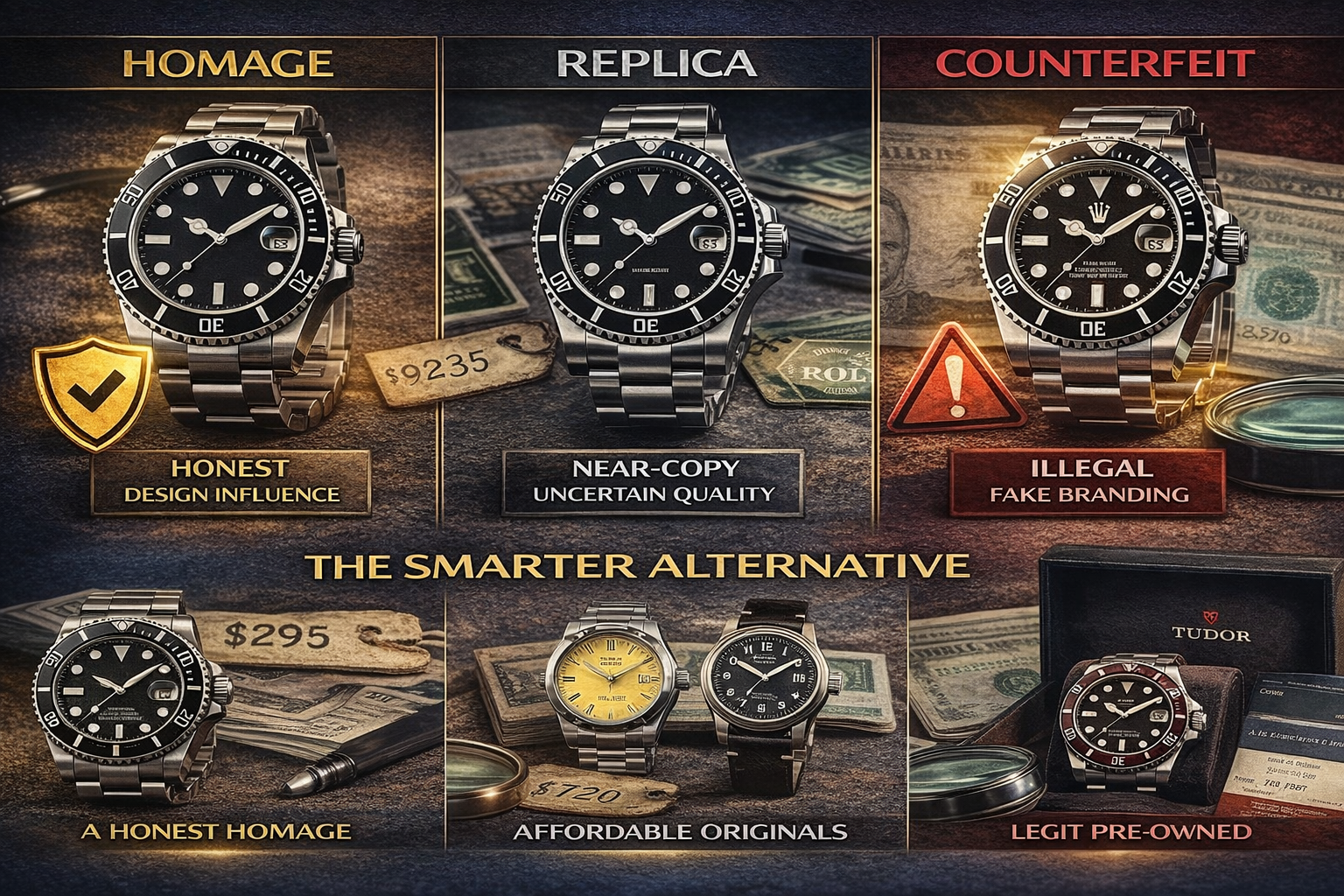 Homage vs Replica vs Counterfeit Watch: What’s the Difference and What Should You Actually Buy?
A lot of watch buyers say they want a “replica” when what they really mean is one of three very different things.
Sometimes they mean a watch that captures the look of a famous model without pretending to be the real thing. Sometimes they mean a near-copy with suspicious wording, vague branding, and uncomfortable legal gray areas. And sometimes they mean a fake watch trying to pass as a Rolex, Omega, Cartier, or Patek Philippe.
Those are not the same category. They do not carry the same risks, and they do not lead to the same ownership experience.
This matters because plenty of first-time buyers are not actually trying to do anything shady. They are simply budget-conscious, attracted to iconic design, and overwhelmed by how loosely these terms get used online. A seller says “homage.” A forum user says “rep.” A marketplace listing says “inspired by.” Another one says “1:1.” Before long, buyers are comparing completely different products as if they belong in the same conversation.
They do not.
If you care about style, value, long-term satisfaction, and avoiding a bad purchase, you need to separate homage, replica, and counterfeit clearly before spending money.
Quick answer
A homage watch takes inspiration from a famous design but does not claim to be the real brand. A replica watch is usually marketed as a close copy of a famous watch and often lives in a murky space that overlaps heavily with fakes. A counterfeit watch is a fake watch pretending to be an authentic branded product. If you actually want a watch you can wear confidently, the safest choices are usually an honest homage, an affordable original design, or a legitimate pre-owned luxury watch. A counterfeit is almost never the smart buy.
Why buyers confuse these three categories
The confusion happens because all three categories exist around the same emotional problem: people like iconic watches, but not everyone wants to spend iconic money.
Someone loves the Rolex Submariner look, the Cartier Santos shape, or the Omega Speedmaster story. They may not be ready to spend thousands, or they may not even know whether that style fits their real life yet. That is a normal buying situation. The problem starts when online sellers blur the language on purpose.
They know that words like “replica,” “homage,” “inspired,” “custom,” “factory,” and “clone” attract attention without always making the product clear. That ambiguity benefits the seller, not the buyer.
The easiest way to stay grounded is to stop thinking only about appearance and start thinking about intent. What is the watch trying to be? What is the seller trying to imply? And what kind of ownership experience are you actually paying for?
What is a homage watch?
A homage watch is a watch that clearly borrows from a famous design language but does not claim to be the original brand.
It may use a similar case profile, bezel style, hand set, dial balance, or overall category feel. A dive watch homage may remind you of a Submariner. A square sports watch homage may nod toward a Santos. A chronograph homage may borrow the mood of a Speedmaster. But the key point is that it is sold under its own brand, with its own name, and without trying to trick you into believing it is the real thing.
That distinction matters.
A good homage says, in effect, “You like this style, here is our version of that idea.” It does not say, “Here is a Rolex, just trust me.”
This is why homage watches exist in a different buying conversation from fakes. They are often bought by people who like a certain look, want to test a style before spending more, or simply do not care about the original brand enough to chase it.
In practical terms, a homage can make sense when the buyer is honest about what they want. If what you really love is the clean daily-wear utility of a dive watch, you may not need a luxury logo at all. In that case, it helps to think about what actually matters in day-to-day ownership, which is exactly the point of Best Everyday Automatic Watch Features: 8 Specs That Matter More Than Marketing.
What is a replica watch?
This is where things get messy.
In casual conversation, “replica” often gets used as a softer, less confrontational word for “fake.” In the actual market, replica usually means a watch designed to copy a famous luxury model as closely as possible. Sometimes sellers show the real brand name. Sometimes they blur the logo in photos, mention “factory version,” or use language like “1:1” or “super clone.” But the intent is usually obvious: the product is trying to imitate the original as closely as possible.
That is very different from a homage.
A homage borrows style. A replica tries to recreate identity.
That identity can include case shape, dial furniture, text layout, bracelet design, color scheme, and even fake paperwork or fake packaging. Some listings stop just short of openly calling the watch genuine. Others go all the way and become direct counterfeits. Either way, the buyer is entering a category built around imitation rather than honest design.
This is why replica watches are rarely a satisfying long-term buy. Even if the watch looks decent in photos, the ownership experience usually comes with one or more of the following problems:
- unclear quality control
- no trustworthy seller support
- misleading specifications
- poor serviceability
- no real resale confidence
- awkwardness when anyone asks what it is
- constant second-guessing about whether it was worth it
That is not a small downside. That is the entire experience.
What is a counterfeit watch?
A counterfeit watch is the clearest category of all: it is a fake watch pretending to be a real branded watch.
If a watch says Rolex on the dial and is not a Rolex, that is counterfeit. If it says Cartier, Omega, Tudor, Patek Philippe, or Audemars Piguet while not actually coming from that brand, it is counterfeit. There is no stylish gray area there. It is not homage. It is not “inspired by.” It is not a clever alternative. It is a fake branded product.
This matters because some buyers try to soften the category with nicer words. They say “mirror copy,” “super rep,” or “high-end replica” as if better finishing somehow changes the core reality. It does not.
A better fake is still a fake.
And from a buyer’s point of view, counterfeit watches create the worst version of this whole category: the most legal risk, the most seller dishonesty, the most confusion, and the least clean ownership experience.
The easiest way to tell the difference
If you want a simple rule, use this one:
- If the watch has its own brand and is not pretending to be the original, it is probably a homage.
- If the watch is trying to look almost exactly like the original and the seller keeps using slippery language like “1:1,” “factory,” or “clone,” it is replica territory.
- If the watch uses the real luxury brand name or logo without actually being from that brand, it is counterfeit.
Once you see the categories that way, most listings become easier to read.
Why people still buy replicas and counterfeits
The obvious answer is price, but that is not the full story.
People buy replicas because they want the visual effect of an expensive watch without paying the real price. Some want to test whether they even like the style. Some want the social signal. Some are curious. Some are simply pulled in by online hype and “surprisingly good” review culture.
But the emotional logic often breaks down once the watch arrives.
A buyer may think, “If this looks 90% the same, why not save the money?” The problem is that watches are not judged only by shape. The ownership experience includes how it feels on wrist, how it ages, how it runs, whether it can be serviced, how you feel wearing it, and whether you trust the thing at all.
That last point matters more than people admit. A watch that looks impressive for ten seconds on Instagram can feel strangely hollow after a week if the whole value proposition rests on pretending to be something else.
A real-world example
Imagine three buyers, all with the same taste.
They all love the Rolex Submariner look: black dial, rotating bezel, solid bracelet, strong everyday presence.
Buyer one buys an honest homage from a known brand. It does not pretend to be a Rolex. It just delivers the dive-watch formula at an affordable price. He wears it happily because he likes the style and had realistic expectations.
Buyer two buys a “1:1 replica” from a seller who promises premium finishing, Swiss-grade feel, and unbelievable accuracy. The watch looks convincing in photos, but once it arrives, the bracelet feels rough, the bezel action is inconsistent, and he is never quite comfortable wearing it around anyone who knows watches. The novelty fades fast.
Buyer three waits six months, adds to the budget, and buys a legitimate pre-owned Tudor or Omega from a reputable seller. It costs more, but the ownership experience feels clean. He can service it, resell it, and wear it without mental friction.
These three buyers started with the same taste. They ended up in very different places because they were not really buying the same kind of product.
What should you actually buy?
This is the question that matters.
In most cases, the best answer is one of these three:
1) Buy an honest homage if you mainly want the style
If what you really care about is the overall aesthetic of a field watch, dive watch, pilot watch, or integrated-bracelet sports watch, an honest homage can be a reasonable buy.
This works best when you are clear that you are buying a design mood, not a luxury brand experience. It is especially sensible if you are still learning your taste and do not want to overspend before knowing what suits you.
For example, someone who is curious about dive watches may be much better served by starting with an honest affordable diver, then deciding later whether they truly want something more expensive. That is often smarter than forcing a rushed luxury purchase or drifting into replica territory. And if you are still refining what kind of sports watch actually fits your life, Tool Watch vs Dress Watch: Which One Fits Your Lifestyle Better? and Dress Watch vs Everyday Watch: What’s the Real Difference and Which Should You Buy First? help clarify the kind of watch you should be chasing in the first place.
2) Buy an affordable original if you want legitimacy without luxury pricing
This is the option many buyers skip too quickly.
Instead of chasing a copy of a Rolex, Cartier, or Omega, you can buy a legitimate watch from a brand that offers real value in your budget. That often leads to a better result because you are buying a coherent product rather than a compromise built around imitation.
If your budget is still modest, Best Automatic Watches Under $300: Affordable & Reliable Picks, Best Automatic Watches Under $500: Premium Value Without Overspending, and Best Swiss Automatic Watches Under $1000: Luxury Feel Without the Luxury Price are all better places to start than any fake-watch rabbit hole.
Those articles matter because they solve the real problem: not “How do I make people think I bought something expensive?” but “What can I buy that is actually good at my budget?”
3) Save and buy authentic pre-owned if you want the real brand experience
If what you actually want is not just the look, but the brand history, finishing, movement, resale confidence, and emotional satisfaction of owning the real thing, then the cleanest answer is simple: wait longer and buy authentic.
That does not always mean buying new. In many cases, buying pre-owned from a trustworthy seller is the more rational move. You get closer to the watch you really wanted, without drifting into replica regret.
This is also where a lot of buyers realize that the “cheaper” route was never really cheaper. A fake or شبه-copy often leads to disappointment, then replacement, then a second purchase anyway. Waiting once is usually better than buying twice.
The emotional trap behind replica buying
Replica culture often sells a fantasy of control.
The pitch is basically this: you can skip the brand premium, beat the system, and get nearly the same thing for a fraction of the price. That idea is attractive because it feels clever. But the ownership experience is usually not clever. It is tense.
You question the quality. You question the seller. You question the movement. You question whether the watch will last. You question whether anyone notices. You question whether you are comfortable explaining it.
That is a lot of mental noise for a product that is supposed to be enjoyable.
A good watch, whether cheap or expensive, should feel simple once it is on your wrist.
Red-flag language buyers should watch for
If you see these phrases in a listing, slow down immediately:
- AAA quality
- 1:1 version
- super clone
- mirror copy
- factory build
- same as genuine
- Swiss style
- custom logo available
- no brand shown for legal reasons
That language almost never leads to a clean buying experience. It usually means the seller is trying to keep the watch attractive while keeping the truth blurry.
And blurry is exactly what you should avoid when buying watches online.
How brand desire changes the decision
Not every buyer wants the same thing, and that is where honesty helps.
If you are drawn to a Cartier Tank or Santos because of design elegance, shape, and the way it changes your overall look, then an unrelated square watch may not scratch the same itch. If you love an Omega Speedmaster because of the story, the layout, and the emotional identity of the model, then a generic chronograph may not feel satisfying either. And if you want a Rolex because of what Rolex specifically represents, no amount of “close enough” usually fixes that.
That is why the smartest question is not “How do I get the look for less?” It is “What part of this watch do I actually care about most?”
If the answer is style, a homage may be enough. If the answer is ownership legitimacy, save for authentic. If the answer is status imitation, that is usually where buyers make their weakest decisions.
A better buying framework
Before buying anything in this space, ask yourself these four questions:
- Do I want the design, or do I want the brand?
- Will I still enjoy this watch if nobody ever mistakes it for the luxury original?
- Am I buying this because it suits my life, or because it helps me imitate a life I do not actually live?
- If this purchase disappoints me, will I end up buying the authentic version later anyway?
Those questions sound simple, but they save money.
Final verdict
Here is the honest answer: homage, replica, and counterfeit watches are not interchangeable, and treating them as if they are usually leads buyers in the wrong direction.
A good homage can be a fair, enjoyable purchase if you genuinely want the style and are comfortable with the brand on the dial. A counterfeit is almost never a smart buy, no matter how persuasive the listing sounds. And replica watches, in practice, usually sit too close to fake-watch culture to offer a clean, satisfying long-term ownership experience.
If you want a watch you can wear comfortably, discuss honestly, and keep without second-guessing, your best options are usually clear: buy a real affordable watch, buy an honest homage, or wait and buy authentic pre-owned.
Everything else tends to create more friction than value.
FAQ
Is a homage watch fake?
No. A homage watch is not fake if it is sold under its own brand and does not claim to be the original luxury watch. It may borrow design language, but it is not pretending to be that brand.
Is a replica the same as a counterfeit?
In everyday use, the terms often overlap. In practice, many replica watches are very close to counterfeit territory because they are designed to imitate a branded original as closely as possible.
Is it wrong to buy a homage watch?
Not necessarily. If you like the design and the brand is honest about what it is selling, a homage can be a reasonable budget choice.
Why do replica watches usually disappoint buyers?
Because they promise visual similarity, but the ownership experience often includes poor quality control, weak support, no clean resale path, and an uncomfortable feeling that the watch is built around imitation rather than honest value.
What is the best alternative to buying a fake luxury watch?
Usually one of three things: an honest homage, a well-made affordable original, or an authentic pre-owned watch from a reputable seller.