GADA Watch Explained: What It Means, Why It Matters, and How to Choose One That Actually Fits Your
GADA Watch Explained: What It Means, Why It Matters, and How to Choose One That Actually Fits Your Life
Some watches are easy to admire.
A GADA watch is supposed to be easy to live with.
That is the whole idea.
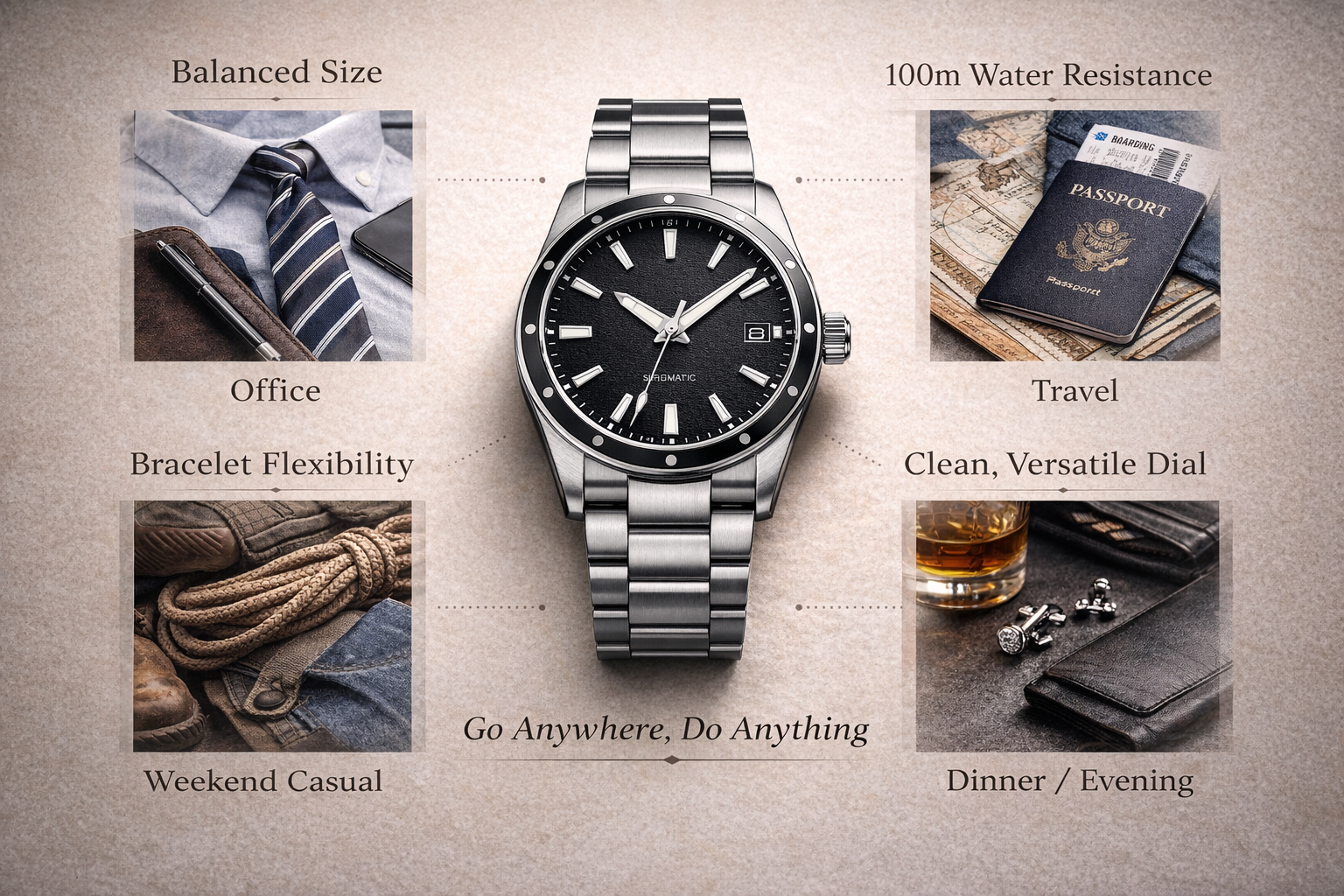
“GADA” stands for Go Anywhere, Do Anything. In watch language, it describes a watch that can move through most of normal life without feeling out of place, underdressed, overdressed, or overly fragile. It is the kind of watch you can wear to work, on weekends, to dinner, while traveling, in the rain, and through the ordinary chaos of real life—and still feel like you chose well.
That is why the term matters.
Because for most buyers, the real goal is not owning the most specialized watch. It is owning the watch that keeps making sense after the excitement of buying it fades.
So here is the practical answer first:
A true GADA watch is not just versatile on paper. It is a watch with balanced size, practical durability, clean styling, good comfort, and enough refinement that it can move across your actual life without asking for constant compromise.
That is the short version.
And that last part matters. A watch can be durable without being GADA. It can be elegant without being GADA. It becomes GADA only when it balances enough things well enough that you keep reaching for it without second-guessing the choice.
If you are still early in the process, it helps to start with What Is an Automatic Watch? Pros, Cons & Who Should Buy One and Best Everyday Automatic Watch Features: 8 Specs That Matter More Than Marketing. But if your real question is what a GADA watch actually is, and how to choose one intelligently, this guide is the practical version.
The short answer: what is a GADA watch?
A GADA watch is a watch that feels appropriate in most real-life situations.
That usually means it can handle:
- daily wear
- commuting
- office or smart-casual settings
- weekends
- travel
- normal weather
- the occasional dressier moment
- the occasional rougher day
A GADA watch is not usually the best watch for every single extreme situation. It is not a formal dress specialist or a hardcore dive specialist. It is the watch that performs well across the widest range of normal life.
That is the point.
It is not about perfection.
It is about breadth without awkward compromise.
Why GADA matters more than buyers think
Because many people do not actually need a highly specialized watch.
They think they do. They buy like they do. But then real life steps in.
A very formal dress watch may look perfect—until you realize most of your week is casual.
A rugged tool watch may seem like the smart practical choice—until you realize it feels too bulky or too sporty in nicer settings.
A minimalist watch may look exactly right in photos—until it starts feeling too limited or too delicate in daily life.
That is where the idea of GADA becomes useful.
It forces a better question:
Not “What looks coolest?”
But “What will still make sense on an ordinary Tuesday, a dinner on Thursday, and a weekend trip on Saturday?”
That is usually the watch worth owning first.
What makes a watch truly GADA?
A lot of brands and buyers use the term loosely. But in real-life ownership, a true GADA watch usually needs to get five things right:
- Balanced styling
- Wearable dimensions
- Practical durability
- Comfort
- Low-friction ownership
If it fails badly at any one of those, it may still be a great watch—but it becomes less convincingly GADA.
1. Balanced styling: the watch cannot lean too hard in one direction
This is the first real requirement.
A GADA watch has to be visually flexible. It cannot feel too formal, too sporty, too tactical, or too fragile-looking. It needs enough neutrality to work with:
- jeans
- knitwear
- business-casual clothing
- simple office clothes
- travel outfits
- the occasional smarter outfit
That usually means:
- a clean dial
- restrained case design
- sensible proportions
- not too much bezel drama
- not too much formality either
A watch that screams “diver,” “dress watch,” or “statement piece” can still be excellent—but it is less likely to be truly GADA.
2. Wearable dimensions: fit matters more than concept
A watch cannot be GADA if it annoys you physically.
That sounds obvious, but many buyers treat versatility like an abstract concept and forget that the watch still has to sit on the wrist correctly.
A good GADA watch usually has:
- moderate case diameter
- reasonable lug-to-lug
- manageable thickness
- enough presence to feel substantial
- but not so much that it becomes limiting
For most buyers, that usually means something in the range of:
- 36mm to 40mm
- with moderate thickness
- and proportions that feel balanced rather than aggressive
This is exactly why fit-related topics matter so much in the GADA conversation. A theoretically versatile watch that wears badly is not versatile in real life. If fit is something you already struggle with, Best Automatic Watches for Small Wrists: What to Look for Before You Buy becomes highly relevant.
3. Practical durability: enough toughness to stop babying it
A GADA watch does not need to be indestructible.
But it does need to be durable enough that you stop treating it like a fragile object. That usually means practical features like:
- decent water resistance
- sapphire crystal
- a reliable movement
- a case design that feels confident in daily use
A watch that makes you nervous about rain, sinks, travel, or ordinary contact is much harder to call GADA.
This is why practicality matters. A watch does not need to survive deep diving or mountain climbing to be GADA. It just needs to be durable enough that you stop asking, “Should I switch watches for this?”
4. Comfort: because GADA only works if you keep reaching for it
Comfort is one of the most underrated parts of the whole idea.
A GADA watch should feel like something you can wear:
- all day
- through mixed situations
- on busy days
- while moving around
- without constant awareness or irritation
That means:
- the case should not feel too tall
- the bracelet or strap should not fight you
- the watch should not feel too heavy for its role
- the overall wearing experience should be easy
This is where strap choice becomes more important than many people expect. A watch can feel far more GADA on bracelet than on leather, or more relaxed and wearable on the right rubber or strap setup. That is why Leather vs Bracelet vs Rubber Strap: How Strap Choice Changes Fit, Style, and Value sits right next to this topic conceptually.
5. Low-friction ownership: the most important GADA trait of all
This is the hidden trait behind the whole concept.
A GADA watch creates fewer interruptions.
It is easy to wear. Easy to read. Easy to trust. Easy to style. Easy to take on a trip. Easy to keep on the wrist when the day changes from one thing into another.
That means the watch should not constantly force decisions like:
- Should I switch to something more formal?
- Is this too sporty for dinner?
- Can I wear this in the rain?
- Is this too thick for today?
- Is this strap wrong for the weather?
The more often you ask those questions, the less GADA the watch really is.
GADA vs everyday watch: are they the same thing?
Almost, but not always.
An everyday watch is usually a watch you can wear often and comfortably. A GADA watch goes one step further. It is not just easy daily wear—it is socially and stylistically flexible enough to keep working across more situations.
So a watch can be:
- a strong everyday watch
without being a true GADA watch
For example:
- a very casual field watch may be a fantastic everyday watch, but a little too rugged or informal to be true GADA for some buyers
- a very sleek minimalist watch may be a good daily office watch, but not quite durable or versatile enough to feel GADA
A true GADA watch usually lives in the overlap between:
- everyday practicality
- and dress-down / dress-up flexibility
That is why it matters as a separate idea.
GADA vs dress watch: where is the line?
A dress watch can feel close to GADA if it is restrained, wearable, and not too fragile-looking. But many dress watches lean too far toward elegance to be fully Go Anywhere, Do Anything.
The difference is usually this:
- Dress watch asks for a more refined setting
- GADA watch can survive refinement, but does not require it
That is why a dress watch can sometimes be part of a GADA wardrobe, but it is not always the best GADA answer. If you want the deeper version of that decision, Dress Watch vs Everyday Watch: What’s the Real Difference and Which Should You Buy First? covers the overlap well.
GADA vs tool watch: are all tool watches GADA?
No.
Many tool watches are great daily watches, but some are too specialized, too bulky, too sporty, or too visually loud to be truly GADA.
A true GADA watch usually borrows some tool-watch logic:
- durability
- legibility
- confidence
- lower-friction ownership
But it avoids feeling too much like specialized equipment.
That means:
- some field watches come close
- some clean divers come close
- some restrained sports watches come close
- some pilot watches do not, because they are too visually specific
- some hardcore divers do not, because they are too large or too sporty
So GADA is not just a feature set. It is a balance.
Real-world buyer case #1: the one-watch buyer
This is the classic GADA buyer.
They want one watch for:
- work
- weekends
- travel
- dinner
- errands
- everyday life
They are not trying to build a six-watch collection. They want one watch that makes sense most of the time.
For this buyer, GADA matters a lot, because buying a watch that is too dressy or too specialized will create friction quickly. The ideal answer is usually a watch that feels:
- clean
- confident
- practical
- not too formal
- not too sporty
This is one of the main reasons GADA watches are so appealing to beginners and budget-conscious buyers alike. They offer more use value.
Real-world buyer case #2: the buyer who dresses smart-casual most of the time
This person does not wear suits daily, but also does not live in gym clothes. Their style lives in the middle:
- chinos
- knitwear
- shirts without ties
- jackets
- good casual shoes
- neat weekend clothes
For this buyer, the best GADA watch is often very easy to identify:
it should look polished enough to feel intentional, but rugged enough not to feel precious.
That middle ground is exactly where the concept works best.
Real-world buyer case #3: the buyer who keeps choosing wrong by going too extreme
This buyer buys a very dressy watch and stops wearing it because daily life is too casual. Then they buy a big sports watch and stop wearing it because it feels too dominant or too limited stylistically.
This is a classic sign that the buyer does not need more extremes. They need better balance.
That is what GADA offers.
It is often not the most exciting watch category emotionally at first—but it is one of the most satisfying over time because it simply keeps working.
What size works best for a GADA watch?
For most people, GADA works best in moderate dimensions.
That usually means:
- 36mm to 39mm for smaller to average wrists
- 38mm to 40mm for average wrists
- thickness that avoids both ultra-slim fragility and heavy sports bulk
- a case that feels modern but not oversized
Very large watches usually struggle to be truly GADA because they become too sporty, too casual, or too dominant. Very small or ultra-dressy watches may struggle because they become too refined or too limited.
Moderation is the whole point.
What strap is most GADA?
For most buyers, bracelet is the safest GADA starting point.
Why?
Because a bracelet usually gives:
- the broadest seasonal versatility
- better resilience in weather
- easier travel use
- stronger all-round wearability
- the option to dress the watch up or down later
A watch on bracelet often starts closer to true GADA than the same watch on leather, because leather can push it dressier and less weather-friendly.
That does not mean bracelet is always the best final answer. Some watches feel great on leather or rubber depending on the lifestyle. But if you are buying one watch and want the broadest base, bracelet is usually the safest first move.
How much water resistance should a GADA watch have?
A true GADA watch should have enough water resistance that normal life does not become annoying.
For many buyers, that means around 100m is the sweet spot.
Why?
Because it usually covers:
- rain
- hand-washing
- everyday wear
- travel confidence
- more active days
- less ownership hesitation
A watch does not need extreme dive capability to be GADA. It just needs enough real-world resilience that you stop treating water like a negotiation. If this part of the decision still feels unclear, Water Resistance Explained for Everyday Watches: 30m vs 50m vs 100m vs 200m — What You Can Actually Do is directly relevant.
What features matter most in a GADA watch?
If you strip away the watch-forum noise, the most important GADA features are usually:
- balanced size
- moderate thickness
- clean but not overly formal styling
- enough water resistance
- sapphire crystal
- strong legibility
- comfortable bracelet or strap
- reliable, easy-to-live-with movement
That is the real checklist.
Not maximum power reserve.
Not the most complicated dial.
Not the most niche brand story.
A GADA watch wins through balance, not excess.
That is why it overlaps naturally with the broader logic in Best Everyday Automatic Watch Features: 8 Specs That Matter More Than Marketing.
How to know if a watch is really GADA for you
This is important, because “GADA” is personal.
A watch may be called GADA online and still not fit your life.
Use this test:
1. Can you wear it with your most common clothes?
Not your ideal wardrobe. Your real one.
2. Can you wear it in light bad weather without stress?
If not, it is less GADA than it sounds.
3. Does it feel too sporty for dinner or too dressy for errands?
If yes, it may lean too far in one direction.
4. Can it stay on the wrist from morning to evening comfortably?
Comfort matters more than concept.
5. Do you keep imagining when to take it off, instead of when to put it on?
That is a strong sign it is not truly GADA for you.
This test is better than a spec sheet because GADA is not just technical. It is behavioral.
What buyers often get wrong about GADA
1. Assuming GADA means boring
Not at all. A good GADA watch is usually one of the hardest things to design well because it has to balance so much.
2. Assuming any sporty watch is GADA
No. Some are too extreme, too bulky, or too casual.
3. Assuming any clean watch is GADA
No. Some are too dressy, too delicate-looking, or too limited in daily resilience.
4. Thinking GADA means one perfect watch for every imaginable situation
It does not. It means one watch that works well across most normal life, not every extreme edge case.
5. Choosing the idea of versatility over actual fit
A watch that wears badly is never truly GADA, no matter how balanced the concept sounds.
Which buyers should care most about GADA?
Three groups especially benefit from thinking this way.
First-time buyers
Because they are most likely to overbuy a concept and underbuy a lifestyle fit.
One-watch buyers
Because they need the watch to solve more than one role.
Budget-conscious buyers
Because the broader the real-life usability, the more value they get from the purchase.
That is exactly why GADA logic works so well with budget-focused pages like Best Automatic Watches Under $300: Affordable & Reliable Picks, Best Automatic Watches Under $500: Premium Value Without Overspending, and Best Swiss Automatic Watches Under $1000: Luxury Feel Without the Luxury Price.
FAQ
What does GADA mean in watches?
GADA stands for “Go Anywhere, Do Anything.” It refers to a watch that is versatile enough to handle most normal-life situations without feeling out of place.
What makes a watch a true GADA watch?
A true GADA watch usually combines balanced styling, wearable dimensions, practical durability, comfort, and easy daily ownership.
Is a GADA watch the same as an everyday watch?
Not exactly. A GADA watch is usually an everyday watch with stronger social and style flexibility across more situations.
Is a dress watch a GADA watch?
Sometimes, but not always. Many dress watches are too refined or too delicate-looking to be true GADA for most people.
Is a dive watch a GADA watch?
Some are, especially restrained and wearable ones. Others are too bulky or too sporty to be truly GADA.
What is the best size for a GADA watch?
For most buyers, moderate sizes around 36mm to 40mm work best, depending on wrist size and overall case proportions.
Final verdict
If you want the simplest possible answer:
A GADA watch is a watch that keeps making sense.
It is not the most formal watch.
It is not the toughest specialist watch.
It is not the most dramatic watch.
It is the watch that fits into real life well enough that you stop thinking about categories and just keep wearing it.
That is why GADA matters.
Because most people do not actually need a watch for one perfect scenario.
They need a watch that can move through many normal scenarios without becoming the wrong choice.
And when a watch does that well—fit, comfort, durability, styling, and ease all working together—you usually do not just admire it.
You rely on it.