- Home
- Box, Papers, Warranty, and Service History: What Really Matters When Buying Pre-Owned?
Box, Papers, Warranty, and Service History: What Really Matters When Buying Pre-Owned?
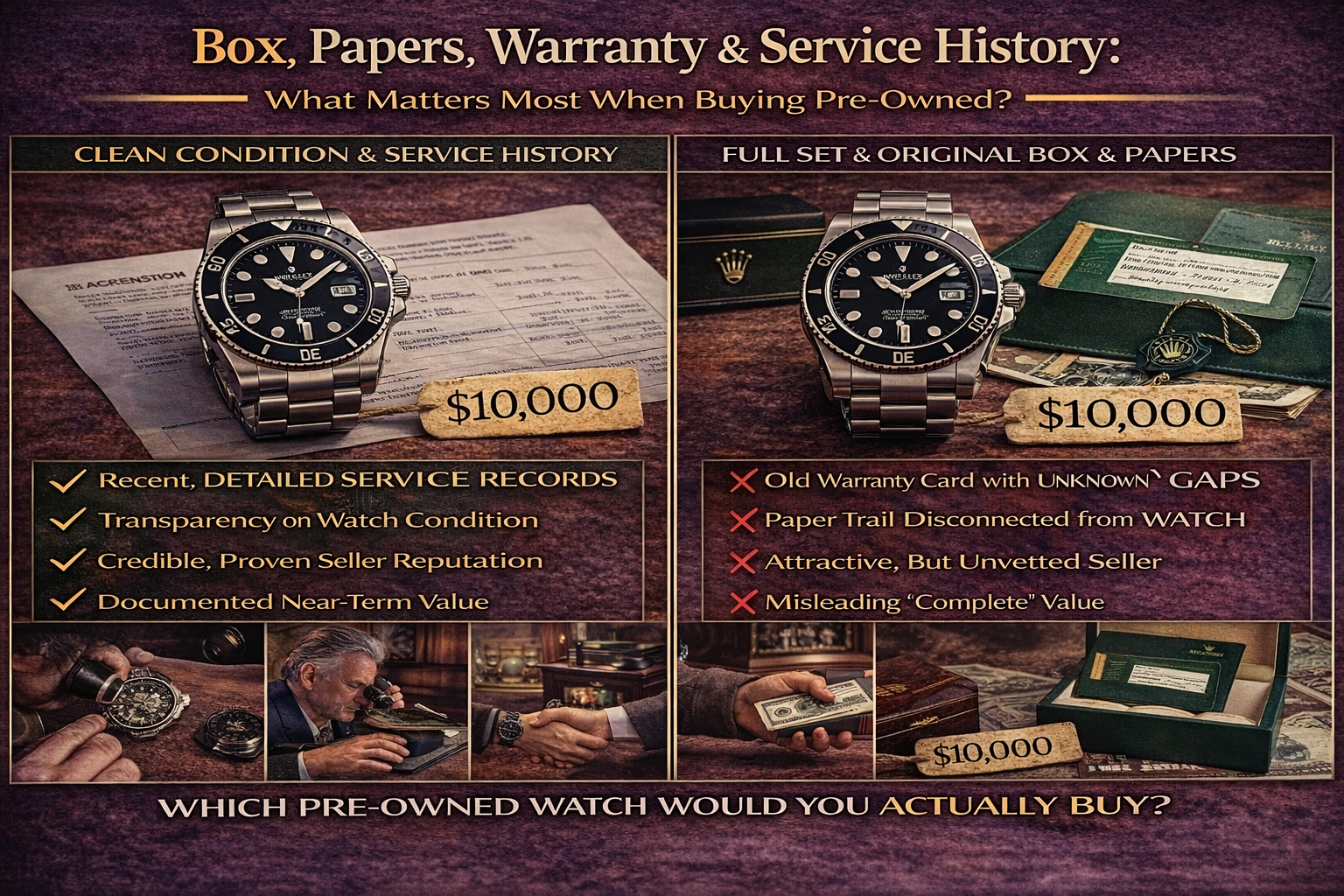
If you spend enough time looking at pre-owned watches, you start seeing the same phrase everywhere: full set.
Box. Papers. Hang tags. Booklets. Warranty card. Maybe even the spare links, receipt, travel pouch, or outer sleeve.
And the longer you browse, the easier it becomes to assume that the watch with the most accessories is automatically the smartest buy.
Usually, it is not.
That does not mean box and papers are useless. They are not. In some cases they help resale, buyer confidence, and model matching. But a lot of first-time pre-owned buyers give them far too much power. They end up overpaying for packaging, underchecking condition, and treating paperwork as if it replaces judgment.
It does not.
If you are buying a pre-owned Rolex, Omega, Cartier, Tudor, or another luxury watch, the real question is not “Does it come with everything?” The real question is “Which details actually protect me, improve ownership, and matter once the novelty wears off?”
That is where this article helps.
Quick answer
When buying pre-owned, service history, seller quality, real condition, and a clear return or inspection policy usually matter more than the original box. Papers can be helpful, especially for newer or more liquid models, but they do not guarantee authenticity or good condition. Warranty only matters if you understand exactly what it covers. In real ownership, a clean watch with honest condition and documented service is often a better buy than a “full set” watch with vague history and hidden issues.
Why buyers obsess over box and papers in the first place
The answer is simple: they feel safe.
A box looks official. Papers feel like proof. A warranty card sounds reassuring. A complete set feels more premium than a watch-only listing, especially online where buyers cannot handle the watch in person.
That emotional reaction is completely understandable.
The problem is that these extras often create a false sense of security. A box does not tell you whether the watch was over-polished. A warranty card does not tell you whether the movement is healthy today. And papers certainly do not tell you whether the seller is trustworthy.
This is especially important in a market where buyers are already nervous about authenticity, hidden service costs, and whether they are overpaying for the wrong example. That is why practical ownership basics still matter more than accessories. If you want the maintenance side of that reality check, How Often Should You Service an Automatic Watch? Intervals, Costs, Warning Signs & What to Expect and How Long Do Automatic Watches Last? Lifespan, Durability, and What Really Determines Longevity are both useful context before you start paying a premium for cardboard and booklets.
Box: nice to have, rarely the deciding factor
The original box is the most over-romanticized part of many pre-owned listings.
Yes, it is nice. It makes the watch feel more complete. It can improve presentation if you are gifting it, and it may help a little when you resell later. But in actual ownership, the box does very little for you.
It does not improve timekeeping.
It does not improve condition.
It does not reduce future service costs.
It does not make a poor buy into a good one.
That is why experienced buyers often treat the box as a bonus rather than a foundation. If two listings are otherwise equal, of course the boxed example may be preferable. But if the “full set” watch has weaker condition, unclear service history, or a less trustworthy seller, the box should not rescue it.
A simple way to think about it is this: the box helps the presentation of the watch, not the quality of the watch.
Papers: useful, but not magical
Papers matter more than the box, but not for the reason many buyers assume.
A warranty card, certificate, or dated sales paper can help verify that the watch matches a specific original sale, reference, or retailer history. That can be valuable, especially on newer watches or highly liquid models where resale confidence matters. It can also help you feel more comfortable that the watch began life as what the seller says it is.
But papers are not the same thing as authentication.
This matters a lot.
First, papers can be missing even on perfectly authentic watches. That is common, especially with older pieces or watches that passed through several owners.
Second, counterfeit and replica culture has become good enough that fake paperwork also exists. That means “comes with papers” is not the same as “therefore genuine.” It is just one data point.
This is especially relevant if you are buying brands that attract heavy counterfeit attention. A fake Rolex with fake papers is still fake. A counterfeit Cartier with a copied card is still counterfeit. Papers help when they support a broader credible story. They do not replace that story.
That is one reason buyers should never treat documents as a substitute for condition checks, seller evaluation, or basic common sense.
Warranty: the most misunderstood part of pre-owned buying
A lot of buyers see the word warranty and relax too early.
That is dangerous, because not all warranties mean the same thing.
There is a huge difference between:
- remaining manufacturer warranty,
- a dealer warranty,
- a short in-house movement warranty,
- and vague listing language like “guaranteed to work.”
Those are not equal.
A remaining manufacturer warranty can be genuinely valuable, especially on a newer watch. A reputable dealer warranty can also be helpful if the dealer is known, responsive, and clear about what is covered. But many pre-owned warranties are much narrower than buyers expect.
Some cover only catastrophic movement failure. Some do not cover water resistance. Some do not cover regulation, magnetism, or wear-related issues. Some sound reassuring until you read the fine print and realize they are mostly marketing.
That is why the right question is not “Does it come with a warranty?”
It is “What exactly does the warranty cover, for how long, and through whom?”
If accuracy is part of that concern, Are Automatic Watches Accurate? Real-World Tolerances, Why They Drift & How to Improve Accuracy is a useful baseline, because some buyers mistake normal mechanical variation for a warranty-worthy defect, while others ignore genuine warning signs because the listing felt reassuring.
Service history: often the most valuable document in the whole deal
If there is one thing pre-owned buyers should value more, it is service history.
A real service receipt, service invoice, pressure test record, or watchmaker note often tells you far more about the current ownership value of the watch than the original box ever will.
Why? Because service history speaks to the watch as it exists now, not just how it was sold years ago.
That matters tremendously.
A pre-owned watch with documented recent service, healthy running condition, and honest notes from a professional often represents a better real-world purchase than a full-set watch with no idea when it was last opened, regulated, or pressure-tested.
This is especially true for watches you actually plan to wear rather than store.
Service history can tell you:
- whether the watch has been maintained responsibly,
- whether seals or gaskets were replaced,
- whether water resistance was tested,
- whether timing was checked,
- whether the watch has already absorbed some near-term ownership cost you would otherwise inherit.
That is practical value, not just emotional value.
And if the seller says a watch is suddenly running erratically, that does not always mean disaster. Sometimes something as simple as magnetism can change how a watch behaves, which is why Watch Magnetism: Signs Your Watch Is Magnetized, How to Test It is useful context when evaluating seller claims and movement behavior.
What matters most depends on the age of the watch
This is where buyers can get smarter very quickly.
A five-year-old watch and a twenty-year-old watch should not be evaluated with the same priorities.
On a newer pre-owned watch, papers often matter more because they support recent provenance, warranty continuity, and easier future resale. On an older pre-owned watch, service history, original condition, and seller honesty usually start to matter more than accessory completeness.
That is because older watches live in a more complicated world. Boxes get lost. Papers disappear. Owners change. Service becomes a larger part of the story. And in many cases, what you really want is not “complete packaging.” You want an honest watch that has not been abused.
A buyer who understands that distinction usually buys better.
Brand by brand, the balance can shift
This is where pre-owned buying becomes more nuanced.
With Rolex, papers often carry more weight because the market is so liquid and buyer expectations are so established. A complete set can help resale confidence, and many buyers feel better paying strong money when the watch comes with matching documentation. That said, even with Rolex, correct condition and seller trust still matter more than accessories alone.
With Omega, buyers are often better served by focusing on condition, bracelet state, service history, and whether the watch fits their life. Omega buyers can sometimes overfocus on package completeness when the real ownership difference lies in movement health and wearability.
With Cartier, especially on style-driven pieces, case condition, polishing quality, strap or bracelet state, and overall elegance on the wrist can matter more than many first-time buyers expect. A Cartier that wears beautifully and has been honestly cared for is often a stronger purchase than a “full set” example that looks tired in person.
With Tudor, buyers often care about getting a solid, modern, wearable sports watch that feels trustworthy and easy to own. In those cases, service clarity and overall condition often tell you more than the packaging does.
In other words, brand culture changes the emphasis a little, but it does not overturn the basic truth: the watch itself still matters more than the accessories around it.
The most common bad trade buyers make
Here is the classic mistake:
A buyer chooses the “full set” example because it looks more official, even though the watch-only example has cleaner condition, better recent service, and a more trustworthy seller.
That trade is often wrong.
Not always, but often.
It happens because box and papers are easy to understand. Service records, case geometry, bracelet wear, and seller credibility require more thought. One feels simple. The other feels like work.
But the work is where the value lives.
A pre-owned watch with an original box and tired internals is still a tired watch. A pre-owned watch with no box but excellent condition, clear running history, and recent service can be a far better ownership experience from day one.
A real-world example
Imagine two pre-owned Omega listings at similar prices.
The first is a “full set” with original box, warranty card, booklets, and hang tag. It looks attractive in photos, but the seller cannot say when it was last serviced, offers only vague accuracy language, and has no recent pressure test record.
The second comes watch-only, but the seller has a recent service invoice, a timing screenshot, a pressure test result, and honest photos showing light wear.
A first-time buyer will often feel safer with the first listing.
A smarter buyer often chooses the second.
Why? Because the second seller is giving you information about the watch you are actually receiving today, not just the accessories it happened to leave the boutique with years ago.
That is the difference between buying a story and buying a watch.
What actually matters most in real ownership
If you are going to wear the watch regularly, the practical hierarchy is usually clearer than buyers think.
The most important things are:
- the watch is authentic,
- the seller is credible,
- the condition is honestly represented,
- the running state is healthy,
- the service situation is clear,
- and you have some reasonable protection if the listing is misleading.
After that, papers help.
After that, the box helps a little.
That order may not sound glamorous, but it saves money.
And if your plan is to actually wear the watch, not just resell it, then maintenance reality matters more than packaging every single time. That is why How to Maintain an Automatic Watch: Daily Wear, Storage & Servicing belongs in the conversation too. A pre-owned watch is not a static object. It is something you are inheriting into your own routine.
What matters more for collectors, and what matters more for wearers
This is a useful distinction.
If you are buying as a collector, especially with future resale in mind, then papers and full-set completeness may matter more. Not because they make the watch better, but because they make the market easier later.
If you are buying as a wearer, service history, current condition, bracelet state, and seller transparency usually deserve more weight. Those things determine whether the watch feels satisfying next month, not just what it might list for later.
Most first-time buyers think they are buying like collectors. In reality, many are buying like wearers. They just do not realize it yet.
That is why it helps to decide what kind of owner you actually plan to be before overpaying for accessories you may barely care about once the watch is on your wrist.
One more thing: paperwork does not fix a bad fit
This sounds obvious, but it gets missed all the time.
A full-set watch that does not suit your wrist, wardrobe, or lifestyle is still the wrong watch.
That is why all the normal buying decisions still matter: size, thickness, bracelet feel, visual balance, and overall daily wearability. Papers will not make an oversized watch feel elegant. A warranty card will not make an awkward bracelet suddenly fit.
If you need to reset around that side of the decision, Automatic Watch Size Guide: 36mm vs 38mm vs 40mm vs 42mm — What Actually Fits Your Wrist? and Bracelet Watch vs Leather Strap Watch: Which One Is Better as Your First Automatic? are both more relevant to pre-owned buying than they first appear.
A simple way to rank a pre-owned listing
If you feel yourself getting distracted by box and papers, use this filter:
First, ask whether the watch itself is the right reference, size, and condition.
Then ask whether the seller sounds credible and transparent.
Then ask whether the service situation makes sense.
Then ask whether the return or inspection terms protect you.
Only after that should you start deciding how much extra the box and papers are truly worth to you.
That sequence alone will save a lot of buyers from overpaying for the wrong listing.
Final verdict
When buying pre-owned, box and papers are helpful, but they are not the center of the decision.
The center of the decision is still the watch:
its condition, its service status, its authenticity, its seller, and whether the ownership story makes sense right now.
Papers can support a purchase.
Warranty can help if it is real and clear.
The box can improve presentation and maybe resale.
But service history often does more for actual ownership than any of them. And a trustworthy seller with honest documentation is usually worth more than a full set wrapped around a vague watch.
So if you want to buy pre-owned intelligently, remember this:
Do not buy the packaging first.
Do not buy the words first.
Do not buy the comfort of a “full set” first.
Buy the watch first. Then decide whether the extras are worth the premium.
That is how strong pre-owned purchases usually get made.
FAQ
Are papers necessary when buying a pre-owned luxury watch?
Not always. Papers are useful, especially for newer watches and resale confidence, but an authentic, well-maintained watch without papers can still be a very good buy.
Is box or papers more important?
Papers are usually more important than the box because they can support provenance and future resale. But neither matters more than condition, seller quality, and service clarity.
Does service history matter more than box and papers?
In many real-world ownership situations, yes. Service history often tells you more about what you are actually buying today.
Can fake watches come with fake papers?
Yes. That is why papers should never be treated as automatic proof of authenticity.
Should I pay extra for a full set?
Sometimes, yes, but only after you are sure the watch itself is strong. A full set can justify a premium, but not if the underlying watch is weaker than a cleaner watch-only example.