Black Dial vs White Dial Watch: Which One Is More Versatile for Everyday Wear?
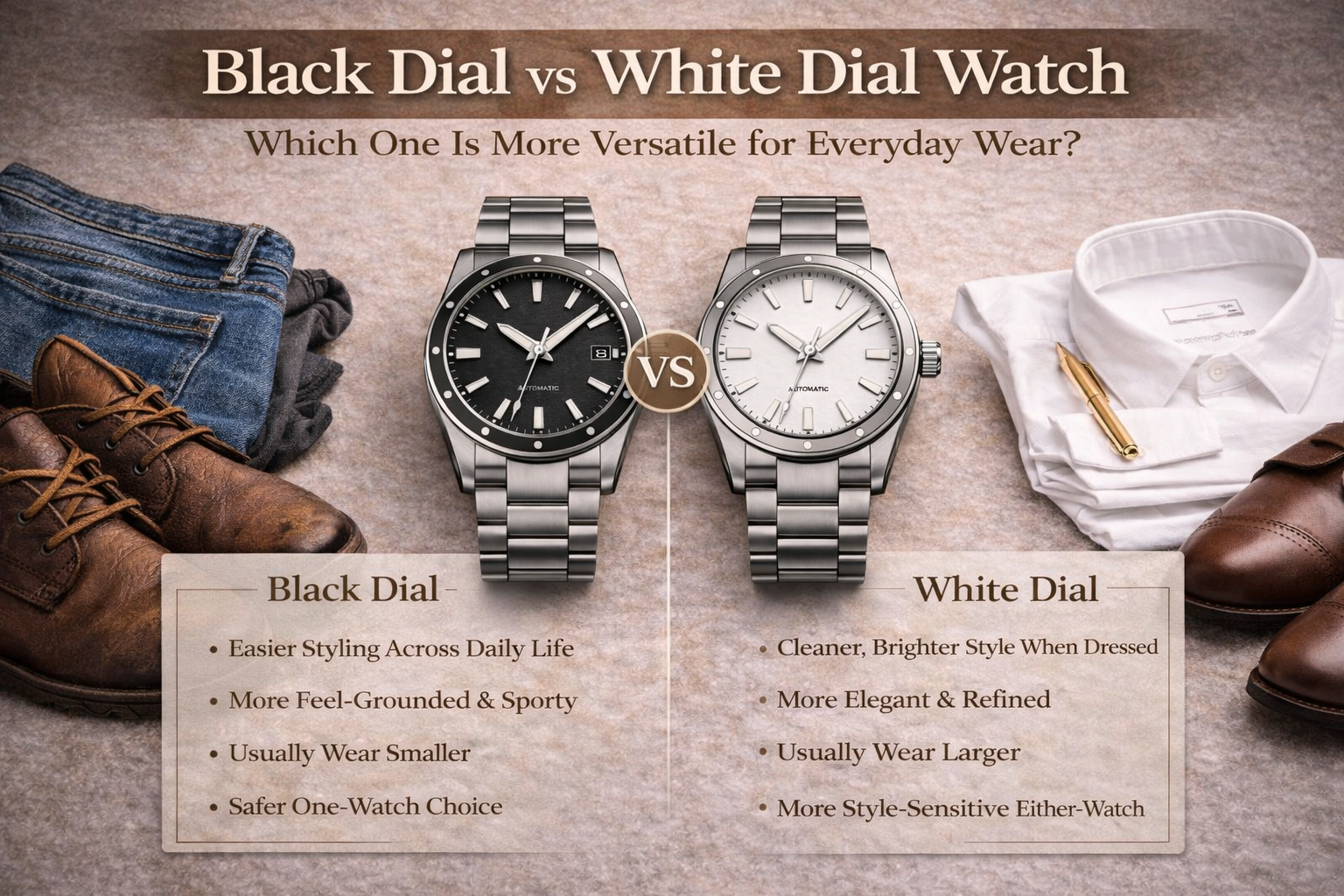
Black Dial vs White Dial Watch: Which One Is More Versatile for Everyday Wear?
Some watch choices are technical.
This one is emotional—but it still affects daily wear more than most buyers expect.
A black dial and a white dial can belong to the same watch, with the same case, same movement, same bracelet, and same price. But once that watch is on the wrist, the personality changes immediately. One feels sharper, sportier, and more grounded. The other feels cleaner, brighter, and often more refined.
That is why black dial vs white dial is not a trivial question.
Because if you are buying one main watch, dial color affects:
- how the watch fits your wardrobe
- how formal or casual it feels
- how readable it looks
- how quickly it starts feeling “right” in daily life
So here is the practical answer first:
For most buyers, a black dial is more versatile for everyday wear because it hides visual contrast better, feels easier in casual settings, and usually works more naturally as a one-watch choice. A white dial can still be extremely versatile—but it usually feels dressier, cleaner, and more style-sensitive.
That is the short version.
The better answer depends on whether you want your watch to feel more like a dependable daily companion or a cleaner, more refined design object.
If you are still working through the basics, it helps to start with What Is an Automatic Watch? Pros, Cons & Who Should Buy One and Best Automatic Watches for Beginners: Top Picks & Buying Tips. But if your real question is which dial color works better in real life, this guide is the practical version.
The short answer: what is the real difference?
The simplest way to think about it is this:
- Black dial = easier daily versatility
- White dial = cleaner elegance
A black dial usually feels:
- more casual
- more grounded
- more sporty
- easier to pair with mixed outfits
- more forgiving as a one-watch choice
A white dial usually feels:
- brighter
- cleaner
- more refined
- more open visually
- slightly more dress-leaning
That does not mean black is always better or white is always dressy. It means the visual tone of the watch shifts in predictable ways.
And for everyday wear, those shifts matter.
Why dial color matters more than buyers think
Because dial color is the part of the watch you look at all the time.
It shapes:
- first impression
- legibility
- how big the watch appears
- how much the watch stands out
- whether it feels more formal or more relaxed
Two watches with identical specs can wear very differently just because one has a black dial and the other has a white dial.
That is why this decision often ends up mattering more than tiny technical upgrades. The dial color changes the mood of the watch every single day.
Black dial vs white dial: the real-life comparison
| Category | Black Dial | White Dial |
|---|---|---|
| Everyday versatility | Usually stronger | Strong, but slightly more style-dependent |
| Casual wear | Excellent | Good |
| Dressier feel | Medium | Usually stronger |
| Visual sharpness | Strong | Clean, bright |
| Perceived size | Often wears slightly smaller | Often wears slightly larger |
| Readability | Often excellent with strong hands | Excellent when contrast is good |
| One-watch safety | Usually safer | Strong, but more taste-sensitive |
| Best for | Daily wear, sporty-casual versatility | Clean style, refined everyday wear |
That table gets to the point fast.
If you want the safer broad-answer choice, black usually wins.
If you want cleaner visual elegance, white becomes very attractive.
Why black dials usually feel more versatile
Because black dials disappear into more situations.
A black dial watch usually feels at home with:
- jeans
- T-shirts
- casual jackets
- knitwear
- office-casual clothing
- travel outfits
- mixed-weather daily wear
It also tends to absorb visual noise better. The watch feels more grounded and less attention-seeking, even when the case itself is sporty.
That is one reason black dials work so well as first watches and one-watch collection candidates. They tend to create fewer styling conflicts.
They are simply harder to make look wrong.
Why white dials feel so good when they work
Because they feel clean in a way black dials usually do not.
A white dial often makes a watch feel:
- fresher
- more open
- more elegant
- more intentional
- more visually crisp
That brightness can be incredibly appealing, especially on watches that lean dressy or restrained. A white dial can make a modest watch look more refined just by increasing the sense of cleanliness and balance.
This is why white dials often feel very right on more elegant watches, including the kind of styles buyers often explore in Best Automatic Dress Watches Under $1000: Elegant Picks for Formal Style.
Which one is better for everyday wear?
For most people, black dial.
That is the simplest everyday answer.
Why?
Because a black dial usually:
- feels less fragile stylistically
- blends more easily into mixed wardrobes
- handles casual settings better
- still works in smarter settings
- usually looks more natural on sporty and practical watches
A white dial can absolutely work every day. But it usually asks for a little more intentionality from the owner. It tends to feel more like a choice. A black dial tends to feel more automatic.
That is why black usually wins on pure versatility.
Which one looks better with casual clothes?
Usually, black dial.
Black dials naturally suit:
- denim
- sneakers
- outerwear
- field-style clothing
- casual office clothes
- travel wear
They usually feel more relaxed and more integrated into everyday wardrobes.
That is one reason black dials are so common on sportier everyday watches and field-oriented pieces. If your taste leans rugged or practical, that same logic overlaps with watches in Best Automatic Field Watches Under $1000: Rugged, Minimal & Built to Last.
Which one looks better with dressier clothes?
Usually, white dial.
A white dial tends to feel:
- cleaner
- lighter
- more elegant
- more refined in shirts and tailoring
- more natural in dress-leaning settings
That does not mean a black dial cannot dress up. It can. But if you are comparing equally restrained watches, the white dial often feels a little more graceful and a little more formally polished.
This is especially true when paired with leather.
Which one is better as a first watch?
For most buyers, black dial is safer.
A first watch usually needs to do more than the buyer expects:
- work
- weekends
- casual evenings
- travel
- different weather
- mixed outfits
Black handles that range more easily.
A white dial can still be a brilliant first watch, especially for someone whose wardrobe is cleaner and more refined. But if the buyer is unsure and wants the lower-risk answer, black is usually the better default.
That is one reason black dials show up so naturally in beginner-focused everyday recommendations like Best Automatic Watches by Budget: $300 vs $500 vs $1000 — How to Choose the Right One.
Which one feels more expensive?
This is subjective, but there is a pattern.
White dial often feels more refined
A good white dial can make a watch feel:
- cleaner
- more elegant
- more architectural
- more dress-adjacent
- more visually “premium” in a quiet way
Black dial often feels more serious
A good black dial can make a watch feel:
- more purposeful
- more grounded
- more robust
- more tool-like
- more modern in a practical sense
So white often feels more refined. Black often feels more capable.
Neither is better. They just project different kinds of value.
Readability: which one wins?
This depends on execution more than color alone.
A white dial with dark hands can be extremely readable.
A black dial with bright markers and hands can also be extremely readable.
That said, the practical difference is often this:
- White dial readability feels cleaner
- Black dial readability feels stronger
White dials can feel airy and easy when the contrast is good. Black dials often feel more assertive and legible in a stronger, more instrument-like way.
In everyday use, both can be excellent. This is one area where design execution matters more than the raw color choice.
Which one wears larger?
Usually, white dial.
This is one of the most overlooked differences.
A white dial often makes the watch feel:
- more open
- visually wider
- slightly larger on the wrist
- brighter and more present
A black dial often makes the watch feel:
- slightly more compact
- more contained
- a bit smaller visually
- easier to wear on smaller wrists
That is important for buyers who are already close to the edge of what their wrist can comfortably wear. If fit is a real concern, especially on the smaller side, black dial often gives you a little more visual forgiveness. That connects directly with the logic in Best Automatic Watches for Small Wrists: What to Look for Before You Buy.
Which one ages better?
For most people, black dial ages more easily.
Not because it is more beautiful, but because it is harder to outgrow in normal daily life.
A black dial tends to stay relevant because:
- it works with more outfits
- it keeps feeling practical
- it usually remains appropriate as your routine changes
- it does not rely as much on a specific aesthetic mood
A white dial can age beautifully too—but it usually does so when the owner truly loves clean, refined visual language. If that taste is strong and stable, white can be just as satisfying long-term.
So the honest answer is:
- black usually ages better for the average owner
- white can age just as well for the right owner
Real-world buyer case #1: the one-watch buyer
This buyer wants one automatic watch for:
- office
- weekends
- travel
- dinner
- daily life
For this person, black dial usually makes more sense.
Why?
Because the watch needs to survive more types of clothing and more types of situations. A black dial makes that easier. It looks natural in more casual settings without becoming unusable in smarter ones.
This is where black’s quiet flexibility really starts to matter.
Real-world buyer case #2: the office-smart buyer
This buyer wears:
- shirts
- knitwear
- cleaner trousers
- loafers or smarter shoes
- a more refined casual wardrobe
For this person, white dial becomes much more attractive.
Why?
Because their clothing already supports the cleaner, brighter feel. In that environment, a white dial can feel more intentional and more polished than black.
This is the kind of buyer who may find black a little too safe and white a little more satisfying.
Real-world buyer case #3: the sporty daily wearer
This buyer likes practical watches and wants something that feels active, confident, and straightforward. Maybe they are already looking at field watches, casual sports watches, or dive-adjacent pieces.
For this person, black dial almost always feels more natural.
It supports the practical identity of the watch instead of softening it.
That is also why black dials feel especially strong in more rugged categories, including many in Best Automatic Dive Watches Under $1000: Durable, Reliable & Built for Adventure.
Which one is better for a GADA-style watch?
Usually, black dial has the edge.
A Go Anywhere, Do Anything-style watch needs to feel natural in more situations with less thought. Black dials tend to do that better because they:
- adapt more easily
- feel more grounded
- handle casual life better
- still dress up reasonably well
A white dial can still work beautifully in a GADA role, especially if the watch design is balanced and the owner leans refined. But if you want the lowest-risk answer for broad daily versatility, black usually wins.
Which one is better on bracelet vs leather?
This is a useful practical distinction.
Black dial on bracelet
Often feels:
- sporty
- modern
- dependable
- most naturally everyday-ready
Black dial on leather
Can feel:
- more vintage
- more restrained
- more style-specific
White dial on bracelet
Often feels:
- crisp
- dressy-sporty
- clean and modern
White dial on leather
Often feels:
- elegant
- classic
- more overtly refined
This is why strap choice can push the dial color in different directions. If you are still thinking through that side of ownership, Leather vs Bracelet vs Rubber Strap: How Strap Choice Changes Fit, Style, and Value sits very naturally next to this topic.
Which one gets boring faster?
This depends on taste, but there is a common pattern.
White dial can feel “too clean” over time
Especially if the owner actually wanted stronger character or more contrast.
Black dial can feel “too safe” over time
Especially if the owner wanted something brighter or more elegant.
But in general, black dials are a bit less risky because they are less style-sensitive. White dials are often more rewarding when they work—but slightly easier to get wrong for the wrong owner.
What buyers often get wrong
1. Assuming black is always sporty and white is always dressy
Not always. The case, hands, markers, and strap change the result a lot.
2. Ignoring how much dial color affects apparent size
This matters more than many buyers realize.
3. Choosing white because it looks premium in product photos
It may still be right, but buyers should ask whether it suits their real wardrobe.
4. Choosing black only because it feels safer
Safe is often smart—but not if you truly prefer brighter, cleaner design.
A quick practical test before you buy
Ask yourself these four questions:
1. What do I wear most often?
Casual-heavy wardrobes usually lean black. Cleaner dressier wardrobes can lean white more easily.
2. Do I want the watch to blend in, or brighten the wrist?
Blend in points toward black. Brighten the wrist points toward white.
3. Am I already close to the upper limit of watch size for my wrist?
If yes, black may wear more comfortably visually.
4. What matters more to me: flexibility or crisp elegance?
Flexibility points toward black. Crisp elegance points toward white.
That usually gives the answer fast.
Which one should most buyers choose?
Here is the most honest recommendation.
Choose black dial if:
- you want the safest everyday choice
- this will be your main or only watch
- your wardrobe is mixed or casual-heavy
- you want stronger daily versatility
- you prefer a more grounded, practical feel
Choose white dial if:
- you love cleaner, brighter design
- your wardrobe is more refined
- you want the watch to feel fresher and more elegant
- you do not mind slightly more style-specific versatility
- visual cleanliness matters more than maximum flexibility
If you are unsure
Choose black dial.
That is usually the lower-risk everyday answer.
FAQ
Is a black dial or white dial watch more versatile?
For most people, a black dial watch is more versatile because it works more naturally across casual and mixed daily settings.
Is a white dial watch dressier?
Usually, yes. A white dial often feels cleaner, brighter, and more refined, especially on restrained watch designs.
Do black dials wear smaller?
Usually, yes. Black dials often make a watch feel slightly more compact, while white dials can feel more open and visually larger.
Is a white dial good for everyday wear?
Absolutely. A white dial can be excellent for everyday wear, especially if your style is clean, refined, or office-smart. It is just a little more taste-sensitive than black.
Which dial color is better for a first watch?
For most buyers, black is the safer first watch choice because it is easier to style and more forgiving in varied daily life.
Which one ages better, black dial or white dial?
For the average owner, black often ages more easily. For the right owner who loves clean design, white can age just as well.
Final verdict
If you want the simplest possible takeaway:
- Black dial is usually more versatile
- White dial is usually more elegant
- Black is the safer one-watch choice
- White is the cleaner style-led choice
That is the real answer.
Not which one is objectively better.
Not which one looks best in a product shot.
Not which one wins a forum argument.
The real question is:
Do you want your watch to adapt more easily, or look cleaner when it does?
If you want easier versatility, choose black dial.
If you want brighter elegance and cleaner visual impact, choose white dial.
And for most people buying one main everyday watch,
black is still the safer choice.