Best Rolex Datejust Configurations: Fluted vs Smooth, Jubilee vs Oyster (What Actually Looks Right?)
Most people do not buy the wrong Rolex Datejust because they chose the wrong size.
They buy the wrong Datejust because they chose the wrong configuration.
That is the trap.
They know they want a Datejust. They know roughly whether they want 36 or 41. They know they like blue, black, silver, or white. But then they get stuck in the part that actually determines whether the watch feels right on the wrist:
fluted or smooth?
Jubilee or Oyster?
And that is where a lot of buyers quietly go wrong.
Because the Datejust is one of those watches where tiny choices completely change the personality. Rolex itself still treats the Datejust as a platform with many aesthetic expressions, and its official model finder shows how much variation exists across sizes, metals, bezels, bracelets, and dials.
The short version is this:
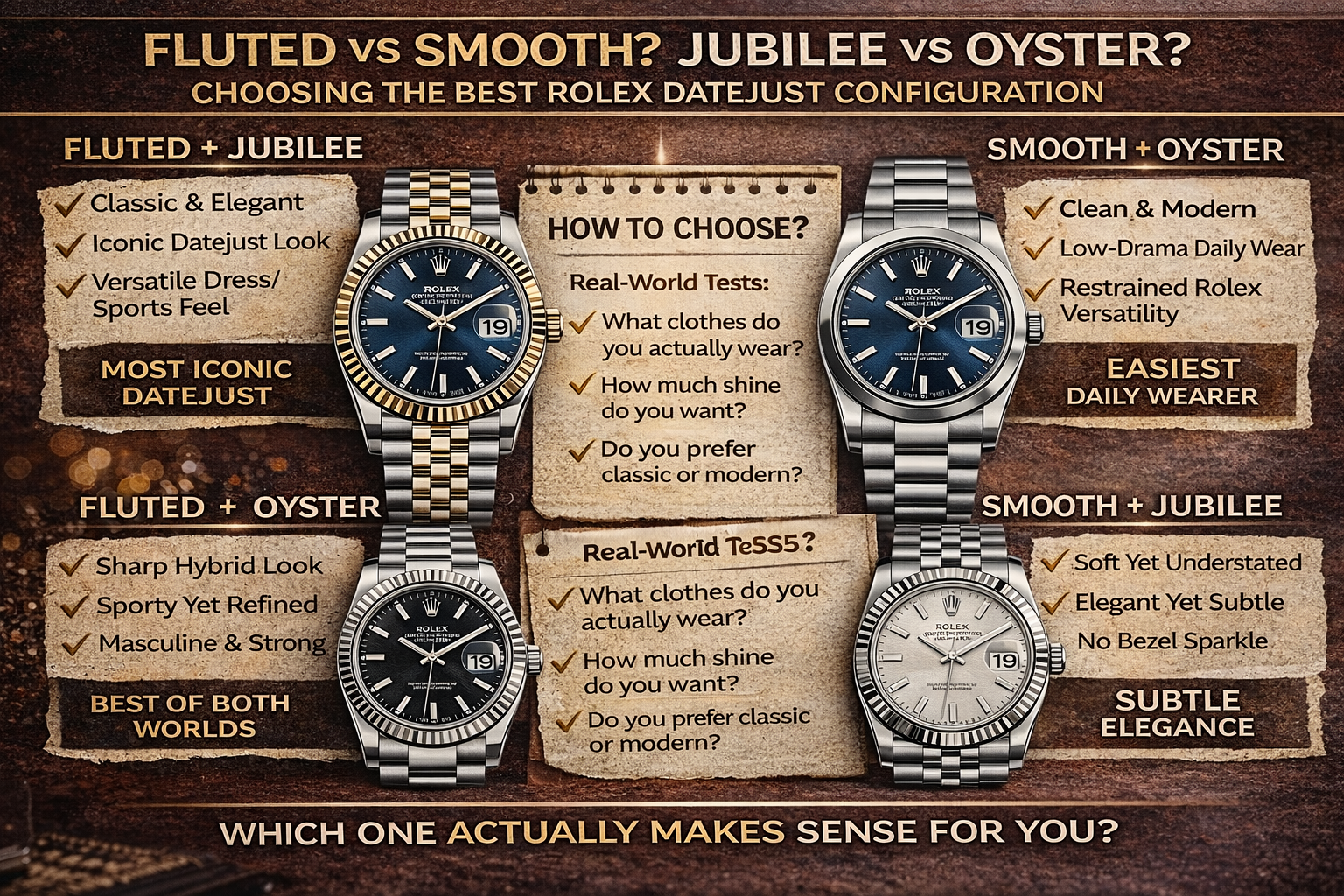
- Fluted + Jubilee is the most recognizably “Datejust” Datejust.
- Smooth + Oyster is the cleanest, sportiest, easiest modern daily-wear setup.
- Fluted + Oyster can work extremely well if you want a sharper, more masculine, more structured look.
- Smooth + Jubilee is the most divisive combo. Sometimes it looks quietly smart. Sometimes it looks like the watch has not fully decided what it wants to be.
But the better question is not which combo is most famous.
It is: which one actually looks right on you, in your life, with your clothes, and with your taste?
That is what this guide is for.
First: what Rolex actually offers on the Datejust
Rolex’s current Datejust lineup shows multiple case sizes and a wide range of options by size and metal. On the official model finder, Datejust appears in 31, 36, and 41 mm with smooth, fluted, gem-set, and in some markets domed bezels listed; bracelets shown across the family include Oyster, Jubilee, and on some Datejust 31 models President. Rolex’s own newsroom also states that Datejust 36 and 41 are available on Oyster or Jubilee, while Datejust 31 can appear on Oyster, Jubilee, or President depending on the reference.
That matters for two reasons.
First, it shows that the Datejust is not one single look.
Second, it explains why so many buyers get overwhelmed and default to copying someone else’s favorite setup instead of choosing their own.
That is a mistake.
The best Datejust configuration is not the one that gets the most approval online. It is the one that makes the watch feel coherent on your wrist.
Why configuration matters more on a Datejust than on most watches
Because the Datejust lives in a very narrow sweet spot.
It is not a pure sports watch.
It is not a pure dress watch.
It is not meant to be rugged in the same way a Submariner is rugged.
And it is not supposed to feel delicate either.
It is a middle-ground watch, which means details matter more.
On a very sporty watch, polished elegance is less important.
On a very formal watch, bracelet architecture matters less.
On a Datejust, everything talks to everything else.
The bezel changes the dial.
The bracelet changes the case.
The metal changes the bezel.
The dial color changes whether the bracelet looks dressy or sporty.
That is why so many people end up revisiting pieces like Rolex Day-Date vs Datejust: Which One Really Makes More Sense? and Rolex Datejust vs Oyster Perpetual: Which One Is the Better One-Watch Luxury Choice? after they start shopping configurations. The closer you get to buying, the more you realize this is a watch about balance.
Fluted bezel: why it works so well
The fluted bezel is the signature move.
Rolex explicitly calls the fluted bezel a Rolex signature on current Datejust product pages, including Datejust 36 and Datejust 41 references in white Rolesor and yellow Rolesor.
That is why fluted works so easily: it instantly makes the watch feel complete.
It gives the Datejust sparkle without requiring diamonds.
It adds visual depth even on simple dial colors.
It helps the watch read as “Rolex” from across the room.
And it often makes the whole package feel more expensive.
In real life, a fluted Datejust usually does three things well:
1. It catches light beautifully
This is the obvious one, but it matters. A fluted bezel gives the watch movement even when the dial is simple.
2. It sharpens the whole design
A Datejust with a fluted bezel tends to feel more finished, especially with plain baton-marker dials.
3. It makes the watch feel more traditional
If what you want is the classic Datejust look people picture instinctively, fluted is usually part of that image.
That is why buyers chasing timelessness so often land here.
Smooth bezel: why more people should consider it
Smooth bezels get underestimated because they photograph less dramatically.
But on the wrist, a smooth Datejust can be one of the cleanest Rolexes you can buy.
Rolex’s official Datejust model finder lists smooth bezel as a current option across the line, including plain Oystersteel examples.
A smooth bezel usually makes sense when the buyer wants the Datejust to lean more modern, more restrained, and a little closer to Oyster Perpetual territory.
This is where smooth wins:
1. It looks calmer
A smooth bezel lets the dial do more of the work. The watch becomes less jewelry-like and more all-purpose.
2. It wears more casually
If you want the Datejust to function as a true daily watch with jeans, knitwear, polos, work shirts, and travel clothes, smooth often makes the watch easier.
3. It reduces the “trying too hard” feeling
For some buyers, especially those new to Rolex, fluted can feel a bit more visible than they actually want. Smooth solves that immediately.
This is also why smooth-bezel Datejusts often attract people who were originally considering simpler daily-wear options like Rolex Explorer vs Oyster Perpetual: Which Simpler Luxury Watch Ages Better?.
Jubilee bracelet: when it looks exactly right
Rolex’s own newsroom notes that the Jubilee bracelet was created in 1945 especially for the Datejust, and the brand continues to offer Datejust 36 and 41 on Jubilee alongside Oyster.
That history matters because the Jubilee does not feel like a random bracelet option. It feels native to the watch.
A Jubilee bracelet usually does four things very well:
1. It makes the Datejust feel unmistakably like a Datejust
This is the classic answer for a reason.
2. It adds elegance without making the watch fragile
Jubilee is dressier than Oyster, but not fragile-looking. It gives refinement without losing the everyday Rolex character.
3. It softens the watch
This is particularly important on larger sizes like 41 mm. Jubilee often helps a Datejust look more balanced and less blocky.
4. It makes polished elements feel intentional
If the bezel is fluted, Jubilee often completes the logic beautifully.
That is why fluted + Jubilee is the configuration that most naturally looks “correct” to the broadest number of people.
Oyster bracelet: when it looks better than Jubilee
This is where the conversation gets interesting.
Because while Jubilee is more traditional, Oyster is often better for real modern taste.
Rolex currently offers Datejust 36 and 41 on Oyster as well as Jubilee, and the official lineup includes both smooth- and fluted-bezel references on Oyster.
Oyster usually wins when you want:
1. More structure
The Oyster bracelet gives the watch stronger lines and a firmer visual stance.
2. More sportiness
A Datejust on Oyster often feels less decorative and more “wear anywhere.”
3. A cleaner silhouette
Especially with a smooth bezel, Oyster makes the Datejust feel almost minimalist by Rolex standards.
4. A more masculine or more architectural look
This is not about gender rules. It is about the shape language. Oyster tends to make the watch feel more solid and direct.
For a lot of buyers under 45, this is where taste has quietly moved. Not away from Jubilee entirely, but toward Oyster whenever they want the Datejust to feel less formal and less obviously “classic Rolex.”
So which combinations actually look right?
Here is the honest breakdown.
1. Fluted + Jubilee
Best for: classic Datejust buyers, timeless look, dressier everyday wear
This is the safest great configuration.
It is the most iconic.
It is the most obviously “Datejust.”
And it is the one least likely to make you second-guess whether you should have chosen something more traditional.
A current official example of this formula is the Datejust 41 in Oystersteel and white gold with a white dial, fluted bezel, and Jubilee bracelet; Rolex also shows similar fluted/Jubilee combinations on Datejust 36 and two-tone references.
Real-world use:
If you wear tailoring, office clothes, smart casual outfits, or simply want one Rolex that always feels a little elevated, fluted + Jubilee is hard to beat.
Potential downside:
For some people, it can feel a little too expected. A little too “default luxury Rolex.”
But expected is not the same as wrong. Often, it is just right.
2. Smooth + Oyster
Best for: modern buyers, daily wear, low-friction one-watch ownership
This is probably the most underrated excellent Datejust configuration.
It strips the Datejust down to its most useful form.
Less sparkle.
Less ceremony.
Less “Rolex energy,” in the loud sense.
More real-life flexibility.
Rolex’s current lineup includes smooth-bezel Oystersteel Datejust references on Oyster, which shows the brand itself still supports this cleaner interpretation.
Real-world use:
If you want one Rolex to wear constantly and not think too hard about, smooth + Oyster is often the smartest configuration.
Potential downside:
Some buyers eventually realize this combo gets very close to Oyster Perpetual territory in mood. If what you really wanted was the full Datejust experience, it may feel slightly too restrained.
3. Fluted + Oyster
Best for: buyers who want classic Rolex cues with a firmer, sportier edge
This is the sleeper pick.
A lot of people assume fluted must mean Jubilee. That is not true. A fluted Datejust on Oyster can look fantastic because it combines the dressier bezel with the stronger bracelet.
The result is a Datejust that feels more structured and less soft than the Jubilee version, while still keeping the Rolex signature of the fluted bezel. Current official Datejust listings include fluted-bezel references on Oyster in several sizes and metals.
Real-world use:
This is often a great choice for buyers who want some Datejust sparkle but find Jubilee too dressy or too busy.
Potential downside:
It can feel slightly less “natural” than fluted + Jubilee to traditionalists, simply because the historical association is weaker.
But visually, it often works extremely well.
4. Smooth + Jubilee
Best for: buyers who want softness without too much flash
This is the hardest combo to judge.
Sometimes it looks excellent: relaxed, elegant, and a little different.
Sometimes it looks like the watch is split between two personalities.
Rolex does show smooth-bezel Datejust references on Jubilee in the current lineup, including Oystersteel Datejust 41 examples.
Real-world use:
If you want some Datejust softness and bracelet charm, but do not want the light-play of a fluted bezel, this can make sense.
Potential downside:
This is the most taste-dependent setup of the four. It can look very right on the right wrist and slightly undecided on the wrong one.
If you already know your taste leans decisive and clean, you will probably prefer smooth + Oyster. If your taste leans softer and dressier, you will probably prefer fluted + Jubilee.
What actually looks right by personality type
This is the easiest way to decide.
If you like classic luxury
Go fluted + Jubilee.
If you like clean modern restraint
Go smooth + Oyster.
If you like traditional Rolex with a more solid stance
Go fluted + Oyster.
If you like understated elegance and do not mind a slightly less obvious answer
Go smooth + Jubilee.
That sounds simple, but it works because most buyers are not confused about bracelets and bezels. They are confused about what kind of wearer they are.
Real buying scenarios
Scenario 1: You want one Rolex for everything
Choose smooth + Oyster or fluted + Jubilee.
If your wardrobe is more casual and minimal, smooth + Oyster usually wins.
If your wardrobe leans smarter and more classic, fluted + Jubilee usually wins.
This connects naturally with GADA Watch Explained: What It Means, Why It Matters, and How to Choose One That Actually Fits Your Life.
Scenario 2: You want the Datejust to feel unmistakably like a Rolex
Choose fluted + Jubilee.
That is the classic Datejust image for a reason. It feels complete, iconic, and immediately legible as a Datejust.
Scenario 3: You like Rolex, but you hate looking flashy
Choose smooth + Oyster.
This is the best answer for the buyer who wants quality and recognition without constantly broadcasting luxury.
Scenario 4: You want something a little sharper and less common
Choose fluted + Oyster.
It has enough Rolex signature to feel special, but enough structure to avoid softness.
The mistake most buyers make
They choose the combo that looks best in dealer photos.
That is the wrong test.
Dealer photos exaggerate polish, bracelet shine, and bezel drama. What matters is how the watch behaves at arm’s length, in daylight, in motion, with your actual clothes.
That is why you should not just ask:
Which configuration looks nicest online?
Ask:
Which one still looks right when I imagine wearing it on a normal Tuesday?
That is the real test.
It is similar to the mistake buyers make when choosing dial color, which is why Black Dial vs White Dial Watch: Which One Is More Versatile for Everyday Wear? fits so well beside this article.
A practical try-on checklist
If you are seeing multiple Datejust setups in person, do this:
Step 1: View each one from arm’s length
Not close-up. Real-life distance.
Step 2: Look at the watch with long sleeves
A fluted bezel or Jubilee bracelet can feel very different once a cuff is involved.
Step 3: Rotate your wrist in normal light
This is where fluted bezels and Jubilee bracelets reveal whether they feel beautiful or just too busy for your taste.
Step 4: Ask which one disappears in the good way
Not disappears as in boring. Disappears as in no friction.
That is usually your answer.
Final verdict: what actually looks right?
For most buyers, the best Rolex Datejust configuration is still fluted bezel + Jubilee bracelet.
It is the most iconic, the most complete-feeling, and the most naturally “correct” Datejust combination. Rolex itself continues to pair fluted bezels with Jubilee across many current hero references, which reinforces how central that formula remains to the line’s identity.
But the best real-life Datejust configuration for a lot of modern buyers is smooth bezel + Oyster bracelet.
It is cleaner, easier, more casual, and less likely to create regret if you want one Rolex to wear constantly. Rolex’s current lineup still includes that stripped-back interpretation too, which is exactly why it remains such a smart choice.
So the honest conclusion is this:
- Want the most iconic Datejust? Choose fluted + Jubilee.
- Want the easiest all-round daily wearer? Choose smooth + Oyster.
- Want a sharper hybrid? Choose fluted + Oyster.
- Want something softer and less obvious? Consider smooth + Jubilee.
The wrong Datejust is rarely the wrong model.
It is usually the wrong combination.
FAQ
What is the most classic Rolex Datejust configuration?
The most classic Datejust configuration is generally fluted bezel with Jubilee bracelet. Rolex continues to show many current Datejust hero models in that pairing, and the Jubilee bracelet was originally created for the Datejust in 1945.
Is smooth or fluted better on a Datejust?
Neither is universally better. Fluted looks more traditional and dressier, while smooth looks cleaner and more modern. Rolex currently offers both across the Datejust line.
Is Jubilee or Oyster better for daily wear?
For pure daily ease, many buyers prefer Oyster because it feels sportier and simpler. For classic elegance and softer wrist presence, Jubilee often wins. Rolex offers both on Datejust 36 and 41.
Does Rolex still make smooth bezel Datejust models?
Yes. Rolex’s current Datejust model finder includes smooth bezel references, including Oystersteel examples.
Can you get a fluted bezel with Oyster bracelet on a Datejust?
Yes. Rolex currently lists fluted-bezel Datejust references on Oyster bracelet in several sizes and metals.
Does Rolex offer President bracelet on the Datejust?
Rolex’s newsroom states that Datejust 31 can be available on President, while Datejust 36 and 41 are offered on Oyster or Jubilee.
Suggested Featured Excerpt
The best Rolex Datejust configuration for most buyers is fluted bezel with Jubilee bracelet because it delivers the most iconic and complete Datejust look. But if you want a cleaner, easier daily wearer, smooth bezel with Oyster bracelet often makes more real-life sense