Best Everyday Automatic Watch Features: 8 Specs That Matter More Than Marketing
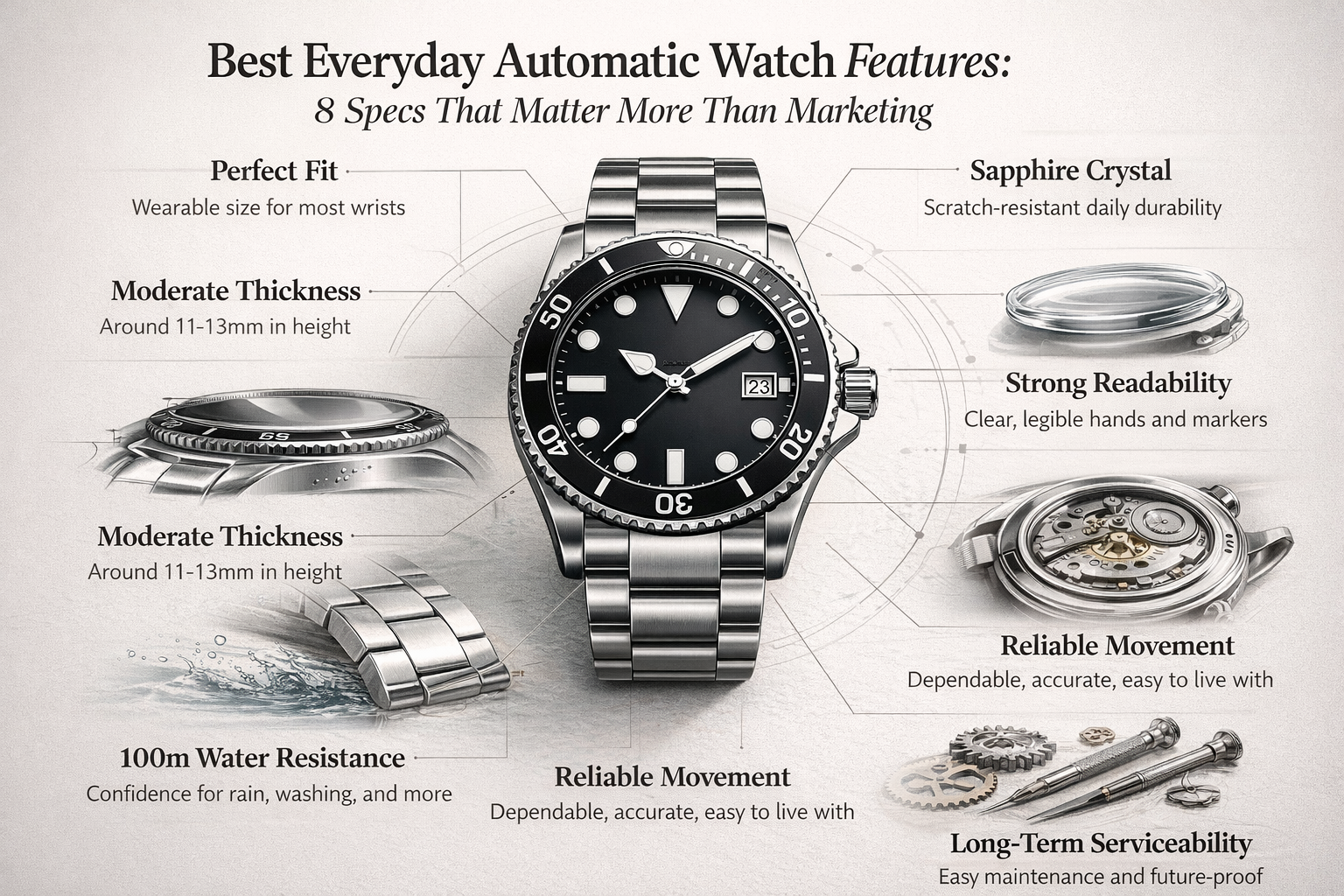
Best Everyday Automatic Watch Features: 8 Specs That Matter More Than Marketing
A lot of watch buyers think they need the most impressive spec sheet.
In real life, they usually need the watch that causes the fewest daily annoyances.
That is the difference between a watch that looks exciting online and a watch you actually keep wearing. The best everyday automatic watch is rarely the one with the loudest marketing story. It is usually the one that feels right on the wrist, reads clearly, handles daily life without drama, and does not make ownership more complicated than it needs to be.
So here is the practical answer first:
The best everyday automatic watch should fit well, wear comfortably, resist normal daily exposure, stay easy to read, and be simple to live with over time.
That means a few features matter far more than flashy buzzwords like “in-house,” “extreme power reserve,” or “limited edition dial texture.” Those things can be nice, but they are not what makes a watch great from Monday to Sunday.
If you are still early in the buying process, start with What Is an Automatic Watch? Pros, Cons & Who Should Buy One and Automatic Watch vs Quartz: Differences, Pros & Which to Choose. But if your real question is what specs actually matter for an everyday automatic watch, this is the buying checklist most people need.
The short answer: what makes a great everyday automatic watch?
For most buyers, the best everyday automatic watch has:
- a size that actually fits the wrist
- a thickness that works with real daily clothing
- enough water resistance for normal life
- a sapphire crystal you do not have to baby
- a clear, readable dial
- a comfortable strap or bracelet
- a reliable movement with practical features
- long-term serviceability
That is the real list.
Not “most expensive movement.”
Not “most complicated dial.”
Not “most aggressive spec sheet.”
An everyday watch wins by being easy to wear, easy to read, and easy to live with.
Why everyday specs matter more than marketing specs
Marketing specs are often designed to impress quickly.
Everyday specs are the ones you notice six months later.
That distinction is important.
A watch may sound exciting because it has:
- a huge case size
- an unusual movement architecture
- a very long power reserve
- extreme styling
- a complicated dial
But the features that actually shape ownership are usually simpler:
- does it fit your wrist?
- does it slide under a cuff?
- can you wear it in rain without worry?
- can you read it instantly?
- will it still feel comfortable after ten hours?
- can it be serviced easily?
Those are the questions that decide whether a watch becomes your daily default or something you admire more than you wear.
Feature 1: A wearable case size matters more than trend size
This is the first filter, and probably the most important one.
A daily watch should not just “look normal” on paper. It should actually fit your wrist and disappear into your routine.
For most buyers, the most practical everyday range is somewhere around:
- 36mm to 40mm for smaller to average wrists
- 38mm to 41mm for average to slightly larger wrists
That does not mean anything outside those numbers is wrong. It means the safest no-regret zone for a daily automatic usually sits there.
A daily watch that is too large often becomes annoying in ways buyers do not expect:
- it catches on sleeves
- it feels top-heavy
- it dominates the wrist
- it stops working with smarter outfits
A daily watch that fits well is more likely to get worn without thought.
That is why size matters more than hype.
Feature 2: Moderate thickness matters more than many buyers realize
A watch can have the right diameter and still feel wrong.
Why? Thickness.
For daily wear, thickness often matters more than buyers expect because it affects:
- cuff behavior
- comfort at a desk
- how sporty the watch feels
- how heavy the watch seems in use
For many everyday automatic watches, the sweet spot is roughly:
- around 11mm to 13mm
That is often where a watch feels substantial enough to be satisfying, but not so tall that it becomes clumsy or overly sporty.
A thicker watch can still be great—especially if it is meant to be a diver or tool watch—but if you want one watch for office, weekend, and travel, moderate thickness usually ages better.
Feature 3: Around 100m water resistance is one of the best real-life specs
This is one of the few spec upgrades that many owners genuinely feel in daily life.
For an everyday automatic watch, around 100m water resistance is often the most practical target.
Why?
Because it gives you confidence for:
- rain
- hand-washing
- daily wear
- travel
- active weekends
- occasional pool use in many normal cases
You do not need an extreme dive rating to have a capable daily watch. But the jump from very basic resistance to something more useful is one of the most meaningful real-world improvements you can get.
A watch that makes you nervous around ordinary life is not a great everyday watch.
This is one reason sporty everyday pieces and many options in Best Automatic Dive Watches Under $1000: Durable, Reliable & Built for Adventure often feel so reassuring in ownership.
Feature 4: Sapphire crystal matters because daily life is full of little contact
Some features sound exciting. Sapphire crystal sounds boring.
For a daily watch, boring is good.
A sapphire crystal usually matters more than decorative extras because it helps the watch feel easier to own. You do not want to spend every week worrying about desk contact, bag zippers, or small day-to-day friction.
A good everyday watch should feel like something you can wear, not just preserve.
And while crystal shape changes personality, the material itself matters because daily ownership is about minimizing low-level anxiety. Scratch resistance is not glamorous, but it is very real.
This is especially important for buyers who want one main watch rather than a large rotation.
Feature 5: Legibility matters more than dial complexity
A daily watch should be easy to read.
That sounds obvious, but many buyers get distracted by interesting dial textures, open-worked designs, or novelty details and forget the core job of the watch.
The best everyday automatic watch usually has:
- clear hour markers
- strong hand contrast
- a dial that is readable at a glance
- enough visual calm that time can be read quickly
This does not mean the watch has to be boring. It means the design should serve daily use first.
A watch can be beautiful and still slightly annoying every time you check the time. Over months, that matters more than buyers expect.
This is also why simpler three-hand layouts often age better than more complicated dial arrangements for everyday ownership.
Feature 6: A comfortable bracelet or strap matters more than prestige details
People often obsess over movement specs and then wear the wrong strap.
That is backwards.
A daily watch lives on your wrist, so the part touching your wrist matters a lot. Comfort can make an average watch feel great and a great watch feel disappointing.
For daily wear, good options are usually:
- bracelet, if you want versatility and long-term flexibility
- leather, if your life is mostly dry and style-first
- rubber, if your lifestyle is active, warm-weather, or water-friendly
For many buyers, a bracelet is the safest first choice because it handles the widest range of situations and is often harder or more expensive to add later. That is one reason a bracelet often makes an everyday watch feel like the more complete purchase.
A watch that looks good but wears poorly will not become your daily watch.
Feature 7: A dependable movement with practical features beats a flashy movement story
This is where watch marketing gets noisy.
A movement can be sold through:
- heritage
- exclusivity
- unusual architecture
- “in-house” language
- big spec numbers
But for a daily automatic watch, the most useful movement qualities are usually much simpler:
- reliability
- predictable performance
- hand-winding
- hacking seconds
- a practical power reserve
- easy servicing
That is what matters in real use.
A 40-hour power reserve can still be perfectly fine for many buyers. A 72-hour reserve is genuinely convenient. But in an everyday watch, the movement should feel dependable first and impressive second.
If you care about how automatic watches behave in real use, Do Automatic Watches Stop If Not Worn? Power Reserve, Why It Happens & Easy Fixes and Are Automatic Watches Accurate? Real-World Tolerances, Why They Drift & How to Improve Accuracy are worth reading alongside this topic.
Feature 8: Serviceability matters more than spec-sheet bragging rights
This is one of the least glamorous features and one of the smartest to care about.
A daily watch should be something you can maintain sensibly over time. That means serviceability matters.
A watch that is hard to service, expensive to maintain, or overly fussy for routine ownership may still be interesting—but it may not be the best everyday choice.
A good daily automatic watch should make long-term ownership feel manageable, not intimidating.
That includes:
- normal servicing intervals
- a movement type that watchmakers can handle confidently
- a design that does not make basic upkeep overly complicated
- a reputation for living well over time
This matters even more if you plan to keep the watch for years rather than flip it after six months.
If that is how you think, How Often Should You Service an Automatic Watch? Intervals, Costs, Warning Signs & What to Expect and How Long Do Automatic Watches Last? Lifespan, Durability, and What Really Determines Longevity are useful companion reads.
The 8 best everyday automatic watch features, simplified
If you want the cleanest summary, these are the eight features that usually matter most:
- Wearable case size
- Moderate thickness
- Practical water resistance
- Sapphire crystal
- Strong legibility
- Comfortable strap or bracelet
- Reliable movement with useful functions
- Easy long-term serviceability
That is the real everyday checklist.
Real-world buyer case #1: the one-watch office commuter
This buyer wears the same watch Monday through Friday, wants it to work with shirts and knitwear, and does not want constant fuss.
For this person, the best everyday features are usually:
- moderate size
- moderate thickness
- clear dial
- bracelet or refined leather
- enough water resistance to stop worrying
- dependable movement over exotic movement
This buyer usually does better with restraint than with feature overload.
Real-world buyer case #2: the active casual wearer
This buyer wants one watch for errands, weekends, travel, casual office use, and occasional poolside life. They do not want the watch to feel delicate.
For this person, the best everyday features are usually:
- 100m-type water resistance
- sapphire crystal
- bracelet or rubber
- clear lume and strong legibility
- case dimensions that feel sporty but not oversized
This is where many versatile field and dive-adjacent automatics start to make sense, especially for buyers comparing categories like Best Automatic Field Watches Under $1000: Rugged, Minimal & Built to Last.
Real-world buyer case #3: the beginner choosing between marketing and practicality
This buyer is drawn to:
- huge power reserve claims
- unusual case materials
- flashy dial designs
- “premium” movement language
- whatever sounds most advanced
But after a few months, what they usually care about is:
- comfort
- readability
- easy setting
- reliable timekeeping
- whether the watch still feels right every day
That is why everyday buying should start with practical specs first.
This is also why beginner-focused lists often work better when they lead with usability rather than prestige, as in Best Automatic Watches for Beginners: Top Picks & Buying Tips.
What matters less than marketing makes you think
This part is important too.
For an everyday automatic watch, some widely advertised features matter less than buyers expect.
1. Extremely large case size
Bigger is not more daily-friendly. Often it is less wearable.
2. Excessive complication count
More functions can be fun, but they rarely make a watch a better daily companion.
3. “In-house” as a buying shortcut
It may matter in some contexts, but it does not automatically make the watch better for normal ownership.
4. Huge power reserve for everyone
Useful for some. Not critical for all.
5. Hyper-detailed dial work
Beautiful in photos. Less important than readability in real life.
The best everyday watch usually wins through balance, not maximums.
A practical 5-minute buying checklist
If you are shopping online or in store, use this simple filter.
Step 1: Check the size and thickness together
Do not judge the case diameter alone. Ask whether the watch looks wearable for your wrist and your sleeves.
Step 2: Ask whether the water resistance matches normal life
You do not need extreme specs, but you do want enough confidence for real daily use.
Step 3: Look at the dial from arm’s length
Not nose-to-crystal distance. Arm’s length. Can you read it instantly?
Step 4: Think about what touches the wrist
Bracelet, leather, or rubber? Which actually suits your climate and routine?
Step 5: Ask the long-term question
Can I live with this movement, this setup, and this level of maintenance for years?
That question filters out a lot of marketing noise.
The best everyday automatic watch is usually not the most exciting one
This is the most honest conclusion in the whole topic.
The best everyday automatic watch is often not the watch that gets the biggest reaction online. It is often the one that feels so natural in use that you stop thinking about it.
That means:
- no major fit issues
- no constant worry
- no frustrating readability
- no unnecessary ownership drama
In other words, the best daily automatic is not the one that shouts.
It is the one that quietly works.
Which type of buyer should care about this most?
Almost everyone—but especially these three groups:
First-time buyers
Because they are the most vulnerable to spec-sheet distraction.
One-watch owners
Because they need versatility more than novelty.
Budget-conscious buyers
Because every feature needs to justify itself in daily life, not just on paper
That is also why budget-based guides like Best Automatic Watches Under $300: Affordable & Reliable Picks, Best Automatic Watches Under $500: Premium Value Without Overspending, and Best Swiss Automatic Watches Under $1000: Luxury Feel Without the Luxury Price are often most useful when read through the lens of everyday practicality, not just brand name or spec inflation.
FAQ
What is the most important feature in an everyday automatic watch?
For most buyers, fit is the most important starting point. If the watch does not wear comfortably, the rest of the spec sheet matters much less.
Is 100m water resistance enough for an everyday automatic watch?
Yes, for many buyers it is one of the best real-life specs because it adds confidence without forcing the watch into extreme sports-watch territory.
Does sapphire crystal really matter for daily wear?
Yes. It is one of the most practical quality-of-life features because it helps reduce worry about everyday contact and long-term visual wear.
Is a bracelet better than leather for an everyday watch?
For many people, yes. A bracelet is usually the most versatile and resilient starting point for everyday ownership, though leather may feel better for dressier lifestyles.
Do I need a long power reserve for a daily automatic?
Not necessarily. A practical, dependable movement often matters more than the biggest power reserve number. Many buyers do very well with a normal reserve if the watch fits their routine.
What matters more: movement prestige or serviceability?
For a daily watch, serviceability is often the smarter thing to prioritize. A watch you can live with easily over time is usually the better everyday purchase.
Final verdict
If you want the simplest real-world takeaway:
The best everyday automatic watch features are the ones that make daily ownership easier, not the ones that sound most impressive in marketing.
That usually means prioritizing:
- fit
- thickness
- water resistance
- sapphire crystal
- legibility
- comfort
- dependable movement behavior
- long-term serviceability
Those are the specs that matter when the watch becomes part of your life instead of just part of your wishlist.
So before you buy your next automatic watch, ask a better question.
Not:
“Which watch sounds the most advanced?”
Ask:
“Which watch will still feel right on an ordinary Tuesday?”
That is usually the watch worth buying.